

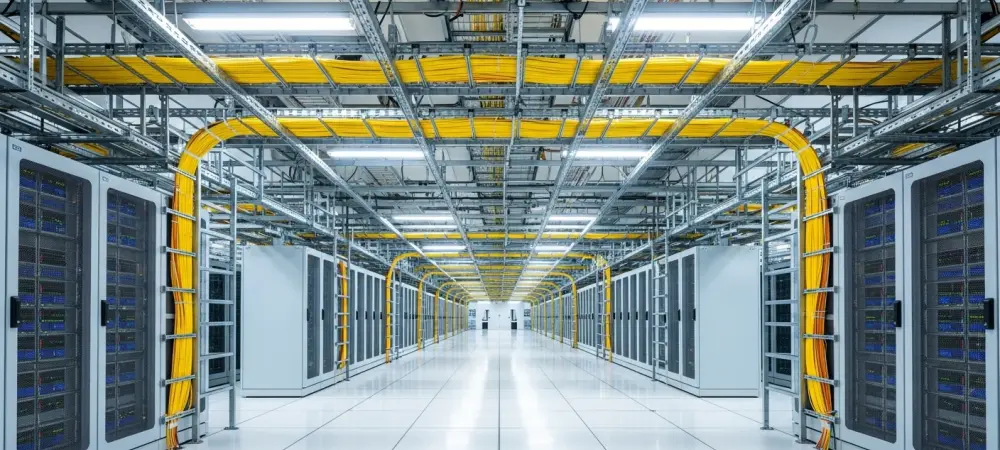
The fundamental shift from rigid hierarchical structures to highly fluid network topologies has completely redefined the operational parameters of hyperscale data centers globally. For decades, the industry relied on the fat-tree architecture, a multi-layered system of switches that directed traffic in a predictable but increasingly inefficient manner. As the volume of data generated by modern applications skyrocketed, the limitations of these legacy models became impossible to ignore, leading to significant bottlenecks and elevated costs. Amazon Web Services initiated a transition toward a more resilient design based on quasi-random graph theory, known as Resilient Network Graphs. This move replaced the traditional tree-like structure with an expander-based fabric that facilitates more direct communication between servers. By removing hierarchical layers, the network architecture gained a level of flexibility that allowed for a flatter mesh capable of adapting to modern cloud environments. This structural overhaul represents a departure from conventional wisdom, favoring an interconnection strategy that optimizes data flow across the entire facility.
Efficiency and Performance Gains: A Structural Revolution
The practical implications of adopting Resilient Network Graphs are immediately evident when examining the drastic reduction in hardware requirements and energy consumption. Traditional fat-tree systems necessitated a massive investment in aggregation and spine switches to handle the traffic moving between different layers of the hierarchy. In contrast, the new model has allowed for the removal of 69% of the networking devices typically found in a standard data center layout. This reduction is not merely a matter of cost savings but also a critical step toward environmental sustainability, as it has directly contributed to a 40% decrease in total power consumption across the network fabric. Furthermore, the removal of intermediate layers and central choke points has unlocked significant performance potential, with internal reports indicating an increase in data throughput of up to 33%. These metrics underscore the fact that more hardware does not always equate to better performance, as the flatter design of the mesh allows packets to reach their destinations with fewer hops and less latency.
Implementing a quasi-random mesh on a massive physical scale presented unique logistical challenges, particularly regarding the complexity of fiber optic cabling. To solve the problem of manual random wiring, which would be prone to human error and impossible to manage, a specialized passive optical device called the ShuffleBox was introduced. This innovation contains internally shuffled fiber connections that create the necessary graph-based mesh within the device itself, allowing external technicians to follow standard, organized cabling practices. From an outside perspective, the data center floor remains tidy and structured, while the ShuffleBox handles the complex internal routing logic required by the expander-based topology. This approach effectively bridged the gap between theoretical graph theory and the practical realities of industrial-scale infrastructure. By utilizing these passive components, the facility maintains the high level of organization required for routine service while gaining the performance benefits of a complex network. This hardware innovation proved that sophisticated mathematical models could be successfully integrated into physical environments.
Intelligent Management and Systemic Reliability
The lack of a defined hierarchy in a quasi-random mesh necessitated an entirely new approach to directing traffic, as traditional routing protocols were built for tree-based paths. To address this, the Spraypoint routing protocol was developed to manage the flow of information across the many available links in the expanded fabric. Rather than sending data along a single primary path, Spraypoint effectively sprays traffic across multiple routes simultaneously, utilizing bandwidth that would otherwise sit idle in a standard hierarchical system. The protocol uses specific waypoints to guide packets toward their final destination, ensuring that no single connection becomes a point of congestion. This dynamic load balancing allows the network to handle massive surges in traffic with exceptional efficiency, as the system can re-route data in real-time based on current link availability. By treating the network as a singular, interconnected fabric rather than a series of vertical layers, Spraypoint maximizes the utilization of every installed cable and port. This intelligent management ensures that performance gains are translated into tangible reliability.
Systemic reliability was a primary driver behind the move toward Resilient Network Graphs, particularly as data centers reached a scale where localized hardware failures were a daily occurrence. In a traditional fat-tree model, the failure of a high-level spine switch could effectively isolate large clusters of servers, leading to significant service disruptions. However, the expander-based mesh of the RNG was designed to degrade gracefully, ensuring that the loss of a few routers only caused a minor and proportional drop in total network capacity. Because every node is connected through multiple quasi-random paths, there are no single points of failure that can compromise the integrity of the entire system. This inherent resilience has made RNG the global standard for general-purpose compute infrastructure, providing a foundation that can withstand physical damage or hardware malfunctions without impacting overall uptime. This architecture redefined reliability for modern cloud providers who manage millions of instances. Consequently, this design has established a more durable foundation for the digital economy, ensuring that operations continue even under stress.
Strategic Integration and Historical Infrastructure Evolution
Looking toward the continuous evolution of cloud computing, the transition to flatter network fabrics has positioned infrastructure to better handle the intensive demands of next-generation workloads. Artificial intelligence training tasks require massive amounts of data to move between thousands of GPUs with minimal delay, a task that hierarchical systems struggled to perform at scale. The interconnected nature of the Resilient Network Graph allows for the massive, low-latency data transfers required by these sophisticated models, enabling faster innovation. Furthermore, the flexibility of the expander-based design means that data centers can be expanded or modified without the need for a total redesign of the networking layers. As organizations continue to integrate more advanced automation and machine learning into their daily operations, the underlying network must be able to scale both horizontally and vertically without hitches. This proactive approach to data center design ensures that the physical infrastructure will not become a bottleneck for software innovation in the years to come.
The implementation of these advanced networking strategies represented a significant milestone in the journey toward more efficient digital environments. Engineering teams determined that the path forward required prioritizing flexible mesh topologies over rigid hierarchies to sustain growth. They discovered that investing in passive optical shuffling was the most effective way to manage physical complexity at scale. These findings highlighted that future network expansions should focus on software-defined routing to maximize existing hardware throughput. The transition demonstrated that resilience could be achieved by embracing quasi-random connectivity as a core design principle for all new regional deployments. Stakeholders observed that by prioritizing mathematical models like expander graphs, the infrastructure became significantly more adaptable to shifting traffic patterns. The successful integration of these systems proved that moving away from legacy hardware standards was necessary to unlock the next level of operational efficiency. These actions established a new industry benchmark for how hyperscale facilities should be constructed.