

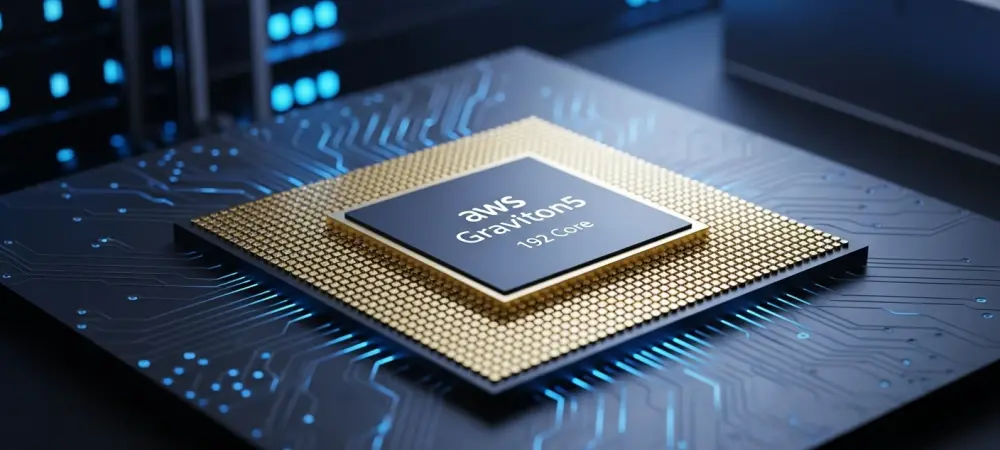
The traditional reliance on universal hardware has evaporated as hyperscalers recognize that generic processors can no longer satisfy the insatiable appetites of modern artificial intelligence and massive data architectures. This shift is perfectly encapsulated in the trajectory of the Graviton series, which transitioned from an experimental Arm-based chip in 2018 to the massive 3nm architecture seen today. By prioritizing energy efficiency and cost-effectiveness, AWS moved away from the limitations of off-the-shelf silicon, choosing instead to design hardware that aligns exactly with the unique demands of cloud-native environments. This specialized approach allowed for consistent scaling of core counts while maintaining a power profile that generic competitors often struggle to match.
The transition from the original Graviton to the current fifth-generation model illustrates a relentless pursuit of performance density. While earlier iterations focused on proving that Arm architecture could survive in the data center, the Graviton5 is a statement of dominance in a market increasingly defined by workload-specific hardware. By controlling the entire stack from the transistor level to the hypervisor, AWS has effectively bypassed the standard upgrade cycles of traditional chip manufacturers, delivering a processor that is purpose-built for the high-concurrency tasks that define modern web services and distributed systems.
The Evolution of Custom Cloud Silicon: An Introduction to AWS Graviton5
Custom-designed silicon has moved from a niche interest to a central pillar of cloud infrastructure, driven by the need to optimize price-performance ratios for global enterprises. The Graviton5 represents the pinnacle of this lineage, moving into the highly efficient 3nm manufacturing realm to accommodate 192 cores on a single die. This evolution reflects a broader trend toward vertical integration, where the cloud provider acts as both the hardware architect and the service vendor to eliminate the inefficiencies inherent in general-purpose computing. Historically, the Graviton series has scaled its impact by focusing on specific bottlenecks like memory bandwidth and energy per instruction. Since its inception, the series has consistently doubled or tripled its core capacity to handle the growing complexity of microservices and containerized environments. The current iteration continues this trend, offering a platform that is not just a faster version of its predecessor, but a fundamentally different tool for managing the massive data throughput required by modern enterprise applications.
Architectural Innovations and Performance Metrics
Cutting-Edge Core Density and 3nm Manufacturing
The integration of the 3nm process technology is a transformative step that allows for 192 cores while simultaneously reducing the energy footprint of each operation. This density is crucial for massive parallel processing, as it enables the processor to handle thousands of concurrent threads without the thermal throttling that often plagues older architectures. Perhaps more importantly, the reduction in inter-core latency by 33% ensures that communication across the chip occurs with minimal delay, which is a vital requirement for high-performance computing workloads.
Managing such a high number of cores requires a sophisticated interconnect strategy to prevent data congestion. The Graviton5 architecture addresses this by optimizing the pathways between individual cores, ensuring that the 192-core array functions as a cohesive unit rather than a collection of isolated processors. This architectural refinement translates directly into smoother performance for applications that rely on heavy multi-threading, such as large-scale scientific simulations or complex financial modeling.
Next-Generation Memory and I/O Throughput
To feed the 192 cores effectively, the Graviton5 incorporates DDR5-8800 memory, providing some of the fastest data access speeds available in the current cloud landscape. This upgrade, paired with PCIe Gen6 support, facilitates a massive increase in total throughput, allowing the processor to ingest and process data at rates that were previously impossible. These technologies are essential for data-intensive tasks where the processor would otherwise spend significant cycles waiting for information to arrive from storage or peripheral devices. The memory hierarchy has also seen a dramatic overhaul, featuring a five-fold increase in total L3 cache compared to previous generations. By expanding the cache available to each core, the chip minimizes the frequency of high-latency fetches from main memory, which significantly accelerates the execution of complex algorithms. This change is particularly impactful for database engines and real-time analytics platforms, where even millisecond delays in data retrieval can lead to noticeable performance degradation at scale.
Latest Developments in the Graviton Ecosystem
The deployment of the Graviton5 via the new M9g and M9gd EC2 instances has provided organizations with a substantial 25% compute uplift over previous generations. These instances are designed to serve as the backbone of general-purpose cloud computing, offering a balanced mix of compute, memory, and networking resources. The move toward these platforms signals a shift in how enterprises approach hardware lifecycle management, favoring instances that provide higher throughput per dollar rather than just raw clock speeds. Emerging trends in local storage have also been addressed through the d-series instances, which now offer up to 11.4 TB of local SSD capacity. With a 30% increase in Input/Output Operations Per Second, these instances are ideal for applications requiring high-velocity data access directly on the host machine. Furthermore, the industry-wide move toward “Agentic AI” has prompted a specialized co-design of hardware and software, where the Graviton5 serves as the primary engine for autonomous software agents that require rapid decision-making capabilities.
Real-World Applications and Industry Adoption
High-growth sectors have been quick to adopt the Graviton5, with Meta leading the way by deploying the architecture for large-scale AI initiatives. The chip’s ability to handle massive parallel workloads makes it a natural fit for the training and deployment of the next generation of social media algorithms and content recommendation engines. By moving these workloads to specialized silicon, firms can reduce their total cost of ownership while simultaneously improving the responsiveness of their user-facing services.
In the realm of database management and data warehousing, the impact has been equally significant for companies like Snowflake and Uber. The 35% increase in processing speed for general-purpose applications allows these firms to run complex queries more efficiently, reducing the time required for data-driven decision-making. This efficiency is not merely about speed; it is about the ability to process more data within the same budgetary constraints, allowing for more comprehensive analytics across global operations. AI and machine learning inferencing have also benefited from the expanded cache architecture of the Graviton5. Real-time model deployment requires hardware that can quickly access weights and parameters, a task that the 192-core design handles with ease. This capability has made the processor a preferred choice for organizations looking to integrate AI into their operational workflows without the high costs and availability issues often associated with dedicated GPU clusters.
Addressing Technical Hurdles and Market Obstacles
Despite its impressive specs, the Graviton5 faces the ongoing challenge of software optimization, as many legacy enterprise applications are still primarily tuned for x86 architectures. Developers must continue to refine their codebases to fully exploit the unique features of Arm-based silicon, a process that requires both time and specialized expertise. While the ecosystem of compatible libraries and compilers has grown significantly, the transition remains a hurdle for organizations with deeply entrenched legacy systems. Market competition has also intensified as other major cloud providers develop their own proprietary silicon, such as Azure Cobalt and Google Axion. This competition drives innovation but also creates a fragmented landscape for developers who must now consider multiple custom architectures when designing cross-cloud applications. To maintain its lead, AWS must ensure that its hardware remains consistently ahead in terms of pure performance and ease of integration into existing developer workflows.
There are also physical limits to how much network and EBS bandwidth can scale alongside a 192-core compute capacity. While the Graviton5 has seen improvements in these areas, ensuring that the I/O subsystem does not become a bottleneck for such a powerful CPU remains a constant engineering struggle. Balancing the massive compute potential with the necessary data delivery speeds is essential for maintaining the overall efficiency of the M9g instance family.
Future Outlook and the Trajectory of Custom Infrastructure
Looking ahead, the shift toward 2nm manufacturing processes promises even greater gains in density and energy efficiency for future iterations of AWS silicon. These advancements will be vital for meeting global data center sustainability targets, as the demand for compute power continues to rise. The integration of dedicated generative AI accelerators directly onto the CPU die could also be a major development, further blurring the line between general-purpose processors and specialized AI hardware.
The long-term impact of this technology will likely be seen in a move toward decentralized, workload-specific hardware across the entire IT sector. Rather than relying on a single type of processor for every task, data centers will increasingly feature a heterogeneous mix of silicon optimized for specific functions like security, networking, or AI inferencing. This modular approach to infrastructure will allow for unprecedented levels of efficiency and performance as hardware continues to be co-designed with the software it is intended to run.
Final Assessment: The Impact of Graviton5 on Cloud Computing
The AWS Graviton5 marked a definitive shift in the capabilities of custom cloud CPUs by successfully bridging the gap between extreme core density and practical energy efficiency. It established a new benchmark for what enterprises should expect from a cloud-native processor, moving beyond incremental gains to offer a significant leap in performance. The architecture proved that specialized silicon could handle the most demanding modern workloads, from complex database management to high-velocity AI inferencing, without the excessive costs typically associated with high-end hardware.
Amazon created a platform that addressed the core needs of a data-hungry global economy, providing the necessary bandwidth and cache to support the next generation of software agents and distributed applications. The hardware ensured that the transition toward Arm-based computing remained not only viable but preferable for organizations seeking to optimize their infrastructure. Ultimately, the chip became a cornerstone of the modern cloud, fundamentally altering the price-performance expectations for businesses worldwide and solidifying the role of custom silicon as the future of enterprise IT.