

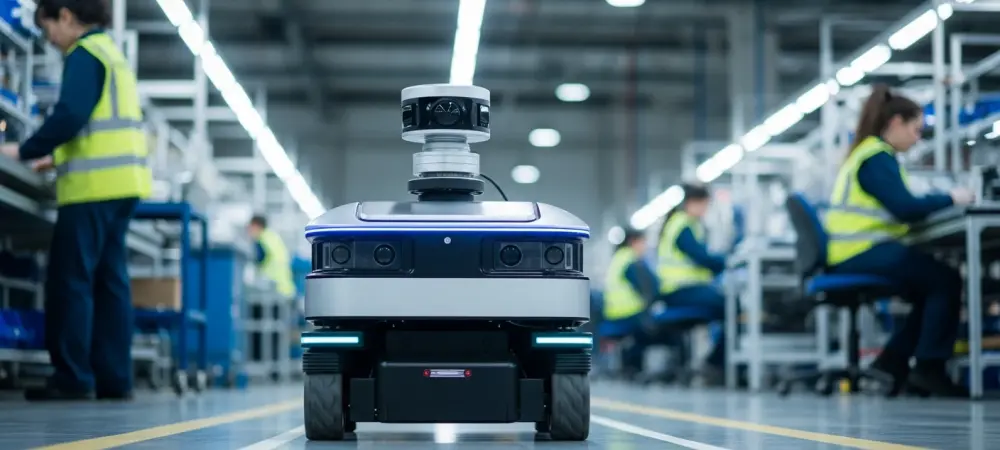
The silent whir of a multi-ton delivery unit navigating a crowded hospital corridor represents a profound shift in how humanity delegates physical labor to silicon and steel. In the current landscape of 2026, the transition from reactive automated appliances to proactive, AI-driven systems has moved beyond the experimental phase into a necessary industrial reality. Unlike the early consumer vacuum units that relied on randomized “caroming” patterns to eventually cover a surface, modern Autonomous Mobile Robots (AMRs) operate with a localized understanding of their environment that rivals human spatial awareness. This evolution marks the end of the era of “blind” automation and the beginning of the age of contextual intelligence, where machines do not just follow a path but actively interpret the world around them to maximize efficiency.
The relevance of this shift cannot be overstated in a global economy grappling with labor shortages and the need for hyper-efficiency. While previous generations of robotics were confined to safety cages on factory floors, the modern AMR is designed to exist in the “wild”—unstructured environments like retail aisles, airport terminals, and public sidewalks. This leap from controlled to uncontrolled spaces has necessitated a fundamental redesign of robotic brains, moving away from simple “if-this-then-that” logic toward complex neural networks capable of predictive modeling. Consequently, these machines are no longer just tools; they have become mobile nodes in a decentralized intelligence network that redefines the boundaries of the service and logistics sectors.
The Evolution of Autonomous Navigation and Intelligence
The core principle behind modern autonomous navigation lies in the fusion of Simultaneous Localization and Mapping (SLAM) with real-time semantic segmentation. By integrating data from LiDAR, ultrasonic sensors, and inertial measurement units, these robots create high-fidelity 3D maps of their surroundings while simultaneously identifying their own position within that space. This dual-track processing allows them to differentiate between static obstacles, such as a structural pillar, and dynamic ones, like a walking pedestrian or a runaway luggage cart. The context of this evolution is rooted in the maturation of edge computing, which allows robots to process massive datasets locally without the latency issues inherent in cloud-based systems.
Furthermore, the intelligence of these systems has shifted from mere obstacle avoidance to proactive intent recognition. Modern AMRs are programmed to analyze the trajectory of human movement, allowing them to “give way” or adjust their speed before a potential collision occurs. This proactive nature is what separates the current generation of detail robots from their predecessors. Instead of stopping and waiting for a path to clear, they recalculate routes in milliseconds, ensuring that the flow of operations is never interrupted. This level of sophistication has transformed robots into reliable partners in complex workflows rather than stumbling blocks that require constant human supervision.
Key Technical Components of Modern Detail Robots
Advanced Computer Vision and Perception Systems
The primary differentiator for high-end AMRs is their ability to “see” through a combination of high-resolution stereoscopic cameras and artificial intelligence sensors. This perception stack allows for substance identification, a feature that was once the stuff of science fiction. For instance, a cleaning robot in a high-traffic mall can now distinguish between a liquid spill on a marble floor and a discarded piece of solid debris. This distinction is critical because it dictates the robot’s physical response; it may deploy a specific absorbent for a spill while utilizing a high-suction vacuum for solid waste, ensuring that the surface is treated appropriately without cross-contamination. Performance metrics for these “spot cleaning” capabilities have reached unprecedented levels of accuracy, often exceeding 98% in varied lighting conditions. The AI doesn’t just recognize a mess; it analyzes the material and surface type to choose the most efficient cleaning protocol. This granular level of detail ensures that industrial tiles are scrubbed with the correct pressure while delicate hardwood surfaces are treated with non-abrasive methods. By automating these nuanced decisions, the technology removes the margin for human error and ensures a level of consistency that manual labor simply cannot replicate across a twenty-four-hour cycle.
Multi-Tooling and Adaptive Hardware
Beyond digital perception, the physical adaptability of modern robots has undergone a significant transformation through modular hardware. Technical systems are now built with “hot-swap” capabilities, allowing a single chassis to transition between diverse roles—from a floor scrubber to a UV-C disinfecting unit or a heavy-duty hauler—with minimal downtime. This versatility is essential for real-world usage where the environment is rarely uniform. A robot might spend the morning navigating the carpeted halls of an office building and the afternoon managing the concrete floors of a loading dock, adjusting its mechanical torque and tool height automatically to match the terrain.
The performance characteristics of these physical systems are governed by sophisticated actuators and suspension arrays that maintain stability even when the robot is fully loaded. In an industrial setting, this means a robot can carry several hundred pounds of material while navigating tight corners without the risk of tipping. The significance of this adaptability lies in the “return on investment” for the end-user; instead of purchasing three specialized machines, a facility can deploy a single, multi-tooling fleet that adapts to the shifting needs of the workday. This mechanical flexibility is the backbone of the “utility robot” concept that is currently dominating the market.
Emerging Trends in Robotic Business Models and Logistics
One of the most disruptive developments in the field is the rapid adoption of the “Robotics as a Service” (RaaS) model. Because the upfront cost of high-performance autonomous hardware remains significant, the subscription-based approach has opened the door for smaller enterprises to integrate robotics into their operations. This model shifts the burden of maintenance, software updates, and hardware depreciation from the client to the manufacturer. It creates a symbiotic relationship where the robotics provider is incentivized to ensure maximum “up-time,” as they are essentially selling a service outcome rather than a static piece of equipment.
Simultaneously, industry behavior is being reshaped by a move toward local supply chains and domestic manufacturing. There is an increasing emphasis on ensuring that the hardware powering critical infrastructure is secure and reliable. By “re-inventing” local manufacturing hubs, companies are mitigating the risks associated with international shipping delays and geopolitical instability. This trend toward localization is not just about security; it is about serviceability. When a robot breaks down in a high-stakes environment like a hospital, having a local support infrastructure to provide parts and repairs is the difference between a minor inconvenience and a total operational failure.
Real-World Applications and Human Interaction
The deployment of Public-Area Mobile Robots (PMRs) has become a common sight in industries ranging from aviation to healthcare. In airports, autonomous units are tasked with everything from floor maintenance to delivering food to passengers at their gates. These use cases require a delicate balance of efficiency and social grace. Interestingly, some manufacturers have begun integrating “social intelligence” into their robots, such as verbal greetings or expressive LED “eyes” that signal the machine’s intended direction. These features are not merely cosmetic; they are designed to lower the psychological barrier for humans sharing space with large, autonomous machines.
In healthcare settings, the implications are even more profound. Robots are now used to transport bio-hazardous waste or deliver medication, tasks that require strict adherence to safety protocols and precise navigation. The social interaction element becomes vital here, as robots must navigate corridors filled with stressed patients and busy medical staff. By using verbal cues to announce their presence or apologize for a delay, these machines integrate more seamlessly into the human environment. This “soft” side of robotics is becoming just as important as the “hard” engineering, as public acceptance is the final hurdle to widespread adoption.
Technical Hurdles and Regulatory Obstacles
Despite the rapid progress, the industry still faces a “Wright Brothers” learning curve regarding physical deployment. Hardware failure rates remain a significant concern; unlike software, physical machines are subject to the laws of gravity, friction, and mechanical wear. A demonstration that works perfectly in a pristine lab can end in disaster on a real-world site if the robot encounters a steep incline or a patch of ice. This physicality introduces a level of unpredictability that requires constant iterative improvement. Every broken wheel or failed sensor provides data that fuels the next generation of more resilient designs.
Perhaps the most pressing challenge is the “Rights-of-Way” dilemma in public spaces. Currently, there is a lack of clear regulatory frameworks governing how robots should interact with pedestrians on a legal level. If a delivery robot is forced to yield to every person it encounters in a busy terminal, its efficiency drops to zero. Conversely, giving robots priority could lead to safety concerns. There is an urgent need for “rules of the road” that define liability and priority in shared spaces. Without these standards, the threat of legal action and insurance complications will continue to act as a bottleneck for the scaling of autonomous fleets in urban environments.
Future Outlook and the Path to Seamless Integration
The trajectory of autonomous robotics points toward a future where machines and humans coexist with minimal friction. This will be driven by the development of more nuanced safety standards and the maturation of “collaborative AI.” We are moving toward a period where robots will be capable of long-distance logistics, transitioning from indoor environments to outdoor sidewalks and even public roads. The breakthroughs required for this will likely involve improved battery density and more robust 5G or 6G connectivity, allowing for real-time coordination between thousands of autonomous units.
The long-term impact on the labor market and societal efficiency will be transformative. As “autonomous armies” take over repetitive, dangerous, or physically demanding tasks, the human workforce will likely shift toward oversight and strategic roles. This transition will require a robust service infrastructure to maintain the vast fleets of machines keeping our cities running. The path to integration is paved with technical and legal challenges, but the momentum is undeniable. The goal is no longer just to make a robot that can clean a floor, but to create a global ecosystem where autonomy is as ubiquitous and invisible as the electricity that powers it.
Summary of the Current State of Autonomous Robotics
The review of current autonomous mobile robotics revealed a landscape that has matured from experimental novelty into a cornerstone of modern industrial strategy. It was found that the success of these systems relied not only on their computational power but also on their physical adaptability and the economic viability provided by service-based business models. The shift toward Public-Area Mobile Robots demonstrated that the technological hurdles of navigation were being solved, yet the social and regulatory challenges of sharing space with humans remained a work in progress. Ultimately, the verdict for 2026 was that the industry had entered a phase where reliability and service infrastructure were the primary drivers of growth. While technical setbacks and the “Wright Brothers” style of trial and error were still present, they were viewed as necessary steps toward a more resilient future. The path forward will require a concerted effort from policymakers and engineers to establish the “rules of the road” that will allow these autonomous fleets to operate safely. As these systems become more deeply integrated into the global supply chain, they will continue to redefine the boundaries of what is possible in the physical world.