

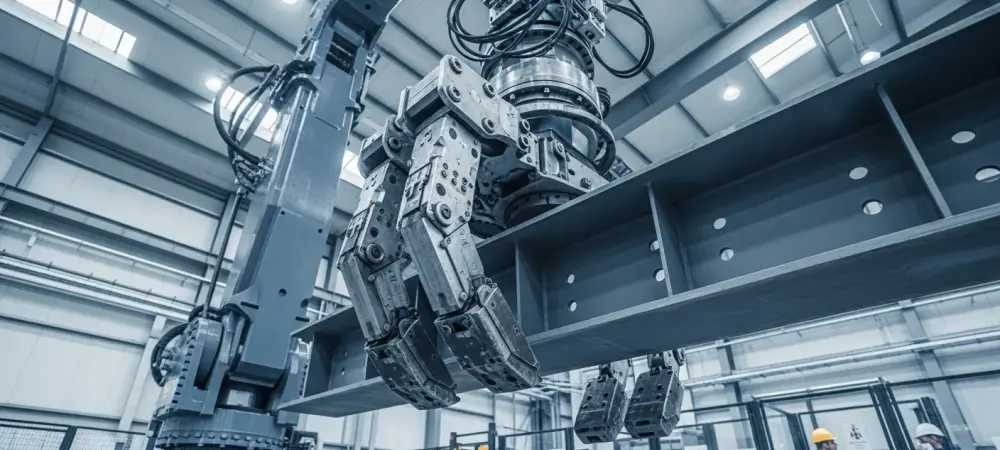
The relentless push for massive structural components in manufacturing has finally outpaced the traditional capabilities of standard overhead cranes and manual material handling systems. Modern industrial landscapes face a unique paradox where the physical size of components is ballooning while the tolerance for error is simultaneously shrinking. This shift has forced a move toward the agility of six-axis robotics, which offers a level of dynamic control that rigid overhead systems simply cannot match.
KUKA has responded to this shift by broadening its heavy-duty portfolio, effectively bridging the gap between raw power and surgical precision. As industrial scaling accelerates globally, the ability to maneuver ton-heavy objects with millimeter accuracy has become a prerequisite for competitiveness. This evolution marks a transition from simple lifting to complex, high-speed manipulation of the largest parts in production today.
The High-Stakes Demand for Ultra-Heavy-Duty Automation
The transition toward green energy has fundamentally altered the physical requirements of the factory floor, particularly within the electric vehicle sector. Battery packs and chassis frames have reached a scale where they hit the payload ceiling of standard industrial robots, necessitating a new class of automation. These components require a delicate touch despite their immense weight, a requirement that has driven the demand for ultra-heavy-duty solutions.
Logistics and automotive sectors are no longer satisfied with robots that merely move heavy loads; they require systems that optimize every square inch of the facility. By increasing both reach and flexibility, these new robotic variants allow manufacturers to reduce the reliance on sprawling conveyor systems. This consolidation of floor space directly translates to lower overhead costs and more efficient production flows in a high-density manufacturing environment.
Engineering the KR TITAN Variants: A Study in Power and Reach
The expansion introduces the KR 1000 R4200-2 F, a machine designed to balance a one-ton payload with an expansive 4.2-meter radius. This variant provides the reach necessary for large-scale welding and assembly tasks where the robot must access distant points without relocating its base. In contrast, the KR 1250 R3700-2 F prioritizes lifting density, enabling the handling of 1.25-ton components within a slightly more compact envelope.
Stability in these machines is achieved through a sophisticated double-link arm configuration and a specialized rigid frame. This mechanical design is crucial for managing high moments of inertia, ensuring that the robot remains stable even during rapid deceleration. The result is a system that maintains high repeatability, allowing for the precise placement of massive chassis modules while maintaining aggressive cycle times.
Specialized Resilience: The Foundry Advantage and Expert Applications
Operating in extreme environments requires more than just mechanical strength; it demands a specialized level of resilience against external stressors. The “Foundry” variants of the series are engineered to withstand intense heat, moisture, and abrasive dust common in casting operations. These robots utilize reinforced seals and heat-resistant coatings to ensure longevity in conditions that would degrade standard industrial equipment.
Managing awkward, off-center loads is a primary challenge for heavy-duty integrators, which is why high-moment capacity is a central feature of this expansion. By offering a spectrum of four distinct configurations, KUKA provides system designers with the specific tools needed to address varied industrial challenges. This versatility ensures that whether a task involves forging or precision assembly, there is a specialized solution available to handle the specific torque requirements of the load.
Implementing Scalable Automation in Modern Factory Layouts
Integrating these massive robots into existing production lines was previously considered a logistical nightmare, yet modern strategies have simplified the process. The “Single-Base” framework allowed facilities to replace multiple smaller units or linear tracks with one extended-reach robot, streamlining the entire workflow. By matching specific robot reaches to the exact cycle time requirements, engineers optimized throughput without requiring massive structural overhauls of the building. Safety protocols evolved to accommodate robots with 1,500 kg capacities, incorporating advanced sensing and zone-monitoring technologies. High-capacity automation became a standard pillar of the factory layout, ensuring that human workers and machines coexisted in a secure environment. These strategic deployments provided the necessary groundwork for future expansions, where the physical limits of manufacturing continued to be challenged by even larger and more complex industrial designs.