

Dominic Jainy stands at the forefront of the modern computing revolution, bridging the gap between raw hardware capabilities and the sophisticated demands of artificial intelligence and machine learning. As an IT professional who has spent years dissecting the intricacies of blockchain and decentralized processing, he brings a unique perspective to the recent emergence of high-performance, small-form-factor AI systems. His insights are particularly relevant now that the industry is moving away from a total reliance on cloud infrastructure toward powerful, localized silicon that allows for immediate, private data processing. With the arrival of the Ascent QN10, Jainy explores how 80 TOPS of neural processing power can fundamentally alter the daily operations of developers and creators. This conversation delves into the shift toward on-device intelligence, the engineering required to keep such small machines cool, and the critical role of hardware-based security in protecting sensitive corporate data.
The shift toward 80 TOPS neural processing units represents a significant jump in local computing; how does this level of performance change the daily experience for a software developer or digital creator?
The jump to 80 TOPS, facilitated by the integrated Hexagon NPU, essentially eliminates the “latency tax” that creators and developers have been paying for years when relying on cloud-based AI. When you are working with an 18-core Oryon CPU on the Snapdragon X2 Elite platform, you feel a tactile responsiveness that simply isn’t there when your data has to travel to a remote server and back. For a developer, this means running local large language model inferencing to debug code in real-time without worrying about their proprietary scripts leaving the local environment. Digital creators will notice that tasks like language translation or content generation happen with a fluid immediacy, making the machine feel like an extension of their thought process rather than a bottlenecked terminal. It is the difference between waiting for a progress bar to clear and seeing an AI-assisted productivity tool react the moment you finish a sentence or a stroke of a stylus.
Given that the Ascent QN10 is 86% smaller than a standard 5-liter desktop system, what are the primary engineering challenges and benefits of packing such high-end AI capabilities into a 0.7-liter chassis?
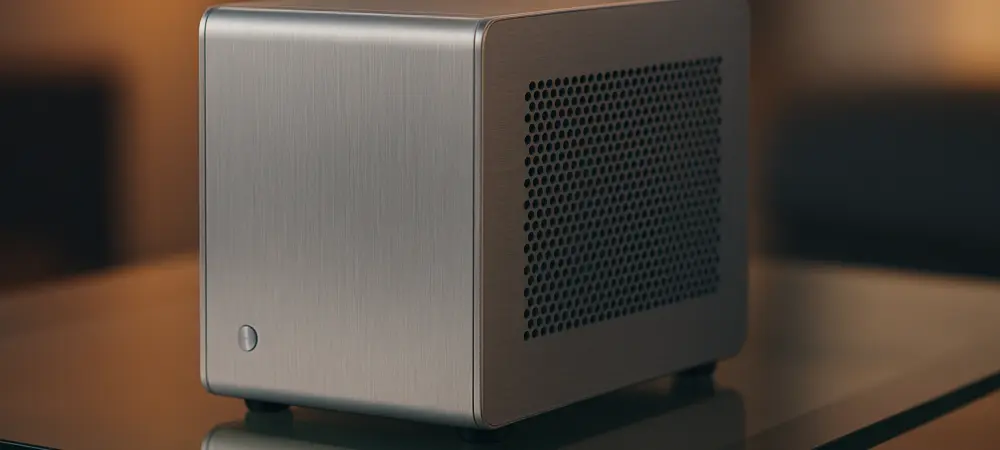
The engineering feat here is balancing extreme density with thermal stability, as the Ascent QN10 is designed to handle sustained AI workloads without the distracting roar of high-speed fans. At less than 0.7 liters, every millimeter of internal space must be optimized to ensure the Snapdragon X2 Elite remains cool while its 80 TOPS NPU and Adreno graphics—which boast 2.3 times the performance of the previous generation—are running at full tilt. This miniaturization provides a profound benefit for edge deployments and crowded office desks where space is at a premium, yet high-performance computing is non-negotiable. There is a certain sensory satisfaction in having a device that occupies so little physical space but possesses the raw power to handle complex workflow automation and multitasking. It allows for a clean, minimalist workspace while providing the horsepower typically associated with much larger, more power-hungry workstations.
Security is a major focus for this new generation of hardware; how do features like Microsoft Pluton and fTPM 2.0 address the specific risks associated with running AI models locally?
When we talk about a “chip-to-cloud” approach, we are addressing the deep-seated anxiety many corporate users feel about the privacy of their internal documents and code repositories. By integrating fTPM 2.0 and Microsoft Pluton directly into the hardware, the system creates a fortified environment where encryption keys and device identities are isolated from potential software-level attacks. This is crucial because local AI execution often involves feeding highly sensitive data into models; if that data were compromised at the firmware or OS level, the consequences would be catastrophic for a business. These security layers ensure that while the device is connected via WiFi 7 or Bluetooth 6.0, the core “brain” where the AI inferencing happens remains a black box to unauthorized observers. It provides a sense of digital sovereignty, allowing a company to deploy branch office systems or edge endpoints with the confidence that their intellectual property is physically locked within the silicon.
The inclusion of the Qualcomm AI Hub and support for agent-based frameworks like OpenClaw suggests a new era for developers; how does this ecosystem facilitate the transition from cloud-only to hybrid AI models?
The Qualcomm AI Hub is a massive catalyst for this transition because it offers developers immediate access to more than 175 pre-optimized models, which removes the grueling manual labor of tuning a model for specific hardware. By supporting “bring-your-own-model” and “bring-your-own-data” workflows, it allows a developer to start a project in the cloud and then seamlessly migrate it to local hardware for better performance or lower cost. We are seeing a fascinating trend where users interact with AI agents via platforms like WhatsApp and LINE, with the Ascent QN10 acting as the local “host” that processes these requests through frameworks like Hermes Agent. This hybrid model is the most commercially viable path forward because it offers the scale of the cloud when needed, but keeps the high-speed, private interactions on the local NPU. It empowers developers to build tools that are not just smart, but are also deeply integrated into the specific, private contexts of their users’ lives and businesses.
What is your forecast for the evolution of mini PCs in the professional market over the next two years?
From 2026 to 2028, I expect the mini PC to move from being a niche “alternative” desktop to becoming the standard endpoint for the AI-integrated enterprise. We will see the 80 TOPS threshold we are seeing today become the baseline, as more organizations realize that processing AI locally is significantly cheaper and faster than paying for recurring cloud tokens. As NPUs continue to evolve, the “0.7-liter workstation” will likely replace the bulky towers in specialized fields like medical imaging and localized financial modeling, where data cannot leave the building. The integration of even faster connectivity like WiFi 7 will make these tiny machines the central hubs for multi-device workflows, where your phone, tablet, and mini PC operate as a single, unified AI ecosystem. Ultimately, the physical footprint of our hardware will continue to shrink, even as the “intelligence” footprint of our local environments expands to touch every part of our professional lives.