

Standard three-hundred-sixty-millimeter radiators often require complex wiring, but this model simplifies the building process with a single integrated frame for its three high-speed fans. In the fast-moving landscape of 2026, where PC enthusiasts demand both aesthetic perfection and high-tier thermal performance, the market has seen a dramatic shift toward integrated solutions that minimize assembly friction. ASRock, once primarily recognized for its dominance in motherboards, has aggressively pivoted to address these needs by expanding its portfolio into thermal management. The introduction of the ROCK series represents a calculated move to challenge established industry giants by providing enthusiast-grade features at prices previously reserved for entry-level air coolers. By pricing a comprehensive three-hundred-sixty-millimeter liquid cooling system at approximately sixty-nine dollars, the brand effectively forces a reevaluation of the value proposition within the mainstream cooling segment.
Technical Foundations: Integrated Fan Engineering
The structural integrity of this cooling solution begins with its robust compatibility suite, which caters to the most modern processing units available in 2026, including Intel LGA 1700 and 1851 sockets along with AMD AM4 and AM5 platforms. Engineered to facilitate a thermal design power of up to three hundred fifty watts, the unit provides enough headroom to sustain high-intensity workloads on flagship consumer processors. The physical architecture centers on a standard thirty-millimeter thick radiator that utilizes a high-density aluminum fin array, maximizing the surface area available for heat exchange without compromising the clearance requirements of most mid-tower chassis designs. Such meticulous engineering ensures that even under sustained thermal pressure, the system maintains a stable operating environment for sensitive internal components. This balance of broad compatibility and high thermal capacity establishes a reliable foundation for any high-end PC build.
Innovation in airflow management is particularly evident in the implementation of the unified-frame fan assembly, which serves as a departure from traditional three-fan configurations that typically complicate routing. Instead of dealing with twelve separate mounting screws and a spiderweb of individual cables, users benefit from a single, cohesive housing that contains all three high-performance fans, significantly accelerating the installation process while enhancing the overall rigidity of the assembly. These fans are calibrated to operate within a versatile range of zero to eighteen hundred fifty revolutions per minute, allowing for complete silence during light tasks or peak delivery of fifty-two cubic feet per minute when the processor hits peak utilization. With a static pressure rating of one point seven millimeters of water, the blades are specifically shaped to push air through the dense radiator fins with minimal resistance, ensuring that heat is whisked away efficiently even during sessions.
Advanced Pump Mechanics: Tubing and Durability
The internal circulatory system of the cooler relies on a next-generation pump driven by a sophisticated three-phase, six-slot, four-pole motor design, specifically chosen for its ability to maintain consistent torque and low vibration. This electrical configuration enhances the movement of coolant through the loop while ensuring that the motor operates with greater efficiency and less heat generation than older four-pole alternatives. The fluid dynamics within the pump housing are further optimized by a dual-side inlet cooling path, a design choice that shortens the transit distance for the liquid as it enters the block. This allows for a more rapid and uniform distribution of chilled coolant across the high-density micro-fin array situated on the precision-milled copper baseplate. By reducing the time it takes for the liquid to absorb heat from the processor, the system achieves a more responsive thermal profile that adapts quickly to sudden spikes in computational demand.
Durability and long-term reliability are addressed through the selection of high-grade materials for the four-hundred-millimeter tubing, which connects the pump to the radiator. ASRock has implemented a specialized composite blend of Ethylene Propylene Diene Monomer and Isobutylene Isoprene Rubber to construct the lines, providing a robust barrier against natural coolant evaporation and structural deformation over time. This material choice is particularly important in 2026, as high-performance systems often run for extended periods, requiring components that can withstand constant thermal cycling without becoming brittle. To complement this internal resilience, the tubes are encased in premium braided sleeves that provide protection against mechanical wear while contributing to a professional appearance. Integrated multifunctional clips are also included to assist in managing the tubing trajectory within the case, preventing unwanted contact with other internal components.
Aesthetic Integration: Real-World Thermal Efficiency
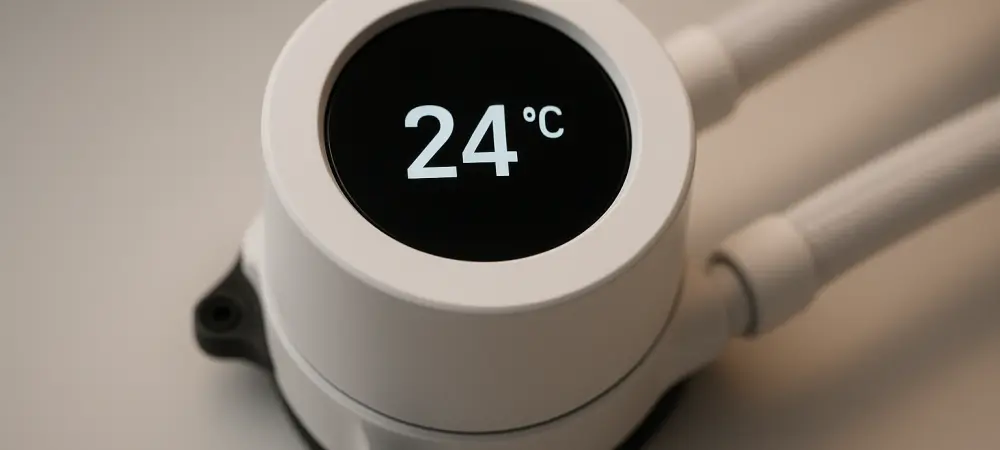
In an era where visual customization is just as critical as raw performance, the inclusion of a one-point-zero-five-inch digital display on the water block serves as a central hub for real-time telemetry. This screen interface connects via a standard internal nine-pin USB header and allows the user to monitor critical system statistics such as real-time CPU temperature, current clock frequency, and the operational speed of the pump. Positioned directly beneath this digital readout is an addressable RGB lighting strip that provides a subtle glow, perfectly complementing the minimalist aesthetic of the all-white chassis design. The lighting is fully compatible with proprietary synchronization software, enabling the cooler to blend into a broader ecosystem of glowing hardware and peripheral devices. This combination of functional monitoring and expressive lighting transforms the cooler from a utilitarian component into a centerpiece of the modern desktop environment, catering to specific tastes. Empirical testing involving the Ryzen 9 7950X3D processor demonstrates that this cooling solution remains competitive even when compared to significantly more expensive liquid coolers. During intense multi-threaded workloads, the system maintains a stable thermal delta that prevents the processor from hitting its thermal throttling threshold, ensuring that clock speeds remain high and consistent throughout the task. The efficiency of the micro-fin array and the high-speed pump work in tandem to dissipate heat rapidly, which is especially noticeable during sudden transitions from idle to full load. Furthermore, the zero-RPM fan technology provides a distinct advantage for users who prioritize acoustics during less demanding activities. By allowing the fans to stop completely when the coolant temperature remains below a specific threshold, the system eliminates fan noise entirely during office work, making it an ideal choice for multi-purpose workstations where silence is often valued.
Strategic Value: Market Positioning and Next Steps
The broader implications of this product release center on its ability to democratize premium features, as it successfully integrates a digital display and a unified fan frame into a package that costs less than many traditional air coolers. ASRock’s decision to offer a comprehensive six-year warranty further underscores their confidence in the long-term viability of the pump and tubing assembly, providing a level of security that is rarely seen at this price point. This extended coverage is a strategic move to build brand trust within the enthusiast community, where reliability is often the deciding factor between competing thermal solutions. While the cable management on the water block itself could be streamlined to further reduce clutter from power and data lines, the overall ease of installation remains high due to the pre-installed fan assembly and clearly labeled hardware. This approach makes the unit an attractive option for both first-time builders and seasoned experts looking for a value upgrade. As the analysis concluded, the ASRock ROCK White 360 Digital established itself as a significant disruptor by bridging the gap between budget constraints and enthusiast aspirations. The performance data suggested that moving toward unified fan designs was a necessary step for the industry to simplify complex builds while maintaining high airflow efficiency. Builders who prioritized a clean white aesthetic found that the unit delivered a cohesive look without the typical premium surcharge associated with specialized color schemes. Future considerations for this product line included the potential for larger display screens or further integration of pump and fan cabling to achieve a truly wireless appearance within the main chamber. Ultimately, the cooler provided a balanced combination of reliable thermal regulation and modern digital features that challenged existing market norms. For those planning a system refresh in 2026, this model represented a practical investment that prioritized durability and ease.