

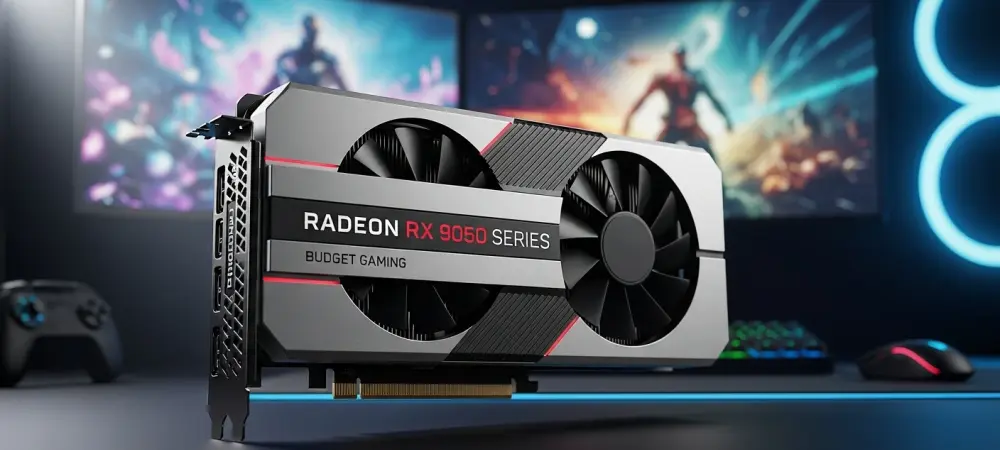
Building a gaming computer in the current economic climate remains a significant challenge for enthusiasts who must balance performance requirements against the rising costs of flagship internal components. ASRock has addressed this persistent market void by introducing the Radeon RX 9050 Challenger series, specifically targeting the entry-level segment where value is the primary driver of consumer choice. This strategic move provides a modern hardware solution for builders who are looking to assemble efficient and affordable gaming rigs without being forced into the inflated pricing tiers of high-end graphics cards. While much of the industry has shifted its focus toward high-capacity memory and extreme resolutions, ASRock acknowledges that a significant portion of the global gaming population still operates within the 1080p ecosystem. The launch highlights a commitment to accessible technology, ensuring that the latest silicon advancements are not exclusive to those with massive budgets. By offering a refined balance of features and cost, the RX 9050 series aims to stabilize a market that has often neglected the needs of casual gamers and budget-conscious professionals.
Architectural Foundations: The Power of RDNA 4
At the heart of the Radeon RX 9050 series lies the Navi 44 GPU core, which serves as a specialized and highly efficient version of the silicon architecture found in the more powerful RX 9060 models. This approach to manufacturing allows AMD to scale its latest technology across various price points, ensuring that the manufacturing process remains cost-effective while delivering modern features to the widest possible audience. The RDNA 4 architecture represents a significant leap in efficiency over previous generations, focusing on maximizing the output of every clock cycle. This efficiency is particularly important in the entry-level space, where thermal constraints and power consumption are critical factors for system stability. By utilizing this architectural foundation, ASRock ensures that the RX 9050 series provides a consistent and reliable user experience, leveraging the same underlying logic that powers more expensive gaming hardware. This democratization of technology allows budget users to access sophisticated graphical features that were previously restricted to the premium market segment, effectively raising the baseline for what an entry-level graphics card can achieve in today’s demanding software environment.
Beyond the raw silicon, the RX 9050 features a total of 1,024 streaming cores and 16 Compute Units, a configuration that is meticulously optimized for high-speed graphical processing. While these specifications might appear modest when compared to the massive core counts of flagship GPUs, the architectural refinements of RDNA 4 allow these units to perform significantly more work per cycle than older designs. One of the most notable inclusions in this budget-friendly card is the presence of hardware-accelerated ray tracing and dedicated AI processing units. These features are designed to handle modern graphical tasks such as realistic lighting calculations and AI-driven upscaling, which have become essential for maintaining smooth frame rates in contemporary titles. The inclusion of such advanced logic in a budget card demonstrates a shift in the industry toward feature parity, ensuring that even the most affordable systems can run modern game engines as intended. This architectural maturity provides a solid foundation for long-term usability, as the card is built to handle the evolving requirements of software developers who are increasingly relying on AI and ray tracing technologies.
Performance Dynamics: Clock Speeds and Memory Configuration
The performance profile of the ASRock Radeon RX 9050 Challenger is specifically engineered to dominate the 1080p gaming landscape, which remains the most popular resolution for competitive and casual gamers alike. With a base clock of 1,920 MHz and the ability to boost up to 2,600 MHz, the card is capable of maintaining the rapid calculation speeds required for fluid motion and low latency. These frequencies are critical for competitive titles where every millisecond matters, providing a smooth experience that matches the refresh rates of modern budget gaming monitors. ASRock has carefully tuned the Challenger series to balance these high clock speeds with thermal stability, ensuring that the card does not suffer from performance throttling during extended gaming sessions. This focus on consistent performance makes the RX 9050 a dependable choice for users who need their hardware to work reliably day after day without requiring constant adjustment or specialized cooling solutions. The result is a card that punchily handles modern workloads while staying within the strict operational limits required by standard desktop configurations.
A defining characteristic of this new series is the clear distinction between the retail-focused 8GB model and the 4GB variant intended for the OEM market. The retail Challenger model features 8GB of high-speed memory on a 128-bit bus, providing a total bandwidth of 288 GB/s, which is essential for handling high-resolution textures and complex shader programs in modern games. This configuration ensures that the card has enough overhead to prevent stuttering in titles that demand significant video memory. In contrast, the 4GB OEM version utilizes a 64-bit bus, resulting in a reduced bandwidth of 144 GB/s. This model is primarily designed for prebuilt office systems and basic computing tasks where high-end gaming performance is not a requirement. By offering these two distinct configurations, ASRock and its partners can cater to different market needs while maintaining a unified product line. For the individual consumer, the 8GB model stands out as the definitive choice, providing the necessary technical specifications to enjoy a modern gaming library without the limitations often associated with low-memory hardware in the entry-level space.
Engineering Design: Cooling and Power Efficiency
The physical construction of the ASRock Challenger series emphasizes practicality and compatibility, featuring a compact dual-slot cooling system that incorporates two high-performance fans. This design is intended to manage the heat generated by the RDNA 4 silicon without necessitating the massive heatsinks found on larger, more expensive cards. The minimalist black shroud provides a clean and professional aesthetic that allows the card to fit seamlessly into a wide variety of builds, ranging from flashy RGB-heavy setups to understated professional workstations. By keeping the card’s dimensions relatively small, ASRock ensures that it can be installed in most standard mid-tower and even some small-form-factor cases, making it an accessible upgrade path for users with limited space. The cooling solution is not just about temperature management; it is also designed to operate quietly, ensuring that the user experience is not disrupted by excessive fan noise during intensive tasks. This thoughtful approach to industrial design reflects a deep understanding of the practical needs of the budget gaming community, where ease of installation and reliability are paramount. Energy efficiency is another cornerstone of the RX 9050 series design, as the card is optimized to run on a modest 450W power supply. This low power requirement is facilitated by the use of a single 8-pin PCIe power connector, which simplifies the cable management process and reduces the overall load on the system’s electrical components. For many users, this efficiency means that the RX 9050 can be installed as a direct upgrade to an existing office PC or an older gaming rig without the need to purchase a new power supply unit. This “drop-in” compatibility significantly lowers the total cost of ownership, as it eliminates the secondary expenses often associated with modern GPU upgrades. In an era where power consumption has become a major concern for both environmental and financial reasons, the RX 9050 offers a responsible alternative that does not sacrifice functionality. The combination of low heat output and minimal power draw makes it an ideal candidate for long-term use in environments where system stability and energy conservation are prioritized alongside graphical performance.
Connectivity and Software: Modern Features for Value Builders
Despite its positioning as an affordable entry-level solution, the Radeon RX 9050 does not skimp on modern connectivity standards, featuring both DisplayPort 2.1a and HDMI 2.1b outputs. This inclusion ensures that the card is fully compatible with the latest generation of monitors and televisions, supporting high refresh rates and modern display technologies that were once the exclusive domain of high-end hardware. These ports allow users to take full advantage of current display advancements, providing a crisp and vibrant visual experience that enhances both gaming and media consumption. Furthermore, the support for modern display standards means that the card is well-prepared for the future of digital content, ensuring that it will remain relevant as display technology continues to advance. By integrating these premium connectivity options into a budget-friendly package, ASRock has ensured that users do not have to compromise on visual quality or peripheral compatibility when building an affordable system, effectively bridging the gap between value and modern technological standards. Software integration plays a vital role in the overall value proposition of the RX 9050, specifically through the implementation of AMD FSR 4 upscaling technology. This AI-based feature allows the GPU to render frames at a lower resolution and then intelligently upscale them to the target output, significantly boosting frame rates in demanding titles without a major loss in visual clarity. For an entry-level card, this technology is a game-changer, as it allows the hardware to handle modern games that might otherwise be too demanding for its native processing power. This software-driven performance boost is particularly important for players in value-sensitive regions who focus on competitive eSports titles like Valorant or League of Legends, where high frame rates and stability are essential for a fair playing field. The RX 9050 provides a stable platform for these gamers, offering the reliable driver support and modern feature set needed to maintain a competitive edge. This strategic focus on software optimization ensures that the card remains a viable gaming tool long after its initial release, providing lasting value to a market that relies on hardware longevity.
Strategic Outlook: Navigating the Budget Hardware Market
The introduction of the Radeon RX 9050 series represented a pivotal moment for budget-conscious PC builders who sought modern features without the premium price tag associated with high-end silicon. ASRock correctly identified a significant gap in the market where consumers were often forced to choose between outdated used hardware or overpriced entry-level components that lacked modern architectural benefits. By delivering a product that balanced 8GB of memory with the RDNA 4 architecture, the company provided a clear path forward for those looking to maintain 1080p gaming performance in a rapidly evolving landscape. The decision to split the product line into retail and OEM versions allowed for a more efficient distribution of resources, ensuring that the specific needs of system integrators and individual enthusiasts were met with precision. This strategic launch helped to stabilize expectations for the low-end market, proving that manufacturers could still innovate within tight financial constraints. The series eventually became a staple for entry-level builds, demonstrating that efficiency and accessibility were just as valuable as raw, high-end power.
For consumers looking to maximize their investment, the primary recommendation was to prioritize the 8GB retail model to ensure compatibility with modern texture-heavy titles. Builders were encouraged to pair the RX 9050 with modern budget CPUs and high-speed DDR5 memory to fully leverage the bandwidth capabilities of the Navi 44 core. Furthermore, taking advantage of AI-driven upscaling tools like FSR 4 proved essential for maintaining longevity, as software requirements continued to climb in the years following the card’s release. Professionals and casual users alike found that the low power draw and dual-slot design made it an ideal candidate for refreshing older systems that were previously limited by integrated graphics or aging discrete GPUs. Moving forward, the industry took note of the success found in this segment, leading to a renewed focus on performance-per-watt and the inclusion of premium connectivity in affordable hardware. The RX 9050 series ultimately served as a blueprint for how a manufacturer could successfully serve the largest portion of the gaming public by focusing on practical, high-value engineering solutions that addressed real-world usage patterns.