

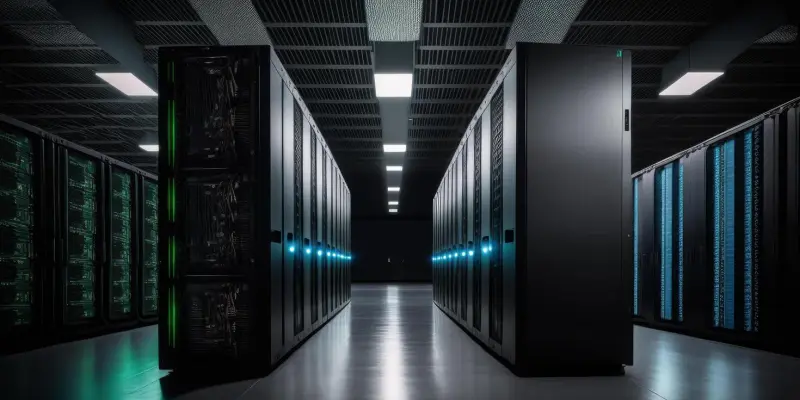
In an era defined by the exponential rise of AI and cloud services, the spotlight is on data centers and their ability to uphold the burgeoning demand. Companies worldwide are making substantial investments to enhance their data infrastructure, underscoring the industry’s need for rapid development, energy efficiency, and innovative solutions to meet global requirements. Recent developments in the data center sector indicate an unwavering commitment to accommodating AI and cloud services, yet the question remains: Are these data centers ready for the surge?
Major Investments in Data Infrastructure
Technology giants like Digital Realty have been at the forefront of data infrastructure advancements, launching initiatives that address critical connectivity gaps. One of their recent milestones includes the unveiling of HER1, the first carrier-neutral data center in Crete. Utilizing Schneider Electric’s prefabricated solutions, this data center aims to serve Southern Europe and the EMEA regions by ensuring seamless interconnection of international, regional, and local subsea cables. This project not only brings Southern Europe a significant step closer to becoming a pivotal digital gateway but also showcases a commitment to energy efficiency and rapid deployment, achieving operational status within just 12 months while adhering to stringent resiliency standards.
Meanwhile, Meta has taken substantial strides in positioning itself at the helm of AI and cloud services by planning a 2GW data center housing over 1.3 million Nvidia AI GPUs. This massive infrastructure investment is poised to elevate Meta AI to a leading position, introduce groundbreaking advancements with the Llama 4 model, and boost R&D contributions significantly. Complementing this effort, Meta is also embarking on a nearly US$1 billion data center project in Wisconsin, expanding its already robust Midwest network. Such extensive investments reflect the pressing need for state-of-the-art facilities to underpin AI innovations, stimulating industry-wide shifts in data infrastructure.
Expanding Network Management Capabilities
Hewlett Packard Enterprise (HPE) is another significant player driving advancements in data centers, particularly in network management and localized control. HPE recently expanded its HPE Aruba Networking Central platform, offering four cloud-native AI operations deployment models: dedicated customer virtual private cloud (VPC), on-premises, public Software-as-a-Service (SaaS), and network-as-a-service (NaaS). Such diversification in deployment models caters to the increasing demand for data sovereignty and localized network control, ensuring that data centers can effectively manage and secure the vast volumes of data generated by AI applications.
Simultaneously, Dell Technologies has introduced enhancements across its entire infrastructure portfolio to support traditional and emerging workloads. Dell’s focus is on addressing current IT challenges such as sustainability goals, the need for hybrid workload management, and escalating cyber threats. By enhancing data protection, servers, and storage solutions, Dell aims to bolster the agility and scalability of modern data centers. This advancement helps ensure that data centers are not only innovatively equipped but also resilient enough to tackle evolving industry demands.
Meeting Hyperscaler and Enterprise Requirements
In Germany, notable investments are underway with Colt Data Centre Services (Colt DCS) leading the charge in expanding data center capacity. Colt DCS announced plans for four new data centers, reflecting a €2 billion investment aimed at adding 117MW to cater to the increased demand from hyperscalers and enterprises deploying AI and high-performance computing (HPC) infrastructure. The development of Berlin 1 & 2 and Frankfurt 4 & 5 is set to elevate Colt DCS’s total capacity in the country to a remarkable 176MW, indicating a strategic move to support the digital economy’s rapid growth.
These actions collectively underscore a broader industry focus on accelerating deployment, improving energy efficiency, and meeting the surging demand for AI and cloud services. The data center landscape is continuously evolving with an emphasis on innovation, sustainability, and robust infrastructure that can support future technological advancements. As companies like Digital Realty, Meta, HPE, and Dell invest extensively in infrastructure, the readiness of data centers to handle the AI and cloud service surge appears imminent.
Future Considerations for Data Centers
In an era where AI and cloud services are rapidly advancing, data centers are now at the forefront due to the increasing demand for these technologies. Companies globally are investing heavily in boosting their data infrastructure. This trend highlights the necessity for rapid advancement, energy efficiency, and innovative solutions to address worldwide needs. These advancements showcase an unfaltering dedication to supporting AI and cloud services. However, the critical question remains: Are current data centers equipped to handle this exponential surge? The future of technological progress heavily relies on whether data centers can keep up with the pace. Effective data management and robust infrastructure are essential for harnessing AI’s full potential and ensuring the seamless operation of cloud services. Additionally, addressing energy consumption and implementing sustainable practices are vital for long-term success. As companies continue to pour resources into modernizing data centers, ongoing innovation and strategic planning will determine their ability to meet rising global demands and support the next wave of technological breakthroughs.