

Dominic Jainy is a seasoned IT professional with an extensive background in artificial intelligence, machine learning, and the intricate world of mobile hardware architecture. His deep understanding of how proprietary silicon interacts with complex software ecosystems makes him a leading voice in troubleshooting high-end consumer electronics. Today, he joins us to discuss the recent reports surrounding the iPhone Air’s innovative C1X modem, the challenges of ultra-thin device engineering, and what the future holds for custom network silicon.
The iPhone Air transitioned from the C1 modem to the proprietary C1X for improved efficiency. What specific engineering challenges arise when switching to custom in-house network silicon, and how do you differentiate a temporary software glitch from a total hardware failure during mobile diagnostics?
Designing a custom modem like the C1X involves the monumental task of ensuring global band compatibility while outperforming established third-party solutions in both speed and power consumption. When moving to in-house silicon, engineers often face “day-zero” integration hurdles where the firmware must perfectly sync with the A19 Pro’s neural engine to manage high-speed data. In the field, we differentiate a software glitch from a hardware failure by looking at the persistence of the error after a soft reset or a clean install of iOS 26.3. If mobile diagnostics explicitly flag a component issue and the cellular stack remains unresponsive despite having active eSIMs, you are likely looking at a physical failure of the C1X chip or its connection to the logic board. It is a heartbreaking moment for a user to see a pristine device—one kept in a case since day one—suddenly lose its primary function due to an internal silicon breakdown.
This device is marketed as the thinnest iPhone while housing the flagship A19 Pro chipset. How does an ultra-slim form factor impact heat dissipation specifically around the modem? What metrics or cooling benchmarks are most critical in ensuring that high-performance networking doesn’t lead to sudden component degradation?
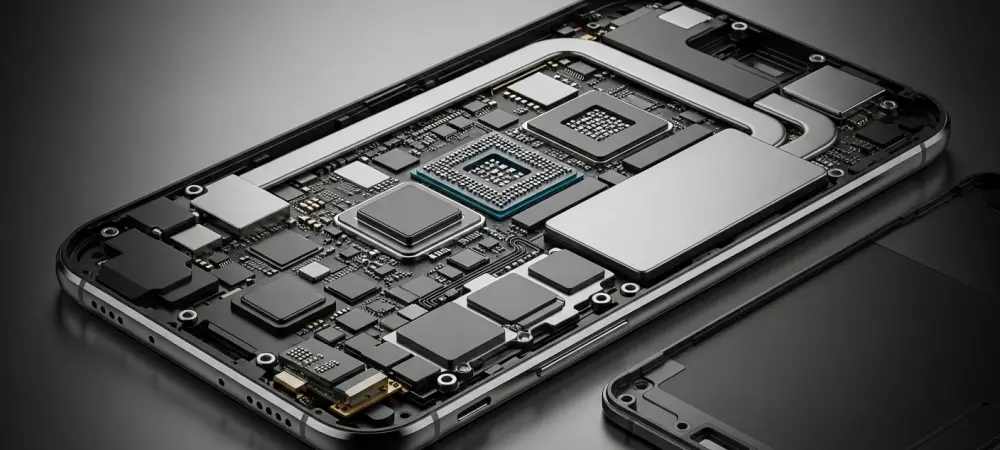
In a chassis as thin as the iPhone Air, the margin for thermal expansion is practically non-existent, creating a high-pressure environment for the A19 Pro and the C1X modem. Because the C1X is marketed as twice as fast as the C1, it likely generates significant heat during sustained 5G sessions, which must be dissipated through an incredibly cramped internal surface area. We monitor thermal throttling metrics and “junction temperature” benchmarks to see if the modem is being pushed past its safe operating limits during peak performance. If the cooling system cannot move heat away from the network silicon fast enough, the resulting thermal stress can lead to micro-fractures in the solder balls or internal degradation of the chip’s circuitry. For a device priced at Rs. 1,19,900, the expectation is that the premium materials will act as an efficient heat sink, but physics always presents a ceiling in ultra-slim designs.
When a device with active eSIMs loses all cellular connectivity despite having no physical damage, what is the step-by-step troubleshooting process for a technician? Please explain how the integration of the C1X modem might complicate hardware repairs compared to older models like the iPhone 16e.
A technician starts by verifying the software environment, ensuring the latest updates are installed, and then moves to “pinging” the modem firmware to see if the hardware is even communicating with the operating system. Since the iPhone Air relies on dual eSIMs, we eliminate physical SIM tray failure immediately and focus on the baseband processor’s ability to authenticate with the network. The integration of the C1X modem is significantly more complex than the C1 found in the iPhone 16e because it is a first-generation proprietary part tightly coupled with the A19 Pro’s architecture. Repairing this often requires a full logic board replacement rather than a modular fix, as the proprietary nature of the chip means third-party components are non-existent and diagnostic tools are highly specialized. It becomes a forensic exercise to determine why a device with no physical impact or water damage would suddenly experience a total modem blackout.
With plans to integrate the C1X modem into upcoming models like the iPhone 17e, what are the potential risks of scaling this proprietary technology? How might reports of localized component failure influence the manufacturing rollout, and what metrics define the threshold between an isolated incident and a widespread defect?
Scaling the C1X to the iPhone 17e is a bold move that carries the risk of magnifying any latent design flaws across a much larger, more cost-sensitive user base. If early reports of “dead modems” turn out to be more than isolated incidents, the manufacturer might have to delay the March 4 launch or adjust the manufacturing yields to improve chip durability. We look at the “Failure Rate per Thousand” (FRPT) and monitor community forums like Reddit to see if the symptoms—sudden death without physical trauma—become a recurring pattern. A threshold for a widespread defect is usually reached when the failure rate exceeds the standard 1% to 2% industry variance or when a specific batch of silicon is identified as having a manufacturing flaw. For a proprietary chip that is the centerpiece of their new networking strategy, even a handful of documented failures can trigger an internal audit of the entire production line.
What is your forecast for the iPhone Air?
I believe the iPhone Air will remain a pivotal, albeit polarizing, milestone in mobile design that eventually proves the viability of ultra-thin, all-silicon integration. While this first reported hardware failure of the C1X modem is a concerning development for early adopters, the sheer performance of the A19 Pro combined with the promised efficiency of the new modem will drive high demand. As we move toward the release of the iPhone 17e, I expect the company to quietly refine the thermal packaging of the C1X to ensure better longevity in slim form factors. Ultimately, the iPhone Air will be remembered as the “proof of concept” that transitioned the industry away from external modems toward a fully unified, proprietary ecosystem, despite these early growing pains.