

The successful navigation of the difficult transition from 3nm to 2nm manufacturing ensures that the A20 Pro remains at the forefront of the global silicon arms race. As the industry’s first consumer-grade 2-nanometer processor, the A20 Pro serves as the heartbeat for the flagship iPhone 18 Pro and Pro Max, while also enabling the sophisticated multitasking required for the foldable iPhone Duo. By shrinking the transistor gate size even further, Apple has managed to overcome physical limits that were once thought to be insurmountable in handheld electronics. The resulting density provides an unprecedented platform for energy efficiency, allowing users to experience desktop-class performance in a pocket-sized form factor that sets a demanding new standard for competitors to follow worldwide.
Architectural Excellence and Graphics Performance
Breakthroughs: Manufacturing and CPU Efficiency
The transition to the 2nm node represents more than just a reduction in physical size; it is a complete reimagining of semiconductor efficiency and transistor density. By partnering with TSMC to pioneer this technology, Apple has successfully integrated billions of additional transistors into the A20 Pro without expanding the chip’s physical surface area. This advancement results in a 40 percent boost in central processing unit performance, allowing for faster app launches and more fluid system navigation. The architecture remains centered on a sophisticated six-core design, but the underlying silicon logic has been optimized to reduce electrical leakage and heat generation. Such engineering feats are critical for maintaining the slender profiles of the iPhone 18 Pro series while delivering the raw power necessary for next-generation applications. As mobile software continues to demand more from hardware, this 2nm foundation provides a reliable buffer for the most intensive user workflows.
Beyond raw speed, the A20 Pro introduces a smarter way to manage power through its refined efficiency cores. These cores have been re-engineered to handle an even broader range of background processes, from fetching mail to managing location services, with a negligible impact on the overall battery percentage. When high-performance tasks are required, the performance cores activate instantly, leveraging integrated Neural Accelerators to solve complex mathematical strings that previously required significant energy spikes. This tiered approach to processing ensures that the device remains responsive during heavy use while staying cool to the touch. The synergy between the manufacturing process and the internal logic overhaul creates a user experience where lag is virtually non-existent, and the transition between simple tasks and heavy workloads is entirely seamless. This balance is particularly important for professionals who rely on their devices for consistent performance throughout the entire workday.
Gaming Performance: Redefining Mobile Graphics
The graphical capabilities of the A20 Pro are anchored by a new seven-core GPU that seeks to eliminate the boundary between mobile gaming and dedicated home consoles. A critical component of this upgrade is the 50 percent increase in memory bandwidth, which effectively removes the data bottlenecks that often limit visual fidelity on portable devices. This expanded bandwidth allows the GPU to stream high-resolution textures and complex geometric data at a much higher frequency, resulting in sharper visuals and more stable frame rates. Mobile gamers can now enjoy titles that feature dense environments and intricate lighting effects without seeing the aggressive downscaling typical of previous generations. This shift reflects a strategic effort to position the iPhone as a primary gaming platform capable of running “AAA” titles natively. The A20 Pro does not just offer more power; it offers a more efficient pipeline for rendering the most demanding visual assets found in modern game engines.
To complement the raw power of the seven-core GPU, the A20 Pro features enhanced hardware-accelerated ray tracing and stable global illumination. These technologies allow for realistic reflections and dynamic lighting that react in real-time to the environment, bringing a level of immersion to mobile screens that was previously restricted to high-end desktop hardware. By integrating these features directly into the silicon, Apple has ensured that developers can push the limits of their creative vision without worrying about excessive thermal throttling or battery drain. The GPU also works in close concert with the display’s refresh rate, ensuring that every movement is captured with pinpoint accuracy. Whether navigating through a fast-paced action game or editing a high-resolution 3D model, the graphical output remains consistently smooth. This commitment to visual excellence makes the A20 Pro a formidable tool for both digital artists and gaming enthusiasts who require the best possible performance.
Advanced Intelligence and Thermal Management
AI Revolution: The 32-Core Neural Engine
Artificial Intelligence stands as the central pillar of the A20 Pro’s design, highlighted by the implementation of a massive 32-core Neural Engine. This configuration provides double the AI processing capacity of its predecessor, marking a definitive pivot toward a “local-first” computing ecosystem. By processing machine learning tasks directly on the device, the A20 Pro reduces the need for cloud-based data transfers, which significantly enhances user privacy and security. “Apple Intelligence” can now operate with near-zero latency, enabling real-time features like instant language translation and sophisticated image recognition without an active internet connection. This massive increase in core count allows the NPU to handle millions of simultaneous operations, ensuring that the system remains snappy even when multiple AI-driven features are running in the background. The result is a device that feels more intuitive, anticipating user needs through advanced on-device pattern recognition.
The sheer power of the 32-core Neural Engine also unlocks new possibilities for generative AI and computational photography. For instance, the A20 Pro can now perform complex on-the-fly video editing, such as removing objects or applying cinematic lighting effects to 8K footage in real-time. Siri has also evolved into a more conversational assistant, capable of understanding context and nuance with a level of sophistication that matches human-like interaction. These advancements are not merely cosmetic; they represent a fundamental change in how users interact with their hardware. By keeping the processing local, the device remains functional in remote areas while ensuring that personal data never leaves the encrypted enclave of the chip. As the industry moves closer to fully autonomous digital assistants, the A20 Pro provides the necessary computational foundation to support these complex models. This localized approach ensures that the future of mobile AI is fast, private, and exceptionally powerful.
Thermal Innovation: Advanced Cooling Systems
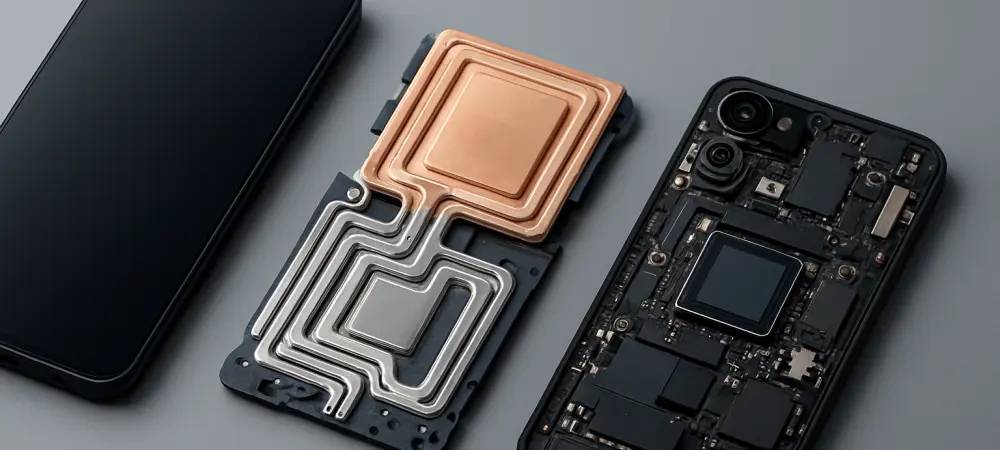
To manage the heat generated by its high-performance silicon, Apple introduced a radical custom packaging redesign for the A20 Pro. In this new architecture, the silicon die and the memory modules are placed side-by-side rather than in a traditional stacked configuration to prevent the heat generated by the memory from being trapped within the CPU’s thermal path. By isolating these components, the chip can operate at higher clock speeds for longer durations without reaching the thermal limits that trigger performance throttling. This side-by-side layout also allows for a more efficient transfer of heat away from the core components, ensuring that the device remains comfortable to hold during intensive tasks. This packaging innovation is a direct response to the increasing thermal demands of 2nm technology, where energy density is at an all-time high. It represents a significant step forward in the quest for sustained mobile performance. Complementing the internal packaging is a redesigned vapor chamber cooling system that offers three times the surface area of previous thermal solutions, allowing the A20 Pro to maintain a 40 percent improvement in sustained performance. The vapor chamber effectively captures heat from the chipset and distributes it across the chassis, where it can be dissipated safely. This level of thermal management is especially critical for the iPhone Duo, where the foldable form factor poses unique challenges for air circulation and heat escape. Users can now record long sessions of 8K video or run complex simulations without experiencing the sudden performance drops that plagued previous generations. By solving the heat equation, Apple has ensured that the raw power of the A20 Pro is actually usable in real-world scenarios, rather than just being a theoretical peak on a benchmark chart.
Ecosystem Synergy and Future Growth
Connectivity: N1 and C2 Integration
The A20 Pro does not function in isolation; it is the center of a sophisticated connectivity hub that includes the N1 wireless chip and the C2 cellular modem. The N1 chip is specifically designed to bring industry-leading support for Wi-Fi 7 and Bluetooth 6, ensuring that the iPhone 18 Pro series serves as a high-performance controller for modern smart home environments. With Bluetooth 6, the device gains much higher precision for proximity sensing, allowing for faster and more secure unlocking of doors or pairing with peripherals. Wi-Fi 7 support means that users can download massive files or stream high-definition content with ultra-low latency, even in crowded network environments. These wireless advancements are tightly integrated with the A20 Pro’s power management system, ensuring that high-speed data transfers do not cause unnecessary battery drain. This holistic design philosophy ensures that the device remains at the cutting edge of networking technology.
In addition to local wireless improvements, the C2 cellular modem is optimized to work within the A20 Pro’s strict power envelope, providing robust 5G and emerging 5.5G connectivity. This modem is designed to maintain a stable connection in challenging signal areas while consuming less power than previous generations. This efficiency is critical for users who rely on cellular data for cloud synchronization or high-stakes mobile gaming. The synergy between the A20 Pro and the C2 modem allows the device to intelligently switch between different network bands to preserve battery life while still delivering the fastest available speeds. Furthermore, the inclusion of the Thread networking protocol ensures that the device is fully compatible with the latest smart home standards. By integrating these connectivity features directly into the core ecosystem, Apple has created a device that is as capable of managing a smart home as it is of performing complex silicon-heavy tasks, ensuring long-term utility.
Market Evolution: Strategic Synthesis
In concluding this technological leap, the A20 Pro established itself as the definitive engine for the mobile landscape of 2026 and beyond. By prioritizing local intelligence and thermal efficiency, Apple provided a clear roadmap for how high-performance silicon should behave in an AI-centric world. The hardware did not merely offer incremental speed increases but rather unlocked entirely new categories of productivity, particularly through the foldable Duo interface. Professionals and creators gained a tool capable of handling 8K video and generative design without traditional mobile thermal limitations. As the industry moves forward, the focus must shift toward optimizing software to fully utilize this massive surplus of computational headroom. The A20 Pro successfully bridged the gap between desktop-class power and mobile portability, ensuring that the next several years of digital innovation remained grounded in high-speed, secure, and efficient local processing.
The long-term implications of this transition to 2nm technology suggest a future where the device becomes an increasingly independent workstation. With the ability to drive high-resolution external displays and manage complex multitasking environments, the A20 Pro-equipped devices are well-positioned to replace traditional laptops for many users. The strategic decision to move away from cloud-reliant AI has also set a privacy benchmark that others in the industry are now scrambling to match. Moving forward, the emphasis will likely remain on refining these local models and further integrating the silicon with wearable technology and specialized sensors. The A20 Pro was not just a yearly update; it was a foundational shift that redefined the expectations for mobile performance. By successfully delivering on the promise of 2nm manufacturing, the groundwork was laid for a decade of innovations that prioritize speed and privacy in equal measure, ensuring that the mobile ecosystem remained vibrant and technologically superior.