

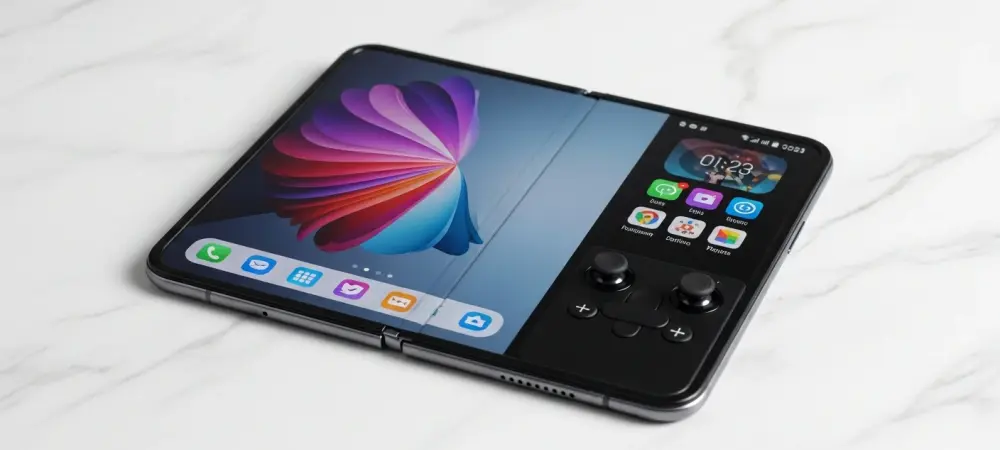
The persistent physical ridge running down the center of foldable smartphones has long served as a glaring reminder of the technological compromises required to achieve a flexible form factor. For years, the mobile industry has chased the dream of a device that offers the expansive real estate of a tablet with the portability of a standard handset, yet every iteration has been haunted by the “valley”—that tactile and visual dip where the screen meets the hinge. Apple has remained notably silent during this era of public iteration, watching from the sidelines as competitors grappled with fragile components and unrefined aesthetics. This silence is finally breaking as new data suggests the company is preparing to launch a device that prioritizes a seamless tactile experience, aiming to transform the foldable from a fragile novelty into a durable, polished flagship that feels like a single piece of glass.
The End of the “Valley”: Why Apple’s Late Entry Into Foldables Is No Accident
Apple has often utilized a “second-mover advantage” strategy, allowing the company to observe the hardware failures of early foldable pioneers while refining its own proprietary solutions in secret. This patient approach meant waiting until the global supply chain could produce a display panel that did not degrade after only a few months of use or exhibit the distracting visual distortions that defined the first half-decade of the category. By letting the market mature through the trials and errors of others, Apple ensured that its eventual entry would not be viewed as a beta test but as a finished realization of the folding concept. The goal was never to be the first to market, but rather to be the first to make the technology feel essential and invisible.
The company’s strategic delay also allowed for the maturation of supporting technologies, such as advanced metallurgy and more efficient semiconductors. While early foldables were often bulky and prone to mechanical failure, Apple’s upcoming device is expected to leverage a decade of refinement in hinge design and material science. This focus on long-term reliability over immediate market presence suggests a belief that the “Pro” user base would only accept a foldable if it maintained the same rigorous standards of build quality as the traditional iPhone lineup. Consequently, the “valley” that has plagued previous devices is being treated not as an inevitable trade-off, but as a problem that must be solved before the product can carry the Apple logo.
Solving the “Crease Problem” to Redefine the Foldable Market
The foldable smartphone market has reached a plateau where hardware specifications are impressive, but the physical compromise of a folding screen remains a significant barrier for many high-end users. A visible or tactile line down the center of a premium device often feels like a regression in quality for those accustomed to the flawless, high-resolution panels of the current iPhone series. Apple’s strategy hinges on the belief that mass adoption will only occur when the folding mechanism becomes functionally invisible to the user. This move is not merely about aesthetics; it is about meeting a threshold of durability and refinement that ensures “folding” does not become synonymous with “compromising.”
To address this, Apple reportedly focused on a holistic redesign of the display stack, incorporating new layers of flexible polymers and glass that resist permanent deformation. For the luxury consumer, the presence of a crease is often seen as a failure of design, a blemish on an otherwise perfect piece of technology. By eliminating this distraction, Apple aims to shift the narrative of foldables from “experimental gadgets” to “professional tools.” This refinement is expected to attract a demographic that has previously avoided the category due to concerns over screen longevity and the unpolished feel of plastic-heavy displays.
Engineering a Seamless Surface: Dimensions and Technical Breakthroughs
Recent reports indicate that Apple is achieving a significant breakthrough in display depth and geometry that could set a new industry benchmark. The “iPhone Fold” is rumored to feature a crease depth of a mere 0.15mm, a measurement so shallow it renders the fold virtually imperceptible to the touch during standard scrolling. This achievement is paired with a rumored crease angle of less than 2.5 degrees, which significantly reduces light refraction and the visual “rainbow effect” often seen on current foldable panels. This level of precision requires a hinge that does not just fold, but carefully manages the tension of the display to prevent the micro-stretching that leads to a permanent indentation. The device is expected to follow a “book-style” architecture, featuring a massive 7.8-inch internal primary display for tablet-class productivity and media consumption. When closed, a 5.3-inch cover screen ensures the device remains fully functional for one-handed use, providing a familiar interface for quick tasks. To manage the weight and stress of this new form factor, Apple is reportedly turning to a hybrid chassis of titanium and aluminum, mirroring the high-strength, low-weight philosophy of its recent flagship models. This material choice is vital for ensuring that the device remains portable without sacrificing the structural integrity required to protect the complex internal folding mechanisms.
The Powerhouse Within: 2nm Silicon and Advanced Multitasking
To drive such a large, high-resolution canvas, Apple is expected to debut the “A20 Pro” chipset, potentially the first consumer processor built on a cutting-edge 2nm fabrication process. This leap in transistor density is vital for managing the thermal demands of a 7.8-inch display while maintaining the battery life users expect from a modern flagship. The increased efficiency of the 2nm process allows the device to handle sustained workloads without the throttling often seen in thinner foldable designs. This silicon powerhouse ensures that the user experience remains fluid, whether the device is in its compact mode or fully expanded for intensive professional tasks. Supporting this advanced silicon is a rumored 12GB of LPDDR5x RAM, a necessary upgrade to handle the complex split-screen multitasking and “Stage Manager” features likely to be ported from iPadOS. This memory capacity allows for seamless transitions between the 5.3-inch cover screen and the 7.8-inch internal display, ensuring that applications do not need to reload when the device is opened or closed. Additionally, the integration of Apple’s proprietary C2 modem indicates a push for total internal control over signal stability and power efficiency. This custom hardware integration ensures that the foldable iPhone remains a leader in connectivity, providing a stable platform for the next generation of mobile computing.
How to Evaluate the First-Generation Foldable iPhone
For those considering the jump to a foldable form factor, Apple’s entry required a specific framework for evaluation that looked beyond simple marketing claims. Potential buyers examined tactile uniformity as a primary indicator of quality; running a finger across the hinge area at 0.15mm, the transition felt like a flat surface rather than a dip. Application continuity also played a crucial role, as the software was expected to transition from the cover screen to the internal display without any perceptible lag. These performance indicators helped users determine if the device truly met the standard of a “Pro” level tool or if it remained an experimental luxury.
Biometric versatility and structural rigidity were the final pillars of this evaluation framework. Analysts noted that the use of a side-mounted Touch ID sensor or an under-display sensor supplemented the traditional Face ID array to accommodate the different holding positions of a folding device. The friction hinge was tested for its ability to hold the screen at various angles, such as a “Laptop Mode,” without sagging over time. These metrics provided a clear roadmap for how the industry shifted toward a future where mechanical complexity was hidden beneath a flawless surface. These considerations established a new baseline for what a premium mobile experience should entail, focusing on long-term durability and the total elimination of hardware compromises.