

Dominic Jainy stands at the cutting edge of information technology, where his deep understanding of artificial intelligence and machine learning informs his perspective on high-performance hardware. As an expert who has watched the evolution of silicon architecture from a professional and enthusiast standpoint, he possesses a keen eye for when a design shifts from being merely iterative to truly revolutionary. The recent emergence of space-grade materials and AI-optimized structures in consumer electronics represents a significant milestone in PC engineering. Our conversation explores the leap toward 3D-printed metal cooling, the staggering power demands of next-generation components, and the move toward more intuitive, “stealthy” build aesthetics that prioritize both safety and functionality.
The X870E Infinity Next introduces a radical AI Gyroid design created through 3D metal printing; how does this specific geometric approach change our understanding of thermal management in high-end motherboards?
This is a fascinating pivot because we are seeing space-grade thermal engineering finally land on the desktop. By utilizing a 3D metal-printed AI Gyroid structure, the design manages to increase the cooling surface area by a remarkable 44% compared to traditional flat or finned heat-sinks. You can actually see and feel the difference in the intricate, white and silver open-cell structure that wraps around the board, which is far more efficient at dissipating heat than a solid block of aluminum. This isn’t just about looks; it is about maximizing every millimeter of space to handle the intense thermal loads of modern processors. When you combine that with a Honeycomb PCB thermal plate that offers a 45% airflow area, you realize the entire board is essentially breathing, moving air through a complex lattice that was once impossible to manufacture without 3D printing technology.
With the motherboard featuring a massive 64-phase power delivery system, what does this level of “data-center-class” engineering mean for the average enthusiast compared to professional overclockers?
When you see a motherboard packing 64 phases—specifically a 16 x 4 configuration—you are looking at power delivery that would typically be reserved for enterprise-grade servers. This setup utilizes quad OptiMOS technology to reach a staggering maximum current rating of 5120A, which provides an incredibly stable and clean flow of electricity to the CPU. For the professional overclocker, this is the holy grail because it ensures that power fluctuations won’t be the bottleneck when pushing silicon to its absolute limits. However, for the daily enthusiast, it means the components are running well below their maximum stress levels, which significantly extends the lifespan of the hardware and ensures rock-solid stability even during the most demanding AI workloads or gaming marathons. It is essentially over-engineering as a form of insurance, providing a level of “clean” power that keeps the system cool and responsive under any condition.
The cooling solution on this board includes a 3D metal-printed vapor chamber with an omnidirectional Fin Wick; how does this push the boundaries of heat dissipation beyond current industry standards?
This is the world’s first application of a 3D metal-printed vapor chamber in this context, and it is a game-changer because it achieves a cooling capacity that exceeds 100W just for the VRM area. Traditional vapor chambers are often limited by their internal structure, but this ultra-dense omnidirectional Fin Wick allows the liquid coolant inside to move with much less resistance, regardless of the board’s orientation. You can feel the weight and the premium quality of the cooling assembly, which is necessary when you are dealing with the kind of heat generated by a 5120A power system. It creates a thermal envelope that is much more uniform, preventing “hot spots” that can lead to system throttling or component failure over time. By moving away from standard manufacturing and embracing these 3D-printed internal geometries, we are seeing a level of precision that makes the cooling feel almost like a living part of the machine.
The X870 AORUS Infinity takes a different approach by rotating the AM5 socket and focusing on dual DDR5 slots; what performance advantages does this layout offer for memory-intensive tasks?
Rotating the AM5 socket is a bold move that is specifically designed to shorten the signal traces between the CPU and the memory modules. By utilizing only two DDR5 DIMM slots instead of four, the board reduces electrical interference and allows for much higher memory frequencies, which is vital for users who want to get the most out of their EXPO DDR5 kits. This layout is a dream for those who focus on memory overclocking, as it includes a dedicated OC panel with BCLK adjustment buttons and dual DEBUG LEDs for real-time troubleshooting. You can feel the intention behind every centimeter of the board, as it prioritizes the shortest possible paths for data to travel, resulting in lower latency and higher bandwidth. It is a specialized tool that turns the motherboard into a precision instrument for squeezing every last drop of performance out of the AM5 platform.
Safety has become a major concern with high-power GPUs, so how does the new T-Guard technology in the AERO series PSUs address the risks associated with the 16-pin power connectors?
The T-Guard system is a vital innovation that brings active monitoring to the most vulnerable part of a modern PC: the GPU power connection. Available in units ranging from 750W up to 1000W, this technology allows users to track the thermal behavior and connection status of those high-power 16-pin cables in real-time. We have all heard the horror stories of connectors melting due to improper installation or poor contact, but T-Guard essentially acts as a digital watchdog to prevent those risks before they become catastrophic. It provides a sensory layer of security, letting you know through software if a connector is running too hot or isn’t seated perfectly. For anyone investing in a high-end build, having that “AERO Dark Wood” or “White” PSU providing both stable power and a safety net for their expensive graphics card is a massive relief.
The B850M Stealth motherboard marks a shift toward backside connectors; how do you see this “stealthy” approach changing the DIY building experience for the broader market?
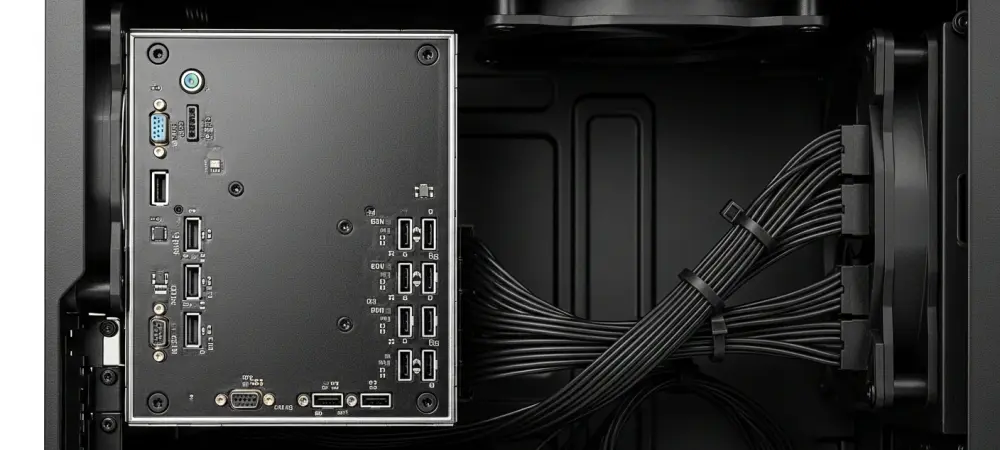
The B850M Stealth is particularly exciting because it is the first mATX design to embrace the backside connector philosophy, which completely transforms how we think about cable management. By hiding all the power and data connectors on the rear of the PCB, the front of the motherboard remains incredibly clean and unobstructed, allowing for much better airflow and a more professional-looking build. It simplifies the DIY process significantly, as you no longer have to struggle with thick 24-pin cables or awkward fan headers cluttering the main chamber of the case. This “stealth” approach, offered in both black and white options, makes high-end aesthetics accessible to people who might not have hours to spend on meticulous cable routing. It turns the interior of the PC into a showcase of the actual components rather than a nest of wires, making the building experience feel much more like assembling a piece of high-tech art.
What is your forecast for the future of 3D-printed materials in mainstream consumer hardware?
I believe we are just at the beginning of a massive shift where 3D metal printing becomes a standard tool for high-end thermal solutions across the entire industry. As manufacturing costs decrease, the 44% increase in cooling surface area we see today will become the baseline for flagship products, eventually trickling down to mid-range gear. We will likely see more “organic” designs that mimic biological structures to maximize airflow and heat dissipation in ways that traditional milling and stamping simply cannot match. This technology will allow us to pack even more power into smaller form factors, like the mATX Stealth boards, without sacrificing the longevity of the components. Ultimately, the integration of AI-driven design and 3D printing will turn our PCs into more efficient, quieter, and more visually striking machines than we ever imagined.