
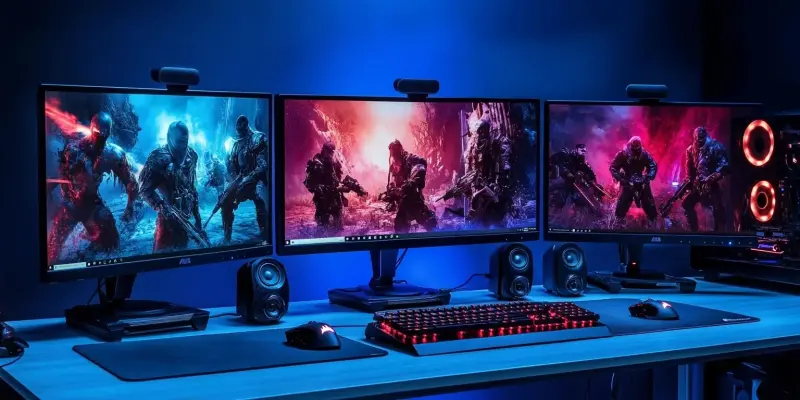
AOC Introduces AGON G42 Series: Budget-Friendly Gaming Monitors

Article Highlights
Off On

In a move aimed at pleasing budget-conscious gamers seeking high performance without breaking the bank, AOC has introduced three new budget-friendly gaming monitors in the AGON by AOC G42 series. The latest lineup includes the 24G42E (24-inch), 25G42E (25-inch), and 27G42E (27-inch) models. Each of these monitors boasts a 1080p resolution, ensuring clear visuals while supporting a refresh rate of up to 180Hz. This remarkable frame rate ensures fluid and immersive gaming experiences for gamers, enhancing the overall responsiveness and engagement in gameplay. Additionally, the monitors employ Fast IPS technology, which comes with a low response time of either 1ms GtG or 0.5ms MPRT. This effectively minimizes blur and ghosting, ensuring that transitions between frames are smooth and clear.

Advanced Features and Technology

AOC has always been dedicated to making advanced gaming technologies accessible to all gamers, and the new G42 series continues this tradition. Though designed for the budget-conscious, these monitors come packed with features that elevate both gaming and viewing experiences. Key technologies include Low Input Lag for faster responses during intense gameplay, HDR10 support to enhance color and contrast, and Adaptive Sync to minimize screen tearing. The G42 series also covers 90% of the DCI-P3 and 120% of the sRGB color spaces, ensuring vibrant and accurate colors for an immersive experience.

The innovation extends further with features like Shadow Control, which improves visibility in darker game sections, and Gaming Color, allowing adjustable color saturation for personalized display settings. Motion Blur Reduction is perfect for fast-paced games, providing clear visuals during quick sequences. These adjustments can be easily accessed via the OSD menu or AOC’s G-Menu software.

AOC ensures affordability with competitive pricing: the 24G42E at $114.99, the 25G42E at $119.99, and the 27G42E at $129.99, all set to ship within the month. This latest AGON series addition demonstrates AOC’s ongoing commitment to delivering high-performance, feature-rich gaming monitors to a broad audience without sacrificing quality.

Explore more

Trend Analysis: Agentic Commerce Protocols

The clicking of a mouse and the scrolling through endless product grids are rapidly becoming relics of a bygone era as autonomous software entities begin to manage the entirety of the consumer purchasing journey. For nearly three decades, the digital storefront functioned as a static visual interface designed for human eyes, requiring manual navigation, search, and evaluation. However, the current

Trend Analysis: E-commerce Purchase Consolidation

The Evolution of the Digital Shopping Cart The days when consumers would reflexively click “buy now” for a single tube of toothpaste or a solitary charging cable have largely vanished in favor of a more calculated, strategic approach to the digital checkout experience. This fundamental shift marks the end of the hyper-impulsive era and the beginning of the “consolidated cart.”

UAE Crypto Payment Gateways – Review

The rapid metamorphosis of the United Arab Emirates from a desert trade hub into a global epicenter for programmable finance has fundamentally altered how value moves across the digital landscape. This shift is not merely a superficial update to checkout pages but a profound structural migration where blockchain-based settlements are replacing the aging architecture of correspondent banking. As Dubai and

Exsion365 Financial Reporting – Review

The efficiency of a modern finance department is often measured by the distance between a raw data entry and a strategic board-level decision. While Microsoft Dynamics 365 Business Central provides a robust foundation for enterprise resource planning, many organizations still struggle with the “last mile” of reporting, where data must be extracted, cleaned, and reformatted before it yields any value.

Clone Commander Automates Secure Dynamics 365 Cloning

The enterprise landscape currently faces a significant bottleneck when IT departments attempt to replicate complex Microsoft Dynamics 365 environments for testing or development purposes. Traditionally, this process has been marred by manual scripts and human error, leading to extended periods of downtime that can stretch over several days. Such inefficiencies not only stall mission-critical projects but also introduce substantial security