

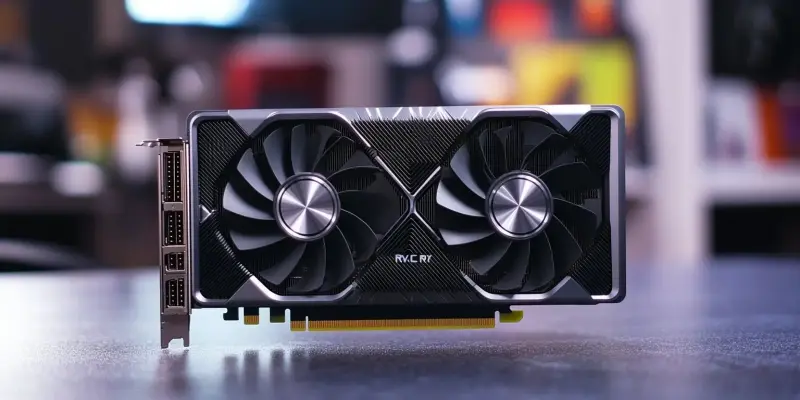
As the competition between tech giants heats up in the realm of AI processing GPUs, Nvidia and AMD have recently engaged in a benchmark battle that has many industry experts and enthusiasts watching closely. The rivalry was sparked when AMD made bold claims about its Radeon RX 7900 XTX outperforming Nvidia’s RTX 4090 and 4080, boasting performance leads of up to 113 percent and 134 percent, respectively. Nvidia swiftly responded with extensive benchmark results positioning their newest flagship, the GeForce RTX 5090, as the superior option, particularly in the intensive task of running AI models. With AI applications rapidly expanding and becoming more central to both professional and consumer usage, the need for powerful GPUs capable of handling complex models is more critical than ever. This article examines Nvidia’s counterclaims, exploring whether the RTX 5090 truly stands as the ultimate GPU for AI model processing.
Nvidia’s Response and Benchmark Results
Nvidia’s riposte to AMD’s assertions was both immediate and thorough, featuring extensive benchmarks related to AI model performance. Specifically, Nvidia’s tests highlighted the capabilities of the RTX 5090 by examining its performance with three versions of the DeepSeek R1 AI model: Distill Qwen 7b, Llama 8b, and Qwen 32b. The results are compelling, showing that Nvidia’s RTX 5090 significantly outpaces AMD’s RX 7900 XTX by margins up to 124 percent when running the Qwen 32b model. With the Llama 8b model, the RTX 5090 exhibited an impressive 106 percent performance lead, while it maintained a 103 percent advantage using the Qwen 7b model. These benchmarks suggest a robust and consistent superiority in handling intricate AI processing tasks.
Interestingly, even Nvidia’s previous generation GPU, the RTX 4090, showcased notable performance advantages over AMD’s current flagship GPU. This points to the inherent strength of Nvidia’s architecture and technology, defining a trend of superior AI processing power. It’s evident from these benchmark results that the RTX 5090 is designed with AI-heavy applications in mind, providing an edge over its competitors. Nvidia’s comprehensive data presentation aims to solidify its position as the leading provider of cutting-edge GPUs for AI model processing, and such consistent outperformance certainly adds weight to their claims.
Technological Advancements and Architectural Benefits
At the core of Nvidia’s argument is the advanced architecture and technologies powering the RTX 50 Series GPUs. The RTX 5090 is equipped with up to 3,352 trillion operations per second of AI processing capability, an impressive stat that underscores its potential. A pivotal feature of the RTX 50 Series is the inclusion of dedicated fifth-generation Tensor Cores. These cores, built on Nvidia’s Blackwell architecture, are specifically designed to enhance the efficiency of running complex AI models on personal computers. This powerful combination ensures that Nvidia’s GPUs not only excel in performance but also maintain low latency, significantly enhancing the user experience.
The advantages of Nvidia’s architectural innovations extend beyond mere performance metrics. One of the key benefits highlighted by Nvidia is the increased privacy afforded by local processing capabilities. By running AI models directly on individual machines, the RTX 5090 minimizes the need for cloud-based computation, thereby reducing latency and enhancing data security. Such features are particularly crucial in sectors where data privacy is paramount, including healthcare and finance. The emphasis on local processing marks a significant shift towards more user-centric AI applications, reinforcing Nvidia’s commitment to delivering cutting-edge technology that meets evolving user needs.
Broader Accessibility and Integration
Another compelling argument in Nvidia’s favor is the broader accessibility of AI capabilities facilitated by its RTX AI platform. Nvidia has extended DeepSeek-R1 functionalities to over 100 million Nvidia RTX AI PCs, including the new GeForce RTX 50 Series GPUs. This wide-ranging compatibility ensures that users across various sectors can leverage the powerful capabilities of Nvidia’s hardware for running AI models. The RTX AI platform’s integration allows diverse applications, from academic research to commercial AI developments, making robust AI processing accessible to a larger audience.
DeepSeek’s family of ‘reasoning models’ is particularly noteworthy, as they are designed to dynamically allocate computing resources to mimic human problem-solving processes. This innovation reflects the growing trend towards more sophisticated and human-like AI functionalities. Nvidia’s RTX 5090, with its enhanced capabilities, appears to be uniquely positioned to handle these demanding applications efficiently. The integration of DeepSeek functionalities into a vast number of PC units indicates Nvidia’s strategic vision of making high-performance AI processing more widely available, thereby influencing the broader technological landscape.
Future Considerations and Industry Impact
Nvidia’s RTX 50 Series GPUs boast advanced architecture and technologies, with the RTX 5090 leading the way. Capable of achieving up to 3,352 trillion operations per second of AI processing power, it demonstrates remarkable potential. A key feature of the RTX 50 Series is its fifth-generation Tensor Cores, built on Nvidia’s Blackwell architecture, enhancing the efficiency of complex AI model processing on personal computers. This powerful setup not only delivers exceptional performance but also ensures low latency, significantly improving the user experience.
Beyond performance, Nvidia’s architectural innovations offer additional benefits. One standout advantage is the increased privacy from local processing capabilities. By running AI models directly on individual machines with the RTX 5090, reliance on cloud-based computation is minimized, thereby reducing latency and bolstering data security. This is crucial for sectors where data privacy is vital, such as healthcare and finance. The focus on local processing represents a significant shift toward user-centric AI applications, reinforcing Nvidia’s commitment to providing cutting-edge technology that adapts to evolving user needs.