

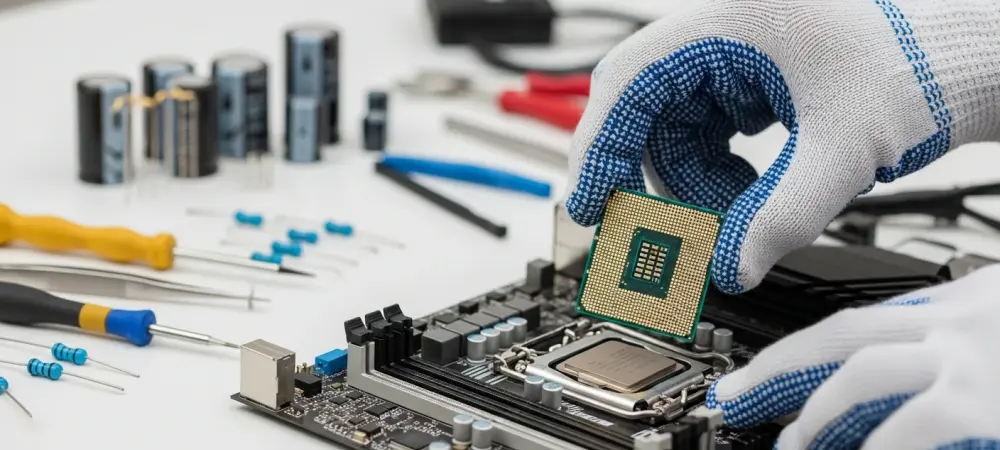
While the halls of CES 2026 buzzed with countless innovations, many enthusiasts left the AMD keynote with a lingering sense of anticipation, noting the conspicuous absence of a new top-tier gaming processor. However, subsequent whispers and subtle hints from company representatives to “stay tuned” have ignited speculation that the company is holding its true trump card close to its chest. The focus of this intense industry chatter is a rumored processor, the Ryzen 9 9950X3D2, a component that promises to redefine performance expectations with a groundbreaking design. Evidence pieced together from partner presentations and even AMD’s own media assets suggests that the next evolution of the Ryzen 9000 “Granite Ridge” series is not only on the roadmap but is poised to introduce a feature never before seen in a consumer desktop CPU: a dual 3D V-Cache configuration. This potential release would represent the pinnacle of the Zen 5 architecture, aimed squarely at the most demanding gamers and content creators who refuse to compromise on performance.
Unpacking the Evidence for a New Flagship
The case for an imminent dual-cache flagship is built upon more than just hopeful speculation, with compelling clues emerging from AMD’s closest partners. During its own CES 2026 showcase, motherboard manufacturer Gigabyte presented a slide that teased its next-generation products, promising “More Cores, Higher Clocks, Greater Potential” for the upcoming “Ryzen 9000X3D” refresh. This statement raised eyebrows, as the officially announced Ryzen 7 9850X3D is an 8-core processor, offering no core count increase over its predecessor. The most logical interpretation is that Gigabyte’s teaser was referencing an unannounced, higher-tier model that fits the description—a model like the rumored Ryzen 9 9950X3D2. Further fueling the fire were images that appeared on AMD’s own press site. Alongside the official assets for the single-CCD Ryzen 7 9850X3D, a photograph of a processor with a dual-CCD (Chiplet Complex Die) layout was spotted, an image that seems far more representative of a 16-core flagship and could be an inadvertent preview of the powerful new chip.
This pattern of a staggered release aligns perfectly with AMD’s established market strategy, lending significant credence to the existence of a more powerful X3D variant. In previous generations, the company often led with its mainstream 8-core X3D model, allowing it to capture the core gaming market before introducing higher-core-count versions to satisfy the enthusiast and prosumer segments. The introduction of a Ryzen 9 9950X3D2 would serve as the ultimate capstone for the “Granite Ridge” desktop lineup, a definitive statement piece designed to secure an unassailable lead in both gaming and multi-threaded application performance. By reserving this flagship, AMD can create a second wave of excitement and media attention, ensuring its Zen 5 platform remains the dominant topic of conversation throughout the year and presenting a formidable challenge to any competing high-end offerings. This strategic delay maximizes market impact and solidifies the Ryzen 9000 series as the undisputed choice for those seeking the absolute peak of desktop computing power.
A Glimpse at the Technical Specifications
The rumored specifications of the Ryzen 9 9950X3D2 paint a picture of a processor that pushes the boundaries of consumer-grade technology. Built on the advanced Zen 5 architecture, it is expected to feature a 16-core, 32-thread configuration, providing immense multi-core strength for demanding creative workloads. However, its truly transformative feature is the implementation of 3D V-Cache on both of its eight-core CCDs. This “Dual 3D V-Cache” design would result in an unprecedented 192 MB of total L3 cache available to the CPU. To put this into perspective, it represents a massive 50% increase over the already substantial 128 MB of L3 cache found in the Ryzen 9 9950X3D, which featured the performance-boosting cache on only one of its two chiplets. This colossal cache pool is designed to dramatically reduce latency and accelerate data access for the CPU cores, promising a significant uplift in gaming frame rates and other latency-sensitive applications that can leverage such a vast and readily available data reservoir.
Such an ambitious dual-cache design necessitates a re-evaluation of the processor’s power and thermal envelope. To adequately supply the 16 cores and the two stacked L3 cache chiplets, the Ryzen 9 9950X3D2 is projected to carry a higher Thermal Design Power (TDP) of 200W. This is a notable increase from the 170W TDP of its predecessors in the Ryzen 9 family, indicating that enthusiasts will need to pair it with robust cooling solutions to unlock its full potential. To operate stably within this new power budget, a slight adjustment to clock speeds is also anticipated. The peak boost frequency is expected to be 5.6 GHz, a minor 100 MHz reduction compared to the 5.7 GHz ceiling of the standard Ryzen 9 9950X and the single-cache 9950X3D. This trade-off is a common engineering practice, balancing raw frequency with the immense performance gains offered by the expanded cache, ensuring that the processor delivers a net increase in real-world application and gaming performance while maintaining system stability.
The Strategic Implications
The body of evidence pointed toward a strategic release window that would maximize the impact of this new flagship processor. Industry analysis suggested that the Ryzen 9 9950X3D2 could have been launched concurrently with, or shortly after, the more mainstream Ryzen 7 9850X3D. This approach would have allowed AMD to cater to two distinct market segments in rapid succession, first satisfying the core gaming audience before unveiling the ultimate performance option for the most discerning enthusiasts. This chip was clearly positioned not just as an incremental upgrade but as the definitive flagship for the entire Ryzen 9000 “Granite Ridge” desktop series. Its introduction was seen as AMD’s decisive move to cement its leadership in the high-performance computing space, offering a product with no direct equivalent and setting a new, formidable benchmark for both gaming prowess and multi-core application throughput that would define the state of the art for the foreseeable future.