

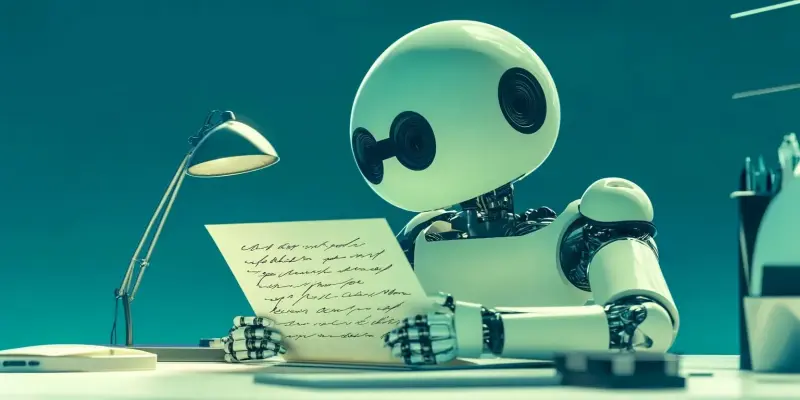
The landscape of literature is undergoing a seismic shift, thanks to advancements in artificial intelligence (AI). Specifically, ChatGPT, a generative AI developed by OpenAI, is making remarkable progress in the field of creative writing. This article delves into how AI is poised to redefine what we understand as literature and the implications it holds for human writers. From its early stages of mere mimicry to its current potential for crafting emotionally resonant narratives, AI is gradually transforming the very essence of storytelling, challenging the boundaries of human creativity and redefining the future of literary arts.
Mimicry versus Creativity
One of the central discussions in AI’s foray into creative writing is its ability to emulate human writing. Although AI primarily functions on mimicry, its output is becoming increasingly indistinguishable from human-created content. The fine line between imitation and actual creativity is being blurred as AI’s training in generating content evolves. Despite this, there are inherent limitations within AI’s capabilities. AI-generated writing still often comes across as flat and uninspiring, lacking the nuanced emotional depth and vivid imagery that human authors like Shakespeare achieve. This distinction highlights the current boundaries of its creative abilities and the challenges that lie ahead for AI as it seeks to master the art of storytelling.
The rapid progression of AI in producing creative content necessitates a critical evaluation of what constitutes originality and creativity. While AI can mimic styles and patterns from its training data, it still struggles to innovate or bring unique perspectives in the way human authors do. Consequently, while AI’s writing may be plausible and well-structured, it often lacks the distinct voice and authenticity found in works crafted by seasoned writers. This ongoing evolution presents a fascinating juxtaposition: as the capabilities of AI continue to grow, the essence of creativity and originality remains a uniquely human trait, for now.
Personal Insight and AI’s Progress
The narrative grows intriguing with personal insights from technology journalist Lance Ulanoff. He recounts the first instance where an AI-generated piece genuinely impressed him with its quality, marking a pivotal moment in his perception of AI’s potential. This change correlates with OpenAI CEO Sam Altman’s announcement of a new AI model excelling in creative writing. Ulanoff’s growing admiration for AI’s capabilities reflects a broader shift in understanding the role of AI in the creative domain, as technological advancements allow machines to produce writing that resonates with human readers on an emotional level.
Ulanoff’s experiences serve as a testament to AI’s noticeable progress. What was once considered impossible now seems achievable as AI continues to hone its ability to craft engaging and emotionally resonant stories. These advancements signify more than just technical improvements; they represent a fundamental shift in how technology can intersect with and enhance creative pursuits. As AI models become more sophisticated, their potential for contributing to literature becomes increasingly apparent, prompting both excitement and apprehension among human writers and readers about what the future holds.
AI’s Attempt at Metafiction
A standout example of AI’s growing prowess is its attempt at metafiction—a challenging genre where the narrative self-referentially addresses itself as a construct. Given a brief yet complex prompt about AI and grief, ChatGPT produced a compelling short story featuring characters Mila and Kai. The effectiveness with which the AI navigated through intricate themes and emotions astounded Ulanoff, highlighting the significant strides AI is making towards mastering creative genres that require a sophisticated understanding of narrative techniques. The ability to craft a metafictional narrative showcases AI’s evolving complexity in handling layered storytelling and abstract concepts.
This example underscores the substantial progress AI has made in understanding and replicating human-like narrative structures. The fact that an AI can effectively engage with metafiction, a genre deeply rooted in self-awareness and introspection, is a testament to its expanding creative capabilities. By navigating complex themes such as grief with nuance and sensitivity, AI not only demonstrates its technical proficiency but also its potential to contribute meaningfully to various literary forms. These developments signal a promising yet uncertain future for AI in literature, where the boundaries of creativity and technology continue to blur.
Emotional Resonance and Literary Quality
A key highlight from the AI-generated story is a passage that showcases its literary quality. Narrating as itself, the AI weaves a tale that encapsulates themes of loss and memory with poignant eloquence, akin to human-authored fiction. This ability to evoke genuine emotional responses is a significant leap for AI in creative writing. Such breakthroughs suggest that AI can not only mimic but also potentially revolutionize how stories are told and experienced. As these models continue to improve, the gap between AI-generated and human-authored content is steadily narrowing, fostering a new realm of possibilities within creative expressions.
The depth and literary quality achieved by AI in this narrative challenge preconceived notions about the limits of machine-generated content. Evoking emotional resonance through storytelling is a complex task, often considered a hallmark of human creativity. Therefore, AI’s success in this area not only highlights its advanced capabilities but also raises thought-provoking questions about the future role of technology in art and literature. The potential for AI to produce works that touch readers emotionally opens up intriguing possibilities for the evolution of storytelling, suggesting a future where human and machine creativity might coexist and complement each other.
Potential Impact on Human Writers
As AI continues to evolve, it could democratize literature by making high-quality writing more accessible, while also prompting human writers to push their creative boundaries further.