

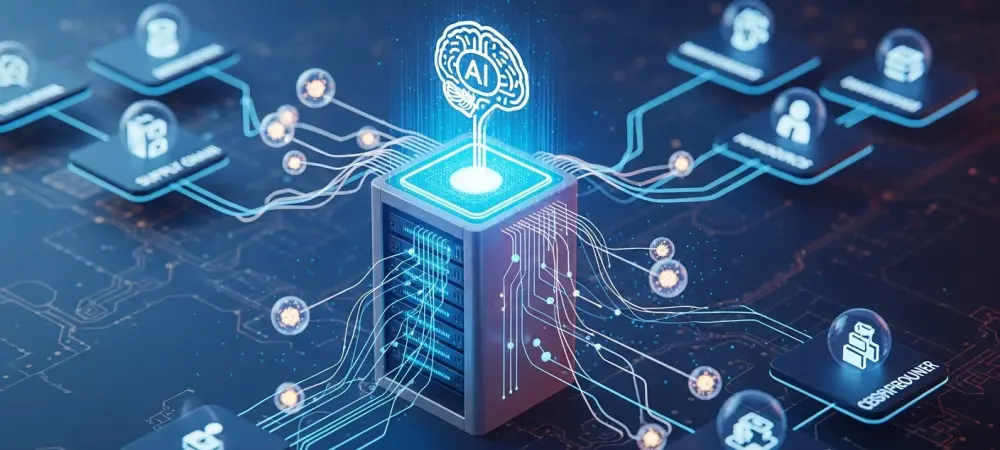
The modern manufacturing floor often operates under a cloud of invisible friction where the digital record of a factory rarely matches the physical reality of its production lines. For decades, Enterprise Resource Planning systems have served as the undisputed source of truth, yet they remain fundamentally reactive, documenting historical transactions while failing to anticipate the cascading effects of a sudden supply chain disruption or a localized equipment failure. As industrial complexity scales beyond the reach of manual oversight, the traditional ERP model is undergoing a radical metamorphosis. Instead of acting as a passive digital filing cabinet, these systems are integrating advanced reasoning layers to bridge the gap between data collection and strategic execution. This evolution does not seek to replace the core transactional integrity of the ERP but rather to augment it with a probabilistic intelligence that can navigate the nuances of high-stakes industrial operations in real time.
Bridging the Gap Between Deterministic Logic and Probabilistic Reality
Traditional ERP architectures are built upon a foundation of deterministic control, enforcing rigid business rules to ensure financial accuracy and regulatory compliance. These systems are exceptional at maintaining an auditable state of inventory balances and production schedules, yet they are inherently limited by their inability to handle the variability of the physical world. When a shipment arrives late or a machine malfunctions, the ERP simply records the deviation as a failed state without understanding the underlying cause or the potential remedies. This creates a reliance on human intervention to interpret the data and manually adjust the system to reflect new realities. The infusion of artificial intelligence introduces a probabilistic reasoning layer that thrives in these environments of uncertainty, allowing the system to weigh multiple outcomes and suggest the most likely path forward based on historical patterns and real-time environmental signals.
By separating the deterministic execution core from the reasoning layer, manufacturers can maintain the integrity of their financial records while gaining a more fluid operational capability. This duality allows the ERP to remain the final arbiter of truth—the system that confirms “what” happened—while the AI component provides the “why” and the “how” for future actions. For instance, while a standard system might flag a production delay, the integrated AI can analyze sensor data from the shop floor and correlate it with historical maintenance logs to determine that a specific motor is showing signs of imminent failure. This synthesis of rigid transactional data with flexible analytical insights transforms the enterprise software from a static reporting tool into an active participant in the manufacturing process, capable of identifying subtle inefficiencies that would otherwise remain hidden within the massive volumes of raw operational data generated daily.
Solving the Why Gap Through Contextual Data Synthesis
A significant challenge in modern enterprise management is the persistent “why gap,” where managers can see that a specific key performance indicator is trending downward but cannot pinpoint the specific operational choices that led to the decline. An ERP might show that a particular job resulted in lower-than-expected margins, but it cannot automatically trace the root cause through a complex chain of events like forecast instability causing schedule compression, which then forced the use of expensive expedited freight. AI-driven systems address this by synthesizing information across disparate modules—from procurement and logistics to shop-floor execution—to create a transparent operational narrative. This capability allows the system to move beyond simple data aggregation to offer genuine diagnostic insights, explaining the interconnected variables that influence the bottom line across different time horizons and business departments.
The ability to synthesize these diverse data streams enables a transition from reactive troubleshooting to a proactive model of operational excellence. Instead of spending hours in cross-departmental meetings trying to reconcile conflicting reports, teams can rely on an intelligence layer that has already mapped the dependencies between a delay in the warehouse and a bottleneck in final assembly. This level of transparency is particularly vital in environments where high-mix, low-volume production is the norm, as the frequency of changeovers and material substitutions increases the likelihood of human error. By providing a clear, evidence-based explanation for operational anomalies, the system empowers decision-makers to focus on high-level strategy rather than getting bogged down in the minutiae of data forensic investigations, ultimately shortening the time between the detection of a problem and its resolution.
The Rise of Cognitive ERP and Closed-Loop Execution
The concept of “cognitive ERP” represents a fundamental shift toward a closed-loop operational system where the software is capable of detecting signals, diagnosing problems, and executing corrective actions autonomously. In this advanced model, the ERP functions as the nervous system of the organization, sensing risks such as rising inventory volatility or shifting supplier lead times. Once a risk is identified, the integrated AI analyzes the probable causes and proposes specific transactions, such as reallocating materials or rescheduling production runs, within the predefined constraints of the business. This creates a dynamic environment where the system not only monitors outcomes but also refines its internal logic based on the success of past interventions. This autonomous loop reduces the cognitive load on human operators while ensuring that the enterprise remains agile in the face of rapid market fluctuations.
This evolution into a dynamic system of execution means that human governance shifts from manual data entry to the oversight of automated logic. Instead of approving every individual purchase order or schedule change, managers define the guardrails within which the cognitive ERP operates, such as maximum acceptable lead times or minimum margin thresholds. The system then manages the vast majority of routine exceptions, escalating only the most complex or high-risk decisions to human experts. This shift allows the organization to scale its operations without a linear increase in administrative overhead. As the system continues to learn from its own execution history, it becomes increasingly adept at navigating the specific idiosyncrasies of the company’s supply chain and production environment, transforming the ERP from a generic software package into a customized competitive advantage that evolves alongside the business.
Strategic Directions for Implementing Intelligent Execution Systems
Organizations looking to capitalize on this technological shift must prioritize the modernization of their data infrastructure to ensure that the AI layer has access to high-quality, real-time information. The transition to a dynamic system of execution is not a one-time software upgrade but a strategic realignment that requires breaking down data silos and establishing a unified data architecture across all business units. Leadership should focus on pilot programs that target specific high-friction areas, such as predictive maintenance or demand forecasting, to demonstrate immediate value before scaling the solution across the entire enterprise. Furthermore, investing in workforce upskilling is essential, as the role of the employee will shift from being a data processor to a strategic orchestrator who manages the outcomes generated by the autonomous system, requiring a deeper understanding of both the business domain and the underlying AI logic.
As the industrial landscape becomes increasingly volatile from 2026 to 2030, the ability to act on insights with speed and precision will distinguish the market leaders from the laggards. The next step for manufacturers is to move beyond the traditional “rip and replace” mentality regarding legacy ERP systems and instead focus on integrating intelligent reasoning layers that can extract new value from existing data assets. By fostering a culture of data-driven decision-making and embracing the transition toward cognitive automation, companies can build a more resilient and responsive operation. The focus should remain on creating a system where human intuition and machine intelligence work in tandem to navigate complexity. Ultimately, the successful implementation of an execution-focused ERP will provide the agility needed to thrive in an era where the only constant is change, ensuring that the digital core of the business is as dynamic as the market it serves.