

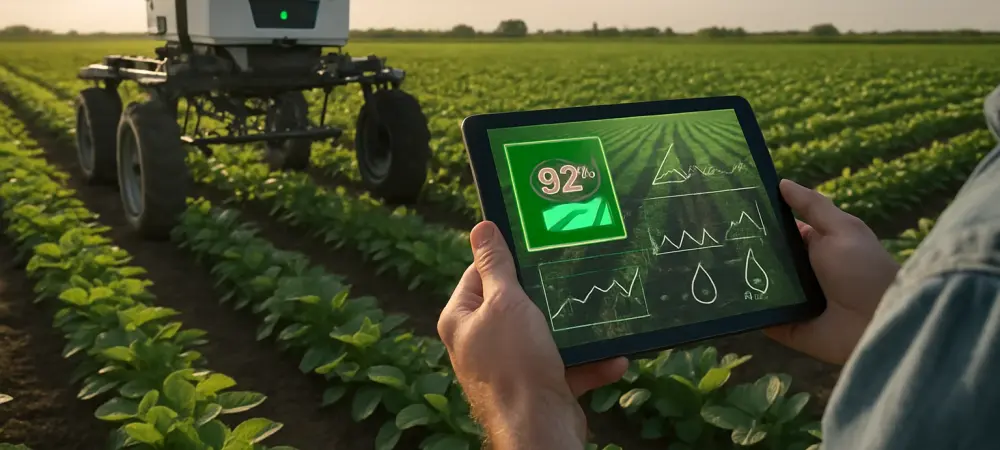
What if the secret to feeding billions while saving the planet lies not in sprawling new farmlands, but in the quiet hum of data and algorithms? Picture a farmer in a remote field, not toiling with guesswork, but consulting a tablet that predicts the exact moment to plant or irrigate, down to the drop. Artificial Intelligence (AI) is no longer a distant dream for agriculture—it’s here, transforming dusty plots into hubs of precision and efficiency. This technological leap promises to tackle some of humanity’s biggest challenges, from hunger to environmental strain, right now in 2025.
The Urgency of AI in Farming Today
The stakes for agriculture have never been higher. With a global population inching toward 10 billion by 2050, and climate change throwing unpredictable weather at every harvest, the demand for food is outpacing what traditional methods can supply. AI steps in as a critical tool, not just a luxury, to bridge this gap. It offers solutions to cut waste, boost yields, and adapt to a warming world, making it essential for food security and planetary health. This isn’t about gadgets for show—it’s about ensuring survival for generations ahead.
The scale of the challenge demands innovation at every level. Conventional farming often drains resources like water and soil nutrients faster than they can replenish, while labor shortages add another layer of strain. AI’s ability to analyze vast datasets and deliver real-time insights provides a lifeline, turning inefficiencies into opportunities. The significance of this shift lies in its potential to redefine how food is grown, making every acre count in a resource-scarce era.
A New Era of Farming Unfolds
AI marks the dawn of a transformative period in agriculture, where technology replaces guesswork with precision. Tools like satellite imagery and sensors now monitor fields with uncanny accuracy, telling farmers exactly when and where to act. This shift means crops get just the right amount of care, slashing overuse of water or chemicals. Studies reveal that such precision can increase yields by up to 20%, proving that smarter farming is already paying off.
Beyond individual farms, this era signals a broader rethinking of agricultural systems. AI-driven insights help not just with day-to-day tasks but also with long-term planning, such as choosing resilient crop varieties for changing climates. The result is a landscape where technology and nature work hand in hand, minimizing harm while maximizing output. This harmony sets the stage for a future where farming isn’t a gamble but a calculated science.
How AI Reshapes Every Aspect of Cultivation
AI’s impact on agriculture spans a wide array of applications, each targeting specific hurdles with tailored solutions. Precision farming, for instance, uses real-time data to map out soil health and crop needs, ensuring resources are applied only where necessary. This method has cut water usage by as much as 30% on equipped farms, showing tangible gains in both cost and conservation.
Smart crop management takes this further by deploying drones and image recognition to spot diseases or weeds before they spiral out of control. These systems often detect issues days before human inspection would, saving entire harvests from ruin. On sprawling operations, this technology replaces hours of manual checks, reducing pesticide reliance and preserving crop quality with surgical accuracy.
Then there’s predictive analytics, a tool that crunches historical weather and market data to forecast yields and optimal planting windows. Farmers in volatile regions have used these insights to sidestep drought losses, adjusting schedules based on AI alerts. Automation, too, plays a starring role—self-driving tractors and robotic harvesters address labor gaps, speeding up tasks while maintaining consistency. Farms adopting these machines report scalability that keeps pace with demand, no extra hands needed.
Stories from the Ground: AI in Action
Hearing directly from those in the field brings AI’s promise into sharp focus. Dr. Emily Harper, an agritech specialist, emphasizes the broader vision: “AI isn’t just about bigger harvests—it’s about rewriting the rules to grow sustainably.” Her perspective highlights how data-driven tools are shifting mindsets, not just methods, across the industry.
A farmer from Iowa shared a personal win, illustrating the practical edge of this tech. “Last season, an AI forecast flagged a frost risk early. I shifted my harvest timeline and saved 80% of my yield,” he recounted. Such firsthand accounts, paired with data showing robotic systems boosting efficiency by 25% on test farms, paint a picture of change that’s both immediate and measurable. These voices confirm that AI isn’t a distant theory—it’s solving real problems today.
In another case, a cooperative in California adopted drone-based monitoring to tackle pest outbreaks. The system identified infested patches within hours, allowing targeted treatment that cut chemical use by half. These stories, grounded in results, reveal a quiet revolution taking root, where technology empowers farmers to act with confidence and care.
Steps for Farmers to Join the AI Movement
Embracing AI doesn’t require a complete overhaul of traditional practices—it can start small and scale with time. One approachable step is investing in basic sensors for soil and moisture tracking, testing precision methods on a single plot. Many agricultural extensions provide resources and advice on affordable tools, easing the entry point for hesitant adopters.
Another practical move is tapping into free AI-powered platforms for weather and market predictions. These tools, often accessible online, guide decisions on planting or pricing without any initial cost. Partnering with agritech firms for trial runs of drones or robotics also offers a low-risk way to explore automation, with many programs subsidizing early use to build trust in the tech.
Training remains a key piece of the puzzle. Workshops and digital courses on AI applications help farmers gain comfort with data-driven approaches, ensuring seamless integration into daily routines. These steps, adaptable to any budget or farm size, make AI a viable partner in navigating the complexities of modern agriculture, turning potential into progress one field at a time.
Reflecting on a Tech-Driven Harvest
Looking back, the journey of AI in agriculture stands as a testament to human ingenuity, blending data with dirt to forge a path of resilience. Farmers who adopted predictive tools have dodged devastating losses, while those using automation have redefined efficiency in their operations. The numbers speak loudly—water use has dropped significantly, and yields have climbed, proving that technology can indeed nurture sustainability.
The road ahead calls for broader access to these tools, ensuring small-scale growers aren’t left behind in this digital shift. Governments and industries have started to fund training and subsidies, a nod to the need for inclusive growth. Reflecting on this era, the challenge becomes clear: scale up adoption while keeping equity in focus, so every farm can tap into AI’s potential.
Ultimately, the story of AI in farming urges a collective push toward integration and innovation. Stakeholders must prioritize partnerships that bring tech to remote fields, while farmers need platforms to share successes and setbacks. This shared effort promises to cultivate not just crops, but a future where agriculture thrives in balance with the earth.