

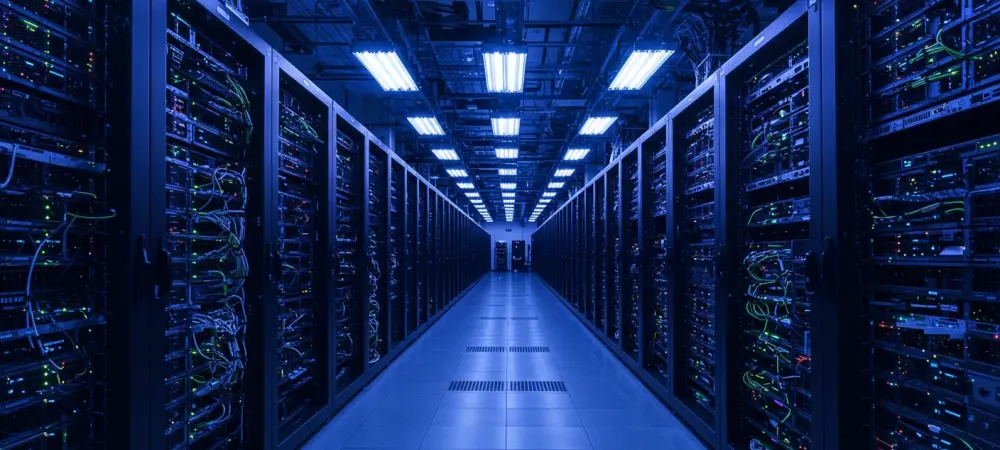
The continuing evolution of artificial intelligence (AI) has profoundly affected global technology infrastructure, particularly in the data center sector, with AI demanding exponentially increasing bandwidth capacities. Between 2020 and 2024, data center bandwidth purchases catapulted by approximately 330%, illustrating an immense shift in network demands. Hyperscale data centers, operated by telecom carriers and key AI players, accounted for a substantial portion of this growth, contributing to 62% of all bandwidth acquisitions in 2024. This expansion in bandwidth requirements was detailed in a Bandwidth Report from Zayo, which highlighted the purchasing activities of more than 1,800 customers and surveyed insights from enterprise decision-makers. These figures indicate a robust shift in the market landscape, driven by the need for enhanced connectivity to support AI’s advanced computations, which require both increased capacity and lower latency.
Hyperscalers Redefine Network Infrastructures
Hyperscalers—major cloud providers and internet companies—play a central role in reshaping the data center bandwidth landscape. They accounted for 57% of Zayo’s metro dark fiber installations from 2020 to 2024 and were responsible for 41% of the significant bandwidth transactions exceeding one terabit. During this period, total bandwidth acquisitions surged, reaching 42.4 terabits—a 133% increase. Metro dark fiber, pertaining to unlit optical fiber infrastructure within urban settings, saw demand soar by 268% between 2023 and 2024, reflecting hyperscalers’ strategic shift towards owning and controlling network resources. This shift enables them to manage scale, latency, and costs more efficiently, favoring rapid expansions without relying on third-party provisioning timelines. Their pursuit of tailored network topologies aligns closely with AI-driven computational needs, facilitating the establishment of redundant and fault-tolerant pathways connecting AI training nodes. This trend signifies a transition toward more vertically integrated network architectures, geared to accommodate AI’s expansive and rapidly evolving computational requirements.
AI as a Catalyst for Networking Demand
The continuous advancements in AI development have steadily influenced the networking trends observed in data centers, acting as a primary catalyst for increased bandwidth demand. As AI workloads expand, they impose extensive requirements on network infrastructures, necessitating substantial bandwidth for managing both inference and training tasks. In 2024, Zayo recorded over $1 billion in long-haul network transactions associated with AI, alongside an additional $3 billion in processes yet to be finalized. AI’s intensive resource needs are fundamentally reshaping network topologies, requiring high-capacity routes that serve established and emerging data center markets alike. The challenge lies not only in bandwidth but also in power consumption and site selection, as operators seek locations with adequate electricity to support such high-demand AI workloads. As existing locations suffer from power constraints, operators are exploring secondary markets and investing in custom electrical infrastructures to maintain growth.
Geographical Shifts and Connectivity Challenges
The shifting geographical dynamics in the data center domain reflect the sweeping demand exerted by AI workloads, which challenge traditional bandwidth capacities. Minimized electrical infrastructure in traditional metropolitan areas has compelled companies to seek new regions with surplus electricity and ample space. These potential areas, though often geographically remote, demand effective interconnections, underscoring connectivity as a vital element for the burgeoning AI infrastructure framework. The explosion of demand in locales such as Memphis, Tennessee, exemplifies this shift, with long-haul and metro bandwidth skyrocketing from 0.3 terabits in 2023 to 13.2 terabits in 2024—a staggering 4,300% increase. Salt Lake City exhibited similar growth, with demand climbing by 348%. Visionary hyperscalers are drawn to these locations due to their favorable land and power costs, further intensifying connectivity challenges and redefining traditional data center geographies.
Future Implications and Industry Adaptations
Hyperscalers, key cloud and internet entities, have been pivotal in redefining the bandwidth dynamics of data centers. These major players contributed to 57% of Zayo’s metro dark fiber setups from 2020 to 2024 and were linked to 41% of high-volume bandwidth deals exceeding one terabit. Over these years, bandwidth acquisitions skyrocketed, reaching 42.4 terabits—a substantial rise by 133%. Demand for metro dark fiber, which refers to unused optical fiber networks in urban locales, jumped by 268% from 2023 to 2024. This mirrors hyperscalers’ strategy to directly own network assets, thereby enhancing their ability to manage scales, reduce latency, and cut costs, all while facilitating quick expansions without third-party delays. Their endeavors align with AI needs, creating sturdy network pathways vital for AI node interconnections. This reflects a movement towards vertically integrated network systems, crafted to support AI’s rapid computational growth, indicating a shift to robust, highly adaptive architectures.