

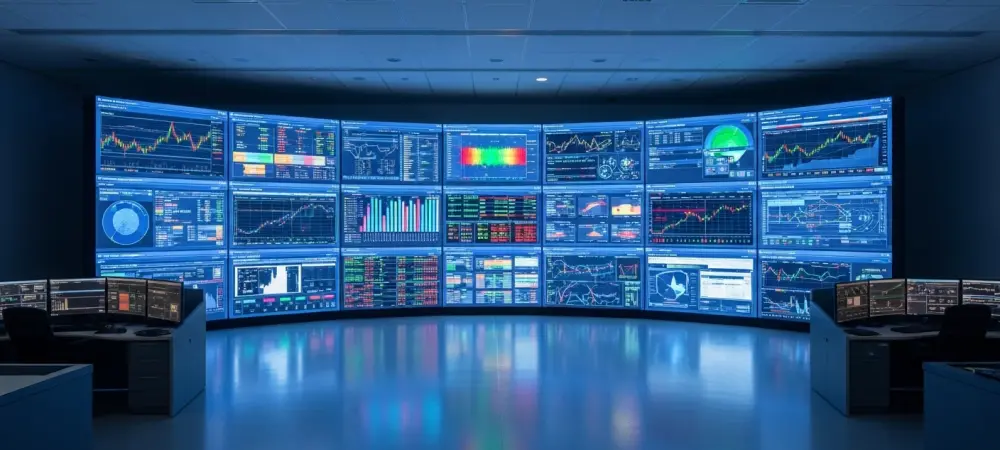
The unrelenting deluge of real-time financial data has fundamentally transformed the landscape of trading, rendering purely manual analysis a relic of a bygone era for those seeking a competitive edge. AI-Powered Trading Tools represent the next significant advancement in financial technology, leveraging machine learning and advanced algorithms to sift through market complexity. This review explores the evolution of this technology, its key features, the performance of leading platforms, and its profound impact on trading strategies, offering a thorough understanding of its current capabilities and future potential.
The Rise of AI in Financial Markets
The integration of artificial intelligence into trading is a direct response to the escalating volume and velocity of market information. At its core, AI-powered trading employs machine learning models to analyze vast datasets, identify subtle patterns, and forecast potential price movements with a speed and accuracy that surpasses human capacity. These systems are not merely executing pre-programmed commands; they are designed to learn from new data, adapt to changing market conditions, and refine their own logic over time.
This technological shift was prompted by the clear limitations of traditional methods. As markets became more interconnected and data streams multiplied, the ability for an individual to process all relevant information became impossible. AI emerged as a necessary tool to manage this complexity, transforming raw data into actionable insights and empowering traders to make more informed, data-driven decisions without being overwhelmed.
A Review of Top Tier AI Trading Platforms
The market for AI trading tools has matured into a diverse ecosystem, with platforms designed to serve different functions and user profiles. From sophisticated market scanners to fully automated execution bots, these tools are reshaping how traders approach analysis and strategy deployment.
Advanced Analysis and Signal Generation
Platforms in this category specialize in dissecting market data to find high-probability opportunities. Trade Ideas, for instance, uses a powerful AI engine to run millions of backtests overnight, identifying statistical patterns and momentum trends that often go unnoticed. It presents traders with a curated list of potential trades, effectively acting as a tireless research assistant that pinpoints actionable breakout and trend-following scenarios.
Similarly, TrendSpider automates the time-consuming process of technical analysis. Its algorithms can instantly draw trendlines, detect classic chart patterns like head-and-shoulders or triangles, and perform multi-timeframe analysis to confirm signals. By generating automated advisories on potential support, resistance, and breakout levels, it frees traders to focus on strategy and risk management rather than manual chart markup.
Automated Strategy and Execution
For traders seeking to automate the entire workflow, a different class of platforms has emerged. Tools like 3Commas NextGen and Pionex Ultra utilize intelligent bots that can dynamically adjust their strategies based on market volatility. These platforms offer sophisticated DCA (Dollar-Cost Averaging) and grid trading bots that autonomously execute trades based on price movements, making automated trading accessible without requiring any coding knowledge.
Meanwhile, Cryptohopper AI Pro empowers users to become strategy architects through an intuitive, no-code interface. Its drag-and-drop builder allows traders to construct and optimize their own AI-driven strategies, providing granular control over risk parameters and logical flows. This level of customization bridges the gap between pre-built bots and complex algorithmic trading, offering a powerful tool for advanced users.
Key Trends Shaping the AI Trading Landscape
A dominant trend in the AI trading space is the end-to-end integration of artificial intelligence across the entire trading workflow. It is no longer confined to a single function like signal generation; instead, AI is being woven into charting, forecasting, risk assessment, and automated execution. This holistic approach creates a more cohesive and intelligent trading environment where each stage informs the next.
Moreover, these powerful tools are becoming increasingly accessible. What was once the exclusive domain of institutional hedge funds is now available to retail traders through user-friendly interfaces and subscription-based models. This democratization is leveling the playing field, allowing a broader spectrum of market participants to leverage sophisticated analytics and automation.
Practical Applications Across Diverse Markets
The utility of AI trading tools extends across nearly all financial markets, including stocks, cryptocurrencies, forex, and commodities. Their algorithmic nature makes them highly adaptable to the unique characteristics and data structures of different asset classes. Whether analyzing the volatility of a cryptocurrency or the trend of a major stock index, the underlying AI can be trained to identify relevant patterns.
This versatility also applies to the user base. For beginners, AI platforms offer automated guidance and simplified interfaces that lower the barrier to entry for systematic trading. In contrast, seasoned professionals and quantitative traders can leverage the same platforms for deep customization, extensive backtesting, and the development of highly specific algorithmic strategies tailored to their unique market perspectives.
Addressing Inherent Challenges and Risks
Despite their sophistication, it is crucial to recognize that AI trading tools are powerful aids, not infallible oracles. The technology faces inherent challenges, including the risk of overfitting to past data and the potential for unexpected behavior during unprecedented market events, often referred to as “black swan” events. These systems do not eliminate risk but rather help manage it more systematically. Consequently, human oversight remains an indispensable component of AI-assisted trading. The ultimate responsibility for setting strategic objectives, defining risk tolerance, and intervening when necessary rests with the trader. A successful implementation of AI involves a partnership where the technology handles the computational heavy lifting, while the human provides the critical thinking and strategic direction.
The Future Trajectory of AI in Trading
Looking ahead, AI trading tools are poised to become standard components of every serious trader’s arsenal. Their evolution will likely focus on more advanced predictive analytics, greater personalization, and deeper integration with diverse data sources, including sentiment analysis from news and social media. The technology will continue to transform the industry by making data-driven decision-making the norm.
The relationship between human and machine will also continue to mature. Rather than replacing traders, AI will augment their abilities, freeing them from repetitive analytical tasks to concentrate on higher-level strategic planning and capitalizing on uniquely human insights like intuition and contextual understanding of geopolitical events.
Final Verdict: A Necessary Evolution in Trading
This review has demonstrated that AI-powered trading tools are no longer a niche technology but a fundamental evolution in how market participants interact with financial data. They have proven their capacity to process immense complexity and distill it into actionable intelligence, providing a decisive advantage in fast-paced markets. Their role in automating analysis and execution has become indispensable for traders seeking efficiency and precision. Ultimately, the analysis confirmed that these platforms are most effective when wielded with a clear strategy and a disciplined approach to risk management. While they have revolutionized the industry by democratizing access to institutional-grade analytics, their success is ultimately dependent on the skill of the trader who directs them. They are not a shortcut to profits but a powerful instrument for enhancing a well-conceived trading plan.