

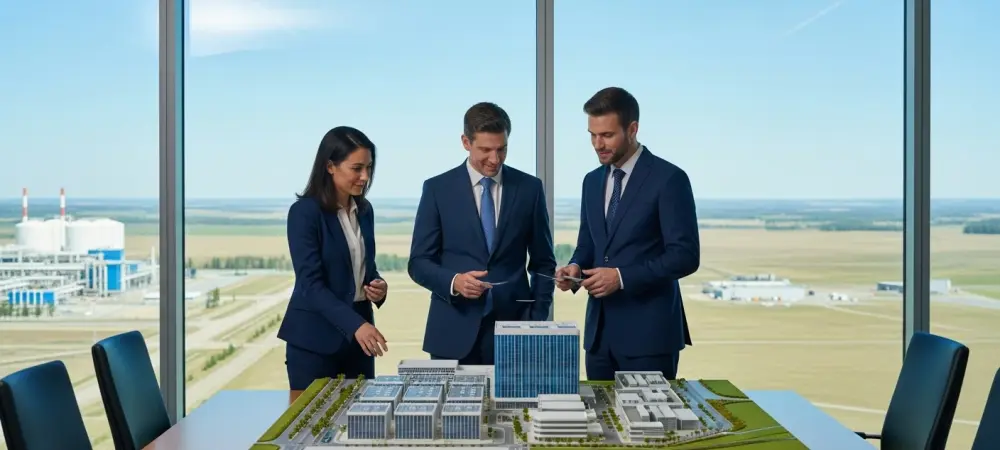
In a bold move that underscores the immense energy appetite of the artificial intelligence revolution, a consortium of European companies is preparing to harness Alberta’s vast natural gas reserves to power a colossal new digital infrastructure project. This initiative signals a strategic convergence of traditional energy resources with the future of high-performance computing, positioning the Canadian province as an unexpected frontrunner in the global race for AI dominance. The plan, if fully realized, would not only reshape Alberta’s economic landscape but also offer a new blueprint for how the world’s insatiable demand for data processing can be met.
A New Energy-Tech Nexus The Scope of Albertas Ambitious AI Play
The groundbreaking partnership between Swiss-based Alcral AG’s Data District and Technologies New Energy Plc (TNE) outlines a vision of unprecedented scale. The firms are targeting a potential $9.4 billion investment to establish a 1-gigawatt AI computing hub, a facility vast enough to handle some of the world’s most intensive computing tasks. This project represents one of the most significant technology investments in the province’s history, promising to create a powerful new nexus between energy production and digital innovation.
This ambitious venture landed in Alberta after a strategic selection process that saw the Canadian province win out over Texas. According to company leadership, Alberta’s vast, cost-effective natural gas reserves, combined with a business-friendly climate, provided a compelling advantage. The project is therefore not just a local development but a critical move on the global chessboard of AI infrastructure, cementing Canada’s role as a key destination for technology investment driven by energy security.
Analyzing the Market The Forces Fueling a Gas-Powered Digital Future
The Unrelenting Demand for AI and the Global Search for Power
The digital world is currently experiencing an exponential surge in demand for AI and high-performance computing, which in turn is creating an insatiable need for energy-intensive data centers. This relentless growth has triggered a strategic shift in development, with companies now prioritizing locations that offer abundant, reliable, and cost-effective power sources over all else. The search for energy is now the primary driver of data center geography.
Consequently, European firms are increasingly looking to North America to build out the next generation of computing capacity. Faced with energy constraints and higher costs at home, these companies see regions like Alberta as essential to meeting surging global demand. The province’s energy profile provides the scale and economic viability necessary for projects that would be difficult to execute elsewhere.
Projecting Albertas Rise as a North American Tech Powerhouse
The development is planned to unfold in phases, beginning with a substantial €780 million investment in the town of Olds. This initial stage is already financed by Alcral and a UK-based firm, with notable interest from Asian sovereign investors signaling strong international confidence in the project’s potential. This measured approach allows the developers to build momentum and prove the concept before committing to the full gigawatt vision.
Despite not having pre-sold any of its future capacity, company leadership remains highly confident, citing the overwhelming market demand for computing power. The value of a 1-gigawatt data center extends far beyond its physical infrastructure; it has the potential to act as a powerful anchor, attracting a broader ecosystem of software companies, AI startups, and related technology services to the region, transforming Alberta into a legitimate North American tech powerhouse.
Navigating the Complexities Hurdles on the Path to a Digital Oasis
The most significant market challenge facing the project is the need to secure anchor tenants and long-term clients. Building a data center of this magnitude on a speculative basis is a high-stakes gamble; its success hinges on attracting major technology companies willing to make substantial commitments to unproven infrastructure in a new market. Without these key clients, the project’s financial viability remains an open question.
Furthermore, the project’s energy model introduces unique financial and public perception risks. While the plan to self-generate 80% of its power from natural gas provides independence, its 20% reliance on the provincial grid could expose it to a proposed hardware tax. At the same time, building a major technology hub powered primarily by a fossil fuel, even a relatively clean one, presents an environmental narrative that could face scrutiny in an era of accelerating energy transition.
The Regulatory Green Light How Policy is Shaping Albertas Tech Trajectory
A pivotal memorandum of understanding between Alberta’s provincial government and Canada’s federal government has created a uniquely favorable regulatory landscape for this project. This political agreement represents a significant de-risking factor for the European investors, providing the policy certainty needed for such a long-term, capital-intensive undertaking.
The agreement involves a crucial trade-off: the federal government agreed to relax its clean electricity regulations for the province in exchange for Alberta implementing a higher industrial carbon price. Critically, this deal explicitly includes federal support for data center construction. This alignment between provincial and federal policy clears a direct path for the gas-powered AI hub, demonstrating how political cooperation can directly enable and attract massive foreign investment in technology infrastructure.
The Future Unleashed What This Project Means for Energy and Technology
If successful, this AI hub could establish a powerful new model for integrating traditional energy resources with next-generation technology industries. It represents a pragmatic approach to powering the digital future, leveraging existing energy strengths to build new economic pillars. This project could prove that fossil fuel economies can pivot to become leaders in the technology sector by capitalizing on their core assets.
For Alberta, the implications are profound. The project offers a tangible path toward diversifying its economy away from a singular reliance on energy exports. By establishing itself as a key player in the digital infrastructure landscape, the province could attract a new wave of talent, including software developers and AI researchers, and spur the growth of a self-sustaining technology ecosystem that attracts further international investment for decades to come.
A Bold Blueprint for the Future Final Verdict on a High-Stakes Venture
The project’s core strategy represented a calculated bet that Alberta’s cheap, abundant natural gas could provide a decisive competitive edge in the global AI arms race. It was built on the premise that in the frantic search for computing power, energy availability would ultimately trump other considerations, making the province an ideal destination for the world’s most demanding digital workloads.
Ultimately, the report’s findings painted a picture of immense opportunity balanced against significant market and environmental risks. The venture’s success depended on the delicate interplay of client acquisition, the stability of a newly forged political agreement, and the project’s ability to navigate complex public perceptions. The outcome of this high-stakes venture was poised to define not only Alberta’s economic future but also a potential new chapter in the relationship between energy and technology.