

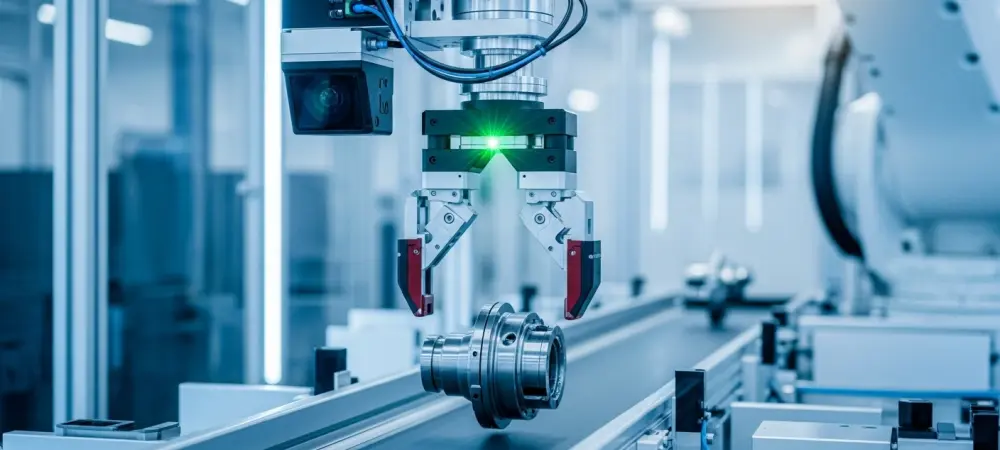
Industrial landscapes are no longer defined by rigid, blind machines bolted to factory floors; they have evolved into ecosystems where robots navigate with the fluid precision of living creatures. Historically, the manufacturing sector relied on pre-programmed automatons that followed a narrow set of coordinates without any awareness of their surroundings. This lack of situational context meant that even a minor misalignment could halt an entire production line, necessitating expensive physical fixtures to keep parts perfectly positioned. Today, the integration of artificial intelligence with sophisticated vision systems has shattered these limitations, transitioning machines from blind tools into perceptive agents. This transformation is driven by the need for flexibility in global supply chains, where the ability to adapt to variability is a major competitive advantage. By leveraging advanced algorithms, modern robotic systems now interpret visual data in real time, allowing them to solve complex spatial problems independently.
The Foundation of Robotic Sight
Hardware Integration and Processing Speeds
The physical layer of robotic sight is built upon an increasingly diverse array of high-fidelity sensors that capture the nuances of the physical world with incredible accuracy. While standard CMOS cameras provide the color and texture data necessary for basic identification, they are now frequently augmented by lidar and structured light sensors to create detailed three-dimensional maps. These multi-sensor arrays allow a robot to calculate distances with sub-millimeter precision, which is essential for tasks requiring high accuracy like micro-soldering or delicate medical assembly. Furthermore, the development of specialized spectral imaging sensors has enabled robots to detect material properties that are invisible to the human eye, such as chemical compositions. As these hardware components become more miniaturized and energy-efficient, they are being integrated into smaller form factors, allowing for more agile robotic designs that can operate in cramped or intricate spaces effectively.
Processing the massive amounts of data generated by these sensors requires a shift away from centralized cloud computing toward decentralized edge processing architectures that offer immediate response times. In high-speed industrial environments, waiting for data to travel to a remote server and back introduces unacceptable latency that could lead to collisions or production errors. By embedding powerful AI accelerators directly into the robotic chassis, manufacturers ensure that visual perception happens in near-real-time, often within milliseconds of a sensor trigger. This localized intelligence allows robots to react to sudden changes, such as a falling object or a human stepping into a workspace, without any external dependency. Moreover, edge computing enhances data security and reduces bandwidth costs, making it a sustainable choice for large-scale deployments. This immediate feedback loop between sight and action is what truly bridges the gap between a machine that simply records video and a robot that understands its world.
Intelligent Recognition and Spatial Awareness
Beyond raw data collection, the core of visual intelligence lies in the ability of deep learning models to identify and categorize objects within a complex scene. Modern neural networks have evolved to support tasks like 6D pose estimation, which identifies not just what an object is, but exactly how it is positioned in space. This capability is critical for robotic arms that must grasp objects from various angles or perform assembly tasks on parts that are not precisely oriented. Unlike traditional rule-based algorithms that required a perfect template, these modern AI models are trained on diverse datasets that include varying lighting, camera angles, and partial occlusions. Consequently, a robot can now recognize a specific bolt even if it is partially covered by a shadow or buried under other components. This level of robustness ensures that automation remains functional in the messy, unpredictable conditions that characterize most industrial and commercial operations today. The shift toward semantic segmentation allows robots to understand the context of their environment rather than just identifying isolated objects in a vacuum. By classifying every pixel in a visual field, a robotic system can distinguish between a floor, a wall, a human worker, and a piece of equipment, enabling more sophisticated navigation. This contextual awareness is particularly important in environments where robots share space with humans, as it allows the machine to predict potential movements based on identified objects. For instance, a robot can recognize that a forklift is likely to move forward and can plan an alternate path. This nuanced understanding of spatial relationships reduces the need for physical barriers and dedicated lanes, leading to more efficient workspace designs. As these models continue to improve through self-supervised learning, the time required to train a robot for a new task is plummeting, allowing for faster deployment cycles across different industries.
Industrial Application and Future Frontiers
Navigating Dynamic Workspaces and Safety
Logistics and warehousing have become the primary testing grounds for the practical application of vision-based navigation and autonomous mobility. Autonomous Mobile Robots have largely replaced traditional automated guided vehicles that required magnetic strips or wires embedded in the floor. By using Simultaneous Localization and Mapping, these robots create and update their own digital maps of a facility while they move through it. This allows for unparalleled operational flexibility, as floor layouts can be changed overnight without the need for expensive infrastructure overhauls or downtime. If a pallet is left in a corridor or a new shelving unit is installed, the robot’s vision system detects the change immediately and calculates an optimal detour. This adaptability has proven vital in the face of fluctuating e-commerce demands, where the speed of order fulfillment depends on the ability of robotic fleets to navigate crowded aisles with maximum efficiency and minimal human intervention. Visual intelligence has fundamentally redefined the standards for quality control and human safety within modern manufacturing workflows. Traditional manual inspections are prone to human fatigue and oversight, particularly when identifying microscopic defects in high-speed production lines. In contrast, AI-powered vision systems can scan every item that passes through a line, identifying surface cracks or misaligned components with superhuman speed. These systems utilize high-resolution imaging to detect flaws as small as a few microns, ensuring that defective products are removed before they reach the assembly stage. Regarding safety, collaborative robots use proximity awareness to monitor the movement of human workers. By using vision to track nearby people, these robots can slow down or change their path to avoid collisions, allowing humans and machines to work side-by-side safely. This symbiosis fosters a better work environment where robots handle heavy lifting while humans manage complex tasks.
The Rise of Goal-Oriented Systems
The current trajectory of robotic development is moving away from rigid programming toward the implementation of Vision-Language-Action models. These VLA models allow operators to communicate with robots using high-level natural language instructions rather than complex lines of code. By integrating large language models with visual perception, a robot can now understand an abstract command like ‘clean up the scrap metal’ by visually identifying which items are misplaced and where they belong. The robot’s vision system identifies the semantic meaning of objects, while the underlying AI plans the motor movements necessary to achieve the desired state. This represents a significant shift from ‘what to do’ toward ‘what to achieve,’ allowing robots to function with a degree of autonomy that resembles human problem-solving. This democratization of robotics means that workers without specialized programming skills can now deploy and manage advanced automation systems, lowering the barrier to entry.
The integration of AI-powered vision successfully transitioned robotics from a state of blind repetition to one of intelligent interaction. In recent months, organizations focused on bridging the gap between perception and action by investing in edge computing and multimodal learning models. These advancements allowed for the creation of systems that not only saw their surroundings but understood the nuanced context of the tasks they performed. To maintain this momentum, stakeholders prioritized the implementation of standardized visual data protocols to ensure interoperability across different platforms. Developing more robust cross-industry datasets became essential to reduce the time spent on bespoke training for individual factory settings. By moving toward a model of pluggable visual intelligence, the industry enabled even the most specialized machines to gain situational awareness with minimal setup. Future efforts emphasized the ethical deployment of these systems to ensure data security.