

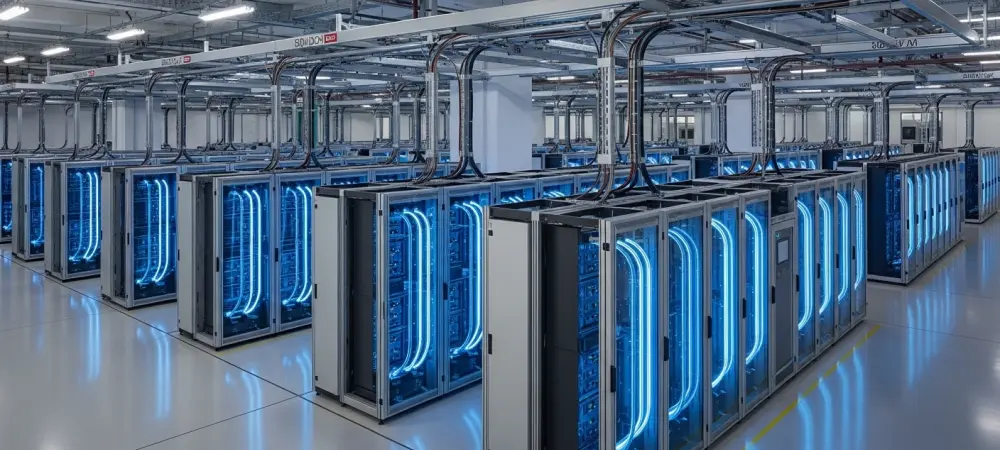
The low hum of traditional air-conditioning units that once defined the corporate server room has been permanently silenced by the intense demands of high-velocity liquid cooling systems required for modern artificial intelligence infrastructure. Walking through a state-of-the-art facility today feels less like visiting an office building and more like entering an industrial engine room where every square inch of space is optimized for heat rejection and extreme power throughput. This transition is not merely a gradual evolution of existing technologies but a total reconstruction of the physical laws governing digital infrastructure. As organizations race to integrate generative models into their core operations, they are discovering that the primary bottleneck is no longer the speed of their software, but the structural and thermal limits of their physical buildings.
The emergence of the “AI factory” represents a fundamental break from the cloud computing era that preceded it. While the cloud was built on the concept of virtualization and spreading workloads across vast arrays of general-purpose processors, the AI era is defined by extreme concentration. Today, the physics of a single server rack can dictate the viability of an entire multi-billion-dollar corporate strategy. If a building cannot deliver the required voltage or dissipate the concentrated heat of a GPU cluster, the most advanced algorithms in the world become useless. Consequently, the role of the infrastructure engineer has shifted from managing server uptime to mastering high-voltage electrical distribution and complex fluid dynamics.
The End of the Enterprise Server Room and the Rise of the AI Factory
The traditional corporate datacenter is currently facing a physical crisis that makes the transition to cloud computing look like a minor adjustment. In the past, IT managers could rely on standardized air-cooling systems and predictable power distributions that remained largely unchanged for decades. However, as graphics processing units replace general-purpose central processing units as the primary engine of modern industry, the sheer density of energy consumption has reached a breaking point. A single high-density server rack can now consume as much electricity as a small residential neighborhood, necessitating a complete rethink of how these facilities are constructed from the ground up.
This shift has birthed the “AI factory,” a new breed of facility where the laws of thermodynamics and high-voltage engineering dictate every design choice. Unlike the “white space” of the previous decade, which focused on clean aisles and modular racks, the AI factory is an integrated machine. For modern organizations, the choice is no longer about which software suite to run, but whether their physical buildings can even withstand the structural weight and intense energy demands of the hardware required to remain competitive. The era of the clean, quiet server room tucked away in a corner of the office is over, replaced by industrial-scale plants that prioritize raw power and thermal efficiency above all else.
In these new environments, the physical footprint of computing has become a liability. To accommodate the weight of liquid-cooled racks and massive electrical transformers, many enterprises are finding that their existing floors require structural reinforcement or entirely new foundations. The transition requires a move away from the “one-size-fits-all” approach to infrastructure. Instead of treating the datacenter as a host for various applications, engineers are designing the building as a specialized enclosure for a singular, high-performance engine. This industrialization of compute represents a permanent shift in the corporate landscape, where the success of a digital transformation is measured in kilowatts per square foot.
Understanding the Thermal Inflection Point and the New Baseline for Density
The primary driver of this transformation is a specific limit in the physics of cooling known as the 700-watt threshold. For most of the history of computing, air was an adequate medium for heat transfer, as processors rarely exceeded a few hundred watts of thermal design power. This has forced a mandatory industry-wide pivot toward direct-to-chip liquid cooling, moving it from a niche scientific tool used in supercomputing to a standard requirement for everyday business operations.
While legacy racks operated between 10kW and 50kW, modern AI clusters are pushing toward 200kW per rack, fundamentally breaking the HVAC models that have governed datacenter design for the last thirty years. This jump in density creates a “thermal inflection point” where traditional air-conditioning units are not only inefficient but physically incapable of doing the job. In an air-cooled system, the fans required to move enough air to cool a 200kW rack would consume more power than the servers themselves, and the resulting noise levels would be dangerous for human operators. Liquid cooling solves this by utilizing the superior heat-carrying capacity of fluids, which can be up to a thousand times more efficient than air at transferring thermal energy away from sensitive components.
The adoption of liquid cooling is also changing the baseline for facility efficiency and sustainability. Because liquid-cooled systems can operate with higher coolant temperatures, they often eliminate the need for energy-intensive chillers that rely on mechanical refrigeration. Instead, these facilities use closed-loop systems that reject heat through radiators, much like the cooling system in a high-performance car. This shift allows for significantly higher operational efficiency and, in many cases, helps facilities operate with nearly zero water consumption. By moving beyond the limitations of air, the industry has unlocked a new path for scaling performance that was previously thought to be geographically and environmentally impossible.
The Mechanical and Electrical Overhaul: Liquid Cooling and 800V DC Architectures
To manage the staggering energy requirements of AI infrastructure, engineers are moving away from traditional low-voltage alternating current (AC) in favor of 800V direct current (DC) power delivery. At the 200kW-per-rack level, the copper cabling required for standard AC power would be too heavy and thick to manage physically within a standard server enclosure. By increasing the voltage, operators can significantly reduce the amperage, which in turn allows for thinner, more manageable cabling and busbars. This electrical evolution is not just a matter of convenience; it is a necessity for the “white space” architecture of the facility to remain functional and accessible for maintenance.
This overhaul extends to the mechanical systems that keep the processors running. Modern AI factories are increasingly built around “sidecar” architectures, where power conversion and cooling manifolds are housed in separate units immediately adjacent to the compute racks. This allows for modularity in environments that were not originally designed for such high densities. Within these systems, coolant is pumped directly to cold plates that sit atop the GPUs, capturing heat at the source before it can escape into the room. This targeted approach ensures that the surrounding environment stays at a manageable temperature, even as the chips themselves operate at the edge of their thermal limits.
Moreover, the shift to high-voltage DC distribution necessitates new safety protocols and specialized hardware. Traditional circuit breakers are often inadequate for the high-energy DC environments found in AI clusters, leading to the development of solid-state protection devices that can react in microseconds to prevent catastrophic failures. This level of electrical sophistication ensures that a fault at a single server blade does not lead to a fire or a cascading shutdown of a multi-million-dollar training cluster. By streamlining the power path and integrating it with advanced liquid cooling, engineers have created a highly controlled environment that maximizes the reliability of the hardware while minimizing the total energy footprint of the building.
Navigating Economic Obsolescence and the Realities of Rapid GPU Innovation
Industry analysts and infrastructure experts are sounding the alarm on the collapsing lifecycle of datacenter hardware and the buildings that house it. In the past, a facility’s power and cooling systems were expected to support four or five generations of hardware refreshes over fifteen years, providing a stable return on investment for capital-intensive projects. Today, the pace of GPU development is so aggressive that a facility built for today’s 100kW racks may be physically incompatible with the 400kW requirements of hardware arriving just eighteen months later. This rapid rate of obsolescence is forcing many Chief Information Officers to reconsider massive capital expenditures, as the risk of building a “stranded asset” is higher than ever before.
This economic reality has fundamentally changed how businesses approach their infrastructure strategy. Building a bespoke AI factory requires a level of investment that can be difficult to justify when the underlying technology is shifting so quickly. If a facility cannot be easily retrofitted to handle the next generation of liquid-cooling standards or higher voltage demands, the initial investment may never be fully recouped. Consequently, many organizations are shifting toward “future-proof” modular designs that allow for incremental upgrades to power and cooling systems without requiring a total overhaul of the building’s core infrastructure.
The pressure to innovate has also created a new market for specialized colocation providers who can absorb the risk of infrastructure obsolescence. By leasing space in facilities that are purpose-built for the AI era, companies can access high-density compute without the long-term burden of maintaining the physical plant. However, even this approach requires a deep understanding of the hardware roadmap, as the physical requirements of future silicon remain a moving target. The challenge for today’s technology leaders is to find the balance between the immediate need for high-performance compute and the long-term financial stability of their infrastructure assets in an era of constant change.
Bridging the Gap Between Cloud Training and On-Premise Inferencing
The path forward for the modern enterprise involves a specialized hybrid strategy that separates the different stages of the AI lifecycle based on their physical requirements. Large-scale foundational model training, which requires massive power and specialized cooling, is increasingly moving to hyperscale cloud providers who can absorb the extreme infrastructure costs and complexity. These “training hubs” are the true AI factories, optimized for massive clusters of thousands of GPUs working in tandem to process trillions of data points. For most companies, attempting to replicate this scale on-premise is neither feasible nor economically sound, given the rapid evolution of the field. However, companies can keep the “inferencing” and “fine-tuning” stages on-premise by deploying modular, plug-and-play liquid-cooled enclosures. This approach allows businesses to maintain control over their sensitive proprietary data and reduce the latency associated with cloud-based queries while utilizing standardized cooling modules that fit within their existing physical footprints. Inferencing does not require the same extreme density as training, but it still benefits from the efficiency and reliability of liquid cooling. By creating “AI-ready” zones within existing datacenters, organizations can bridge the gap between their legacy systems and the high-performance requirements of modern intelligence.
This hybrid model also addresses the growing concerns surrounding data sovereignty and regulatory compliance. Many industries, such as healthcare and finance, are required to keep their most sensitive data within their own physical control. Modular, liquid-cooled units provide a way to host powerful AI models locally without needing to re-engineer the entire building’s HVAC system. These units can be deployed in small batches, allowing an organization to scale its AI capabilities as its needs grow. This pragmatic approach ensures that the enterprise can leverage the power of the AI revolution without being overwhelmed by the massive physical and financial hurdles of building a dedicated AI factory.
The transformation of datacenter physics required a fundamental shift in how organizations approached their long-term infrastructure planning. Decision-makers identified the specific workloads that necessitated high-density cooling and bifurcated their environments accordingly. They recognized that the traditional server room was no longer a viable host for the next generation of silicon and pivoted toward modular, liquid-cooled solutions that allowed for rapid iteration. By prioritizing the structural and thermal requirements of GPU clusters, these leaders successfully avoided the risks of thermal throttling and infrastructure obsolescence.
Forward-thinking teams audited their power distribution networks and upgraded to high-voltage systems that handled the increased load without overwhelming their facilities. They also implemented digital twin modeling to simulate thermal dynamics, ensuring that every rack operated within its optimal temperature range. This proactive stance allowed businesses to integrate advanced artificial intelligence into their operations while maintaining fiscal responsibility. They moved past the limitations of atmospheric cooling and embraced a future where the mechanical and electrical integrity of the building was just as critical as the code running within it. This strategic realignment secured a resilient foundation for the digital challenges of the coming decade.