

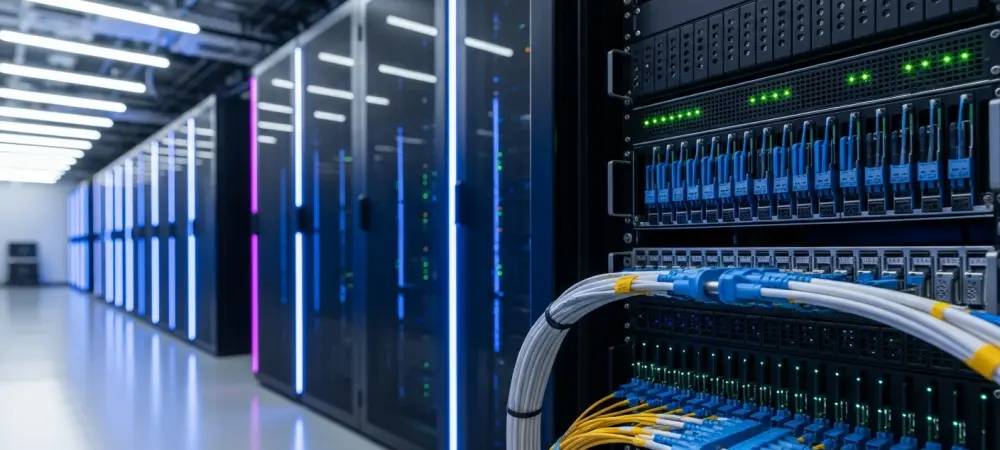
The rapid metamorphosis of the data center from a passive warehouse of servers into a high-octane “AI factory” has fundamentally altered the global computing landscape, making the network fabric as essential as the silicon it connects. This evolution represents a departure from the days when simple GPU-centric clusters were sufficient for basic machine learning. Today, the stack encompasses a sophisticated orchestration of specialized processors, high-speed interconnects, and silicon photonics designed to sustain the brutal demands of large-scale model training and real-time inference. As the industry moves past the “inference inflection point,” the ability to generate billions of AI tokens per second has become the primary metric of success, forcing a shift from monolithic hardware designs to a modular, semi-custom model that blends proprietary ecosystems with third-party innovation.
Introduction to AI Infrastructure Evolution
Historically, building an AI cluster meant stacking identical racks of general-purpose GPUs and hoping the software could bridge the gaps. However, the sheer scale of modern datasets has necessitated a move toward heterogeneous environments where the hardware is as specialized as the algorithms themselves. This shift defines the modern AI factory, a centralized yet modular powerhouse capable of processing multi-trillion parameter models. The current trajectory favors a “semi-custom” architecture, allowing hyperscalers to integrate their own intellectual property directly into established hardware frameworks.
This transition is driven by a massive shift in how compute is consumed. While training used to be the dominant resource hog, the industry is now optimizing for the generation phase. This means the infrastructure must be resilient enough to handle massive throughput while maintaining the low latency required for real-time human-AI interaction. Consequently, the boundary between the chip and the rack has blurred, creating a singular, unified machine that spans thousands of nodes.
Core Components of the Modern AI Stack
NVLink Fusion and Universal Interconnect Fabrics
NVLink Fusion has matured from a simple GPU-to-GPU bridge into the vital connective tissue of the modern data center. By transitioning to a universal fabric, it now allows for the seamless integration of diverse silicon types—including CPUs, DPUs, and custom accelerators—into a single, coherent memory domain. This breakthrough is critical because it eliminates the communication bottlenecks that traditionally crippled large-scale clusters. When hundreds of thousands of nodes must act as a single unit, the fabric ensures that data flows without the overhead of traditional networking protocols.
Moreover, this integration allows for a higher degree of synchronization across massive distributed systems. By treating the entire rack as a unified compute entity, developers can utilize memory pooling techniques that were previously impossible. This results in a significant performance boost for tasks that require frequent data exchange between different processor types, effectively turning the interconnect into a strategic advantage rather than a physical limitation.
Heterogeneous Compute and Specialized Accelerators
The era of the one-size-fits-all processor is over, replaced by a sophisticated blend of GPUs and specialized XPUs, such as Language Processing Units. These specialized accelerators are designed to handle specific sub-tasks, such as transformer-based inference or agentic logic, much more efficiently than general-purpose hardware. By offloading specific workloads to dedicated silicon, the overall system achieves a much higher throughput, significantly reducing the energy cost per token.
This decoupling of functions allows for a more granular approach to data center design. Instead of over-provisioning expensive GPUs for simple tasks, architects can now deploy a mix of hardware that perfectly matches the workload profile. This optimization is the secret behind the latest generation of AI services that offer near-instant responses at a global scale, proving that diversity in silicon leads to superior operational efficiency and lower total cost of ownership.
Silicon Photonics and Optical Connectivity
As clusters continue to expand, traditional copper cabling has hit a physical wall where heat and distance limit the speed of data transmission. The industry has responded by integrating silicon photonics and optical DSPs directly into the infrastructure stack. These components use light rather than electricity to move data, allowing for nearly instantaneous communication across the vast distances of a hyperscale data center. Without this shift toward optics, the processing power of modern AI chips would be wasted as they waited for data to arrive from remote parts of the cluster.
These optical interconnects are not just about speed; they are also a necessity for managing the power envelope of modern facilities. Optical signals generate significantly less heat than electrical signals, which helps mitigate the cooling challenges inherent in high-density AI racks. By overcoming the connectivity wall, silicon photonics enables the creation of truly planetary-scale computers that can function as a single, massive brain.
Innovations in Data Center Architecture
The current wave of innovation focuses on the platformization of the data center, where the value lies in the software and fabric layers that manage the hardware ecosystem. By moving toward a semi-custom model, large-scale providers can now blend their proprietary chips with established AI frameworks. This democratization of custom silicon allows for unprecedented levels of optimization, as companies are no longer forced to choose between total vendor lock-in and suboptimal open-standard performance.
However, a tension exists between these proprietary interconnects and emerging open-standard consortiums. While proprietary fabrics like NVLink Fusion currently offer the highest performance, the industry is watching closely to see if open alternatives can provide the necessary flexibility for a multi-vendor future. The current trend suggests that “control layer” dominance is the ultimate goal, as the company that manages the data center fabric effectively dictates the roadmap for the entire industry.
Real-World Applications and Deployment
AI-RAN and Edge Computing
The deployment of AI infrastructure is no longer confined to massive central clouds; it is rapidly moving to the edge via AI-RAN (Radio Access Network). This integration transforms traditional telecommunications base stations into distributed AI factories, blurring the line between network connectivity and high-performance computing. For autonomous vehicles and 6G applications, this means processing can happen within milliseconds of the data source, enabling real-time decision-making that central clouds simply cannot match.
By pushing AI compute to the network edge, providers are creating a new layer of the internet. This distributed architecture allows for localized processing of sensitive data, improving privacy while reducing the strain on long-haul fiber networks. It represents a fundamental shift in how cellular networks are utilized, turning every tower into a potential node in a global, intelligent grid.
Hyperscale Inference Factories
In the enterprise world, cloud providers are leveraging these advanced stacks to power agentic workloads—autonomous systems that can perform complex, multi-step tasks without constant human intervention. These inference factories are the backbone of global language translation services and automated business logic engines. The ability to handle massive inference loads simultaneously allows these platforms to provide sophisticated services to millions of users with minimal latency.
The differentiation in this market is increasingly based on how effectively a provider can manage these high-density inference tasks. Companies that have invested in specialized hardware and optimized interconnects are able to offer lower costs and higher reliability. This has led to a competitive landscape where the quality of the underlying infrastructure directly dictates the commercial success of the AI applications built upon it.
Technical Challenges and Market Obstacles
Despite the impressive technological strides, the industry is grappling with severe thermal management and power density issues. The energy required to cool a high-density AI rack can sometimes equal the energy used to power the chips themselves, creating a sustainability crisis for large-scale deployments. As clusters grow, the physical footprint and power requirements of these facilities are reaching the limits of existing electrical grids, prompting a search for more efficient cooling solutions and low-power silicon designs.
Furthermore, market obstacles such as vendor lock-in and export controls complicate the global rollout of these technologies. The division between high-performance proprietary ecosystems and flexible open-source standards has created a fragmented market. This fragmentation often forces enterprises to make difficult choices between short-term performance gains and long-term architectural flexibility, all while navigating a complex regulatory environment focused on energy consumption and data sovereignty.
Future Outlook and Technological Trajectory
The future of the AI infrastructure stack is moving toward a state of total modularity, where hardware can be swapped and scaled with the same ease as software. Future breakthroughs in room-temperature optical interconnects and the maturation of 6G will likely lead to the creation of “planetary-scale” computers that ignore geographic boundaries. As the cost of generating AI tokens continues to plummet, intelligence will eventually become a ubiquitous utility, similar to electricity or water, available on demand to anyone with a connection.
Long-term development will focus on the energy-to-compute ratio, seeking ways to maximize processing power while minimizing the environmental footprint. We can expect to see more sustainable data center designs that utilize renewable energy and advanced liquid cooling as standard features. These milestones will be essential for maintaining the current pace of AI expansion without overwhelming the planet’s resources.
Summary and Final Assessment
The transition from rigid hardware configurations to a modular, interconnect-driven ecosystem has successfully unlocked the next level of specialized compute. By integrating custom silicon and high-speed fabrics, the industry has addressed the immediate bottlenecks of model training and real-time inference. Although the trade-offs between proprietary control and open standards remain a point of contention, the current momentum favored integrated systems that prioritize performance and low-latency communication.
The evolution of these “AI factories” ensured that the infrastructure could keep pace with the exponential growth of model complexity. Strategic investments in silicon photonics and edge deployment models have expanded the reach of high-performance computing far beyond the traditional data center. Ultimately, the winners in this space were those who mastered the fabric of the network, proving that the synergy between hardware and connectivity is the true foundation of the global AI expansion. Moving forward, the industry was expected to prioritize sustainability and cross-platform interoperability to sustain this unprecedented growth.