

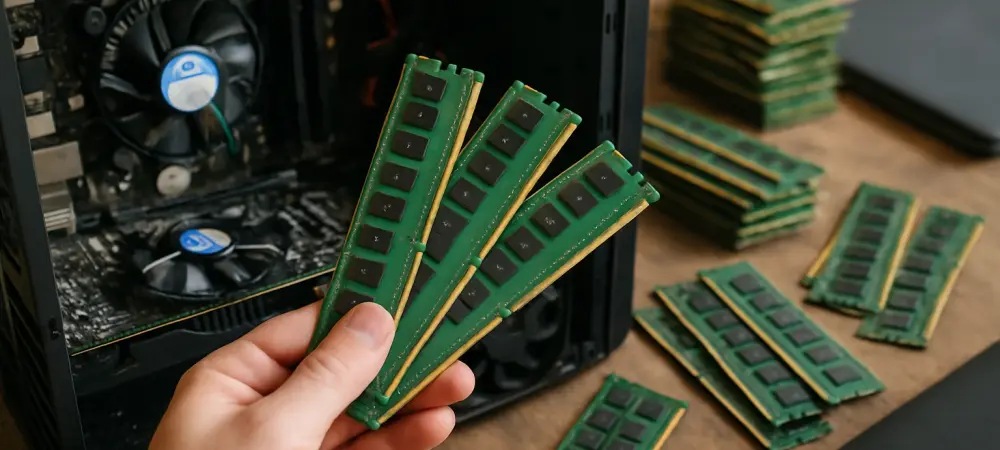
The unassuming memory chip, long a predictable commodity in the world of personal computing, has suddenly become the epicenter of a market-altering tremor, with its scarcity poised to redefine the cost and configuration of PCs for the foreseeable future. A confluence of surging artificial intelligence demands and a finely tuned supply chain has created a perfect storm, leaving both manufacturers and consumers to navigate the turbulent waters of price volatility and component shortages. This report analyzes the seismic shift underway, tracing the ripple effects from AI data centers to the retail price of a standard laptop.
The State of Play: A Look at the Global PC Component Ecosystem
The global PC market operates on a complex, interconnected web of suppliers and manufacturers, where stability hinges on a delicate balance. At the core of this ecosystem lies DRAM memory, a critical component that serves as the short-term memory for every computing task. Without it, a computer cannot function, making its availability and cost a primary determinant of the final product’s price and performance.
This intricate supply chain is dominated by a handful of key players. On one side are the memory producers, who control the global output of DRAM. On the other are the major PC manufacturers, including industry giants like Dell, Acer, and ASUS, who depend on a steady and predictable flow of these components. For years, this relationship has been governed by established dynamics, with supply generally managed to meet the predictable ebb and flow of consumer and enterprise demand, keeping prices relatively stable.
The AI Tsunami: Unpacking the Memory Market’s Seismic Shift
How Artificial Intelligence Became a Memory Hog
The recent explosion in artificial intelligence has fundamentally disrupted this long-standing equilibrium. AI models, particularly those powering generative AI and large-scale data analysis, are incredibly memory-intensive, requiring vast amounts of high-performance DRAM to process enormous datasets. This has created an unprecedented new source of demand, with the lucrative AI sector effectively redirecting a significant portion of the global memory supply away from the traditional PC market.
This shift is compounded by evolving technology needs across the board. Consumers now expect seamless multitasking and faster performance, while enterprises are deploying more sophisticated software that requires greater processing power. This organic growth in demand, combined with the voracious appetite of the AI industry, has created a supply bottleneck that is tightening its grip on the entire electronics sector.
By the Numbers: Tracking the Alarming Rise in DRAM Costs
The market data paints a stark picture of the consequences. In a matter of weeks, DRAM costs have reportedly surged by as much as 50%, an alarming rate of increase that has sent shockwaves through the manufacturing industry. This is not a minor fluctuation but a significant market correction driven by a fundamental imbalance between a finite supply and an exponentially growing demand from a new, high-priority sector.
Looking ahead, there is little indication that this pressure will ease. Projections show that the AI industry’s growth trajectory will continue its steep ascent, ensuring that its demand for high-performance memory will remain a dominant force. This sustained consumption is expected to keep component pricing elevated and availability constrained, signaling a long-term structural change rather than a temporary market anomaly.
Caught in the Crossfire: The PC Industry’s Uphill Battle
For PC manufacturers, the direct impact of this memory shortage is felt in the Bill of Materials (BOM), which is the comprehensive list of parts required to build a product. As the cost of a key component like DRAM skyrockets, the total cost to produce each computer rises significantly, squeezing profit margins and forcing difficult business decisions.
This leaves manufacturers caught in a difficult position. As confirmed by Acer’s Chairman, Jason Chen, the situation has made pricing unpredictable, and price increases have become unavoidable. Companies face the challenging calculus of either absorbing the rising costs, which is financially unsustainable, or passing them on to consumers, which risks dampening sales in a competitive market.
The New Normal: Redefining PC Configurations and Standards
In response, PC manufacturers are actively exploring strategic adjustments to mitigate the full impact of price hikes on consumers. One of the primary strategies under consideration involves recalibrating the standard specifications for new devices, creating a new baseline for what consumers can expect at various price points. A validated approach emerging from this dilemma is the move to establish 8 GB of RAM as the new standard for mid-range systems. While previously 16 GB was becoming the norm for this category, reverting to 8 GB allows manufacturers to manage the BOM more effectively and keep retail prices from becoming prohibitively expensive. This shift, however, will reshape the market landscape, altering consumer perceptions of what constitutes an entry-level, mid-range, or high-end machine.
What’s Next on the Horizon: Forecasting the Future of PC Affordability
The long-term outlook for the PC market is now defined by a period of significant uncertainty and price volatility. The days of predictable, incremental decreases in component costs appear to be over, replaced by a new reality where external market forces, particularly the growth of AI, dictate pricing and availability. The AI sector’s emergence is not a fleeting trend but a permanent restructuring of the component supply chain. Consumer electronics will now have to compete with the high-margin, high-demand data center market for a finite pool of resources. This ongoing competition will likely keep pressure on the supply of components like DRAM, fundamentally altering the economics of PC manufacturing for years to come.
The Bottom Line: Adapting to a More Expensive PC Landscape
The core findings of this analysis are clear: the insatiable demand from the AI industry is creating a structural shortage of DRAM, and as a result, PC price increases are no longer a possibility but an inevitability. This new market dynamic represents a fundamental shift that requires adaptation from all stakeholders.
The industry has entered a new era. The established balance between component supply and consumer demand was disrupted, forcing manufacturers to rethink product strategies and consumers to adjust their budget expectations. This report has shown that as the digital world continues its rapid evolution, the cost of entry was poised to rise, reflecting a permanent change in the technological landscape.