

The industry-wide fixation on graphics processing units has overlooked a critical storage bottleneck that currently threatens the return on investment for massive AI deployments. While the narrative surrounding artificial intelligence has long centered on the scarcity of high-end compute silicon and the staggering power requirements of modern data centers, a secondary crisis is quietly unfolding within the server racks of the world’s largest technology providers. In this year of 2026, the sheer volume of information required to train and maintain generative models has reached a point where physical hardware production can no longer comfortably keep pace with demand. The storage layer, once viewed as a reliable and relatively inexpensive component of the IT stack, has transitioned into a volatile strategic asset. Without a massive and immediate expansion in manufacturing capacity, the ambitious roadmaps of leading AI laboratories risk stalling as they run out of the digital territory necessary to house their creations. This shift marks a fundamental change in the economics of information technology, where the ability to store data is becoming just as constrained as the ability to process it.
The Financial Realignment: Volatility in Hardware Pricing
The pricing landscape for high-capacity enterprise storage has undergone a radical transformation, moving away from the predictable, decade-long downward trend that many industry analysts took for granted. In the current market, prices for high-density solid-state drives and high-capacity magnetic media have experienced sharp vertical increases, driven by an insatiable appetite from hyperscale cloud providers. This economic volatility has effectively ended the era of “cheap commodity storage,” as manufacturers prioritize high-margin specialized hardware designed specifically for the rigorous read-write cycles of AI training clusters. Organizations that failed to secure long-term supply agreements are now facing significant premiums, often paying twice the anticipated cost for hardware that was readily available just a year ago. This price surge is not merely a temporary supply chain hiccup but represents a fundamental repricing of data capacity in an age where information is the primary fuel for economic growth and industrial competition.
This economic shift has forced the world’s leading storage manufacturers to pivot their entire operational strategies, often at the expense of their traditional customer bases. Companies that previously maintained a balanced portfolio of consumer and enterprise products are now dedicating upwards of eighty percent of their production lines to serving a handful of massive AI-focused clients. This concentration of resources means that the latest innovations in storage density and speed are being funneled directly into massive proprietary data centers, leaving the broader market to compete for legacy hardware or significantly less efficient alternatives. The result is a stratified economy where only the most well-capitalized firms can afford the infrastructure necessary to develop next-generation models. For the rest of the tech industry, these pricing dynamics have necessitated a painful re-evaluation of data retention policies, as the cost of holding massive datasets begins to outweigh their potential utility in a high-interest hardware market.
Technical Catalysts: Multimodal Expansion and Data Gravity
The current storage crisis is fueled largely by the transition from text-based models to sophisticated multimodal systems that process and generate high-resolution video and audio. Unlike the relatively lightweight datasets used for early language models, these new systems require trillions of individual data points consisting of massive binary files. As AI models become more adept at understanding the physical world through visual data, the storage requirements for training sets have grown by orders of magnitude. A single training run for a state-of-the-art multimodal transformer now involves petabytes of raw data that must be accessible at ultra-low latency to prevent the expensive GPUs from sitting idle. This “data gravity” effect ensures that as models grow in complexity, they pull in more and more storage resources, creating a feedback loop where the success of the technology directly exacerbates the hardware shortage that threatens its continued growth and deployment across various industries.
Beyond the initial training phase, the development of these advanced models requires a technique known as checkpointing, which places an immense and often underestimated burden on storage infrastructure. Because the training of a large-scale model can take months and involves thousands of interconnected processors, hardware failures are an inevitability rather than a possibility. To mitigate the risk of losing weeks of progress, systems must frequently save their entire internal state, creating massive files that can reach several terabytes each. Over a single training cycle, these checkpoints can accumulate to consume dozens of petabytes of space, requiring high-speed storage tiers that can ingest data at lightning speeds. This constant cycle of saving and reloading data creates a massive overhead that effectively doubles or triples the storage footprint required for any given project. As the models themselves grow to include more parameters, these checkpoint files become even more unwieldy, further straining the already limited capacity of modern data center environments.
Magnetic Endurance: The Role of High-Capacity Hard Drives
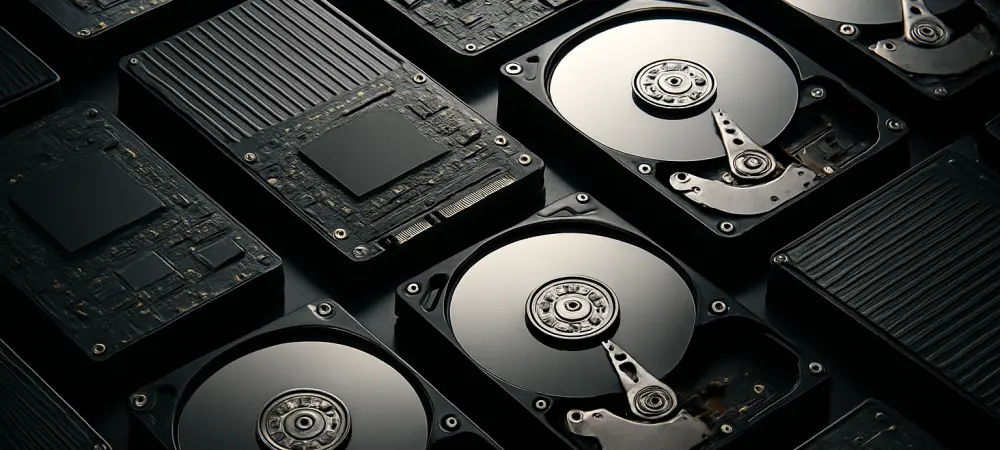
While flash memory dominates the conversation regarding speed, traditional magnetic hard disk drives have remained an indispensable cornerstone of the global AI infrastructure. Despite the narrative that spinning disks are a legacy technology, they offer a price-per-gigabyte ratio that solid-state alternatives simply cannot match at the scale required for massive data archives. In the high-performance clusters of 2026, hard drives serve as the critical “cold” and “warm” tiers where the vast majority of the world’s training data resides before being moved to faster memory for active computation. Manufacturers have responded to the crisis by pushing the limits of magnetic recording technology, introducing drives that utilize heat-assisted magnetic recording to achieve densities that were thought impossible just a few years ago. However, even these technological leaps are not enough to satisfy the hunger of the market, as every new drive produced is immediately claimed by pre-existing contracts with major tech firms.
The reliance on magnetic media has created a unique bottleneck where the physical limits of mechanical engineering meet the digital demands of artificial intelligence. Because these drives are complex machines with precise moving parts, increasing production capacity is not as simple as clicking a button or repurposing a silicon wafer fab. It requires specialized factories and components that have a multi-year lead time for construction and validation. Consequently, the global supply of high-capacity hard drives for the period between 2026 and 2028 is already effectively spoken for by the world’s largest cloud operators. This has left smaller enterprises and regional data centers in a precarious position, unable to expand their own capacity and forced to rely on increasingly expensive cloud services. The enduring relevance of the hard drive highlights a critical reality of the current erwhile the “brains” of AI are digital, the “memory” remains tethered to physical, mechanical constraints that cannot be scaled at the speed of software.
Fabrication Friction: The Competition for Silicon Wafers
The shortage of high-speed solid-state storage is fundamentally linked to a conflict occurring deep within the world’s semiconductor fabrication plants. The primary component of these drives, NAND flash memory, must compete for the same raw silicon wafers and factory floor space as the High Bandwidth Memory required for AI processors. Because the specialized memory used directly on GPU boards commands a much higher profit margin, semiconductor giants have systematically shifted their production priorities. This strategic realignment has led to a structural deficit in the availability of the high-density flash chips needed for enterprise-grade solid-state drives. As long as the demand for AI accelerators remains at its current fever pitch, manufacturers have little financial incentive to revert their production lines back to standard storage components, ensuring that flash prices remain elevated for the foreseeable future.
This manufacturing hierarchy has created a scenario where the growth of AI processing power is effectively cannibalizing the infrastructure needed to support it. The same technological breakthroughs that allow for faster training also make it more difficult to produce the drives required to store the resulting models and their datasets. For memory producers, this is a golden era of profitability, but for the wider technology ecosystem, it represents a significant barrier to entry. This shortage is not a temporary glitch in the supply chain but a calculated strategic choice by the dominant players in the memory market. By prioritizing the most profitable silicon, they have created a bottleneck that filters out all but the most well-funded AI initiatives. This environment has prompted some tech giants to explore building their own proprietary memory fabs, though the immense capital and technical expertise required for such a move mean that relief is still years away from materializing.
Architectural Transformation: New Strategies for Data Management
To survive in an environment defined by hardware scarcity, data center architects have been forced to completely rethink how information is stored and moved. The standard designs of the past decade have given way to highly sophisticated multi-tier storage architectures that use intelligent software layers to manage data placement in real-time. These systems use machine learning to predict which pieces of data will be needed for a specific training task, moving them from slow, high-capacity hard drives to ultra-fast flash tiers just milliseconds before they are required. By optimizing the “hot” data path, companies can maximize the utility of their limited high-performance storage assets, ensuring that not a single megabyte of expensive flash memory is wasted on idle information. This architectural shift represents a move toward “lean” data management, where software efficiency is used to compensate for the physical shortage of hardware components.
In addition to sophisticated tiering, modern infrastructure design now places a heavy emphasis on distributed resilience and data deduplication at an unprecedented scale. Because the cost of physical drives is so high, companies can no longer afford the luxury of simple, redundant backups that merely mirror data across multiple locations. Instead, they are implementing advanced erasure coding and global namespaces that allow data to be reconstructed from fragments spread across thousands of nodes. While this approach increases the computational overhead required to manage the storage layer, it significantly reduces the total physical capacity needed to maintain high levels of data durability. However, the move toward these complex distributed systems has created its own set of challenges, as the failure of a single high-density storage node can now trigger a massive re-balancing operation that consumes significant network bandwidth. Balancing these efficiency gains against the operational complexity of distributed systems has become the primary task of modern systems engineers.
Market Polarization: Large Enterprises versus the General Public
The current storage crisis has resulted in a deep and widening fissure between the enterprise sector and the general consumer market. Large-scale technology firms, viewing storage as a mandatory strategic resource, have begun to engage in aggressive stockpiling and long-term supply hoarding. By utilizing their immense cash reserves to purchase years of inventory in advance, these organizations have insulated themselves from the most extreme market fluctuations, but in doing so, they have drained the available supply for everyone else. This strategic behavior has transformed the storage market into an exclusive club where access to the latest hardware is determined by the size of a company’s balance sheet rather than their technical needs. This polarization is slowing down innovation in smaller startups and academic institutions, which find themselves unable to afford the hardware necessary to compete with the industry giants.
The “collateral damage” of this AI-driven demand is most visible in the consumer electronics sector, where the prices for laptop upgrades, gaming consoles, and external drives have seen steady increases throughout 2026. Because manufacturers are focusing their best silicon and most efficient production lines on the high-margin enterprise market, consumer products are often left with lower-quality components or older technology. For the average user, this means that even basic computing tasks are becoming more expensive as the global supply of memory is sucked into the vortex of AI data centers. This dynamic has effectively forced the public to subsidize the expansion of artificial intelligence through higher costs for everyday technology. As long as the AI industry continues to treat storage as an infinite resource, the pressure on the consumer market will likely persist, making high-performance local storage a luxury rather than a standard feature of modern personal computing.
Looking Ahead: Long-Term Solutions and Infrastructure Resilience
To address the underlying causes of the current capacity gap, the industry initiated several strategic shifts that prioritized the development of entirely new storage paradigms. Research into DNA data storage and holographic optical media moved from the laboratory toward pilot-scale implementations, as these technologies promised density levels that could finally decouple data growth from the limitations of traditional silicon and magnetic manufacturing. Engineers focused on creating more sustainable and dense storage formats that required fewer rare-earth minerals and less energy to maintain, recognizing that the environmental footprint of the global data archive was becoming as much of a constraint as the physical hardware itself. These efforts highlighted a transition toward a more holistic view of infrastructure, where long-term viability was balanced against immediate performance needs.
In the final assessment of the storage landscape, organizations were forced to adopt more disciplined data lifecycle management protocols to navigate the period of extreme scarcity. Leading firms implemented rigorous data auditing processes that purged redundant information and prioritized the retention of high-value synthetic data over raw, unrefined sets. This shift in perspective transformed storage from a passive repository into an active, managed asset that required constant optimization. By focusing on software-defined efficiency and investing in the next generation of physical media, the technology sector began to build a more resilient foundation that could withstand the continued expansion of intelligent systems. These collective actions ensured that while the storage crisis was severe, it served as a catalyst for a more sophisticated and sustainable approach to the world’s ever-growing digital footprint.