

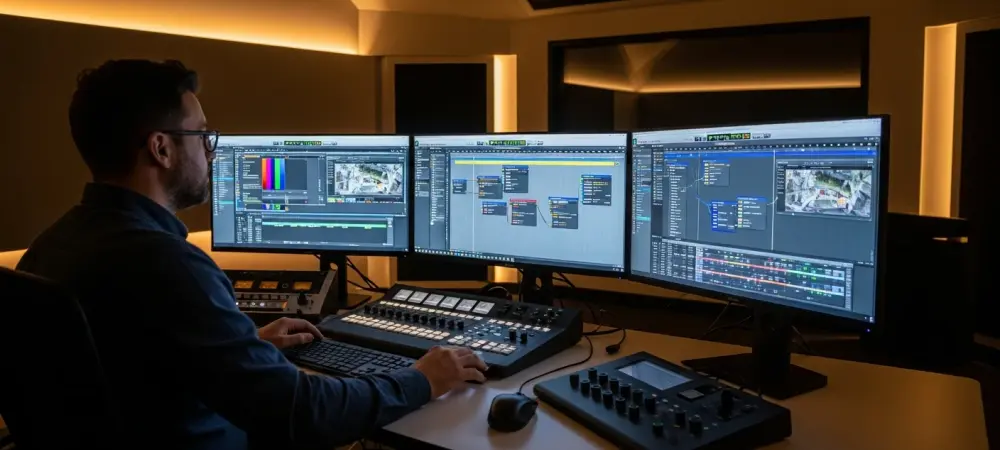
The digital landscape has shifted from the frantic novelty of experimental prompt engineering toward a sophisticated era where artificial intelligence functions as a reliable, industrial-grade production engine. While the early adopters of these technologies were often content with the surprising results of a simple text-to-image command, the current environment demands a far more rigorous approach. This transformation reflects a broader movement within the creative industries, where the focus has moved away from the “magic” of the tool and toward the intentionality of the human operator. As artists and studios integrate these systems into their daily workflows, they are discovering that the true value of artificial intelligence lies not in its ability to generate a random image, but in its capacity to serve as a precise instrument for professional-grade craftsmanship.
Industry analysts are currently observing a significant pivot as the creator economy, now a massive global force, matures into a more structured ecosystem. The “magic vending machine” model of content creation—where low effort yielded high novelty—is rapidly being replaced by production engines that require deep technical knowledge and a refined aesthetic sense. This shift is particularly evident in how creators are utilizing automated tools to bridge the gap between initial concept and final delivery. By moving from curiosity-driven exploration to a “production pipeline” mindset, the industry is setting new standards for what constitutes high-quality output. The goal is no longer just to make something that looks like art, but to create cohesive, scalable projects that can stand alongside the work of legacy studios.
Transitioning from Random Prompts to Intentional Craftsmanship
The transition from the novelty-seeking behaviors that characterized the initial arrival of generative tools to the current era of professional-grade output marks a turning point in digital media. In the early stages, the primary appeal was the shock of seeing a machine produce recognizable imagery from a few words. However, as the market became saturated with high-volume, low-intent content, the professional world moved toward “dense directing.” This approach involves a meticulous level of control over every frame, color palette, and narrative beat, ensuring that the final product reflects a specific human vision rather than a statistical average of the model’s training data.
The burgeoning $480 billion creator economy has provided the financial and cultural impetus for this evolution, as creators now view themselves as high-efficiency production hubs. Rather than relying on a single breakthrough asset, these modern artists are building entire ecosystems around their brands, using algorithmic tools to maintain a consistent output that would have previously required dozens of employees. This shift is redrawing the boundaries between independent creators and traditional media companies, as the former now possess the technical capability to produce studio-level content at a fraction of the cost. The focus has decisively shifted toward building long-term value through intentionality and narrative depth.
Scaling Human Creativity Through Algorithmic Precision
The Rise of the Solo Studio: The Death of AI Slop
The emergence of the “solo studio” is perhaps the most visible indicator of how individual creators are leveraging technology to compete with legacy institutions. These artists use generative systems as “glue and mortar,” filling in the gaps of their production pipelines and handling the repetitive tasks that used to consume the majority of their time. By automating the more tedious aspects of lighting, rendering, or basic asset generation, these creators can maintain absolute creative control while producing at an unprecedented scale. This is not about replacing the artist; it is about providing the artist with a more powerful set of levers to pull.
Conversely, the professional creative community has developed a strong rejection of what is commonly referred to as “AI slop.” This term describes content that is generated with minimal effort, often lacking a coherent theme or refined execution. In a world where the barrier to entry for content generation has been lowered, the primary competitive advantage has become intentionality. Artists who can demonstrate a clear, directed path from their initial idea to the final product are finding more success than those who simply roll the dice on a generative model. This tension between speed and craft is forcing a re-evaluation of how storytelling and collaborative nuance are maintained in an automated environment.
Navigating the Latent Space: The Modern Cultural Sampler
Many forward-thinking creators are beginning to view the latent space of generative models as a vast territory for discovery, much like the early days of musical sampling. Just as the sampler allowed musicians to take snippets of existing sounds and reconfigure them into entirely new genres like hip-hop, the modern digital artist uses AI to sample from the vast repository of human visual culture. This process is not about copying; it is about synthesis and remixing. By exploring the mathematical gaps between known styles and concepts, artists are identifying unique aesthetic territories that were previously unreachable through traditional methods.
Real-world applications of this “sampling” logic are already appearing in sectors like voice cloning and global localization. Creators are now able to preserve their unique vocal identity while scaling their message across dozens of languages, ensuring that their personal “brand” remains intact even when they are not physically present to record the audio. This business shift moves away from “black box” outputs where the user has little control, toward granular interfaces that allow for specific adjustments. Artists are finding that the most innovative results often come from “misusing” these tools—pushing them beyond their intended functions to create unintended, groundbreaking visual languages.
The Hidden Labor: Dense Directing and Consistent Animation
As animation moves into a true production mode, the technical challenges are shifting from the quality of a single frame to the consistency of an entire sequence. Maintaining character logic and motion consistency over a five-minute video requires a level of supervision that many people did not anticipate during the early generative hype. This “dense directing” involves a constant loop of iteration and curation, where the human director must approve or reject hundreds of variations to find the perfect movement or expression. The labor has not disappeared; it has simply changed form, moving from the act of drawing to the act of high-stakes decision-making.
This shift has created what some experts call the “Decision Paradox.” While a production pipeline might run five times faster than traditional 3D animation methods, the human director is forced to make five times as many creative choices in the same window of time. This creates a significant mental and technical toll, as the supervisor must stay alert to “glitches” or logical inconsistencies that an automated system might overlook. The assumption that easier tools make for easier work is being challenged by the reality of professional production, where the demand for perfection remains as high as ever.
Bridging the Gap: Creator Logic and Hollywood Infrastructure
Major film studios are beginning to adopt the “fast-test” and “rough-prototype” mentalities that have defined the creator economy for the past several years. Strategic partnerships between established production houses and AI developers are allowing studios to train custom models on their proprietary libraries, creating a secure environment for experimentation. This approach allows directors to focus on high-level world-building while the underlying infrastructure handles the rapid iteration of background assets, concept art, and lighting setups. It is a move toward “asset factory” management, where the machine does the heavy lifting of production.
Furthermore, the focus is shifting away from the final image itself and toward the proprietary libraries and brand ecosystems that support it. Studios recognize that their long-term value lies in their intellectual property and their ability to maintain a consistent world across multiple platforms. By integrating algorithmic tools into their core infrastructure, they can test ideas more quickly and with lower financial risk. This convergence of creator-led innovation and traditional Hollywood resources is creating a new model for media production, where the speed of the internet meets the polish of the silver screen.
Strategic Frameworks for Navigating a High-Velocity Creative Landscape
To thrive in this high-velocity environment, industry leaders recommend a framework centered on “dense directing” and meticulous curation. Rather than attempting to replace human labor entirely, the most successful strategies involve integrating automation “around the edges” of a project. This means using the technology to solve specific, practical problems—such as generating a complex background or refining a lighting pass—while keeping the core creative decisions firmly in human hands. This hybrid approach ensures that the final product maintains a high standard of quality while benefiting from the efficiencies of modern software.
Moreover, the most valuable currency in a world of abundant content is human “taste.” As the cost of generating an image or video drops toward zero, the ability to recognize what is truly good becomes the ultimate differentiator. Actionable advice for creators often focuses on developing a strong curatorial eye and a deep understanding of art history and narrative structure. In a landscape where anyone can produce a high-fidelity image, the person who knows why a specific image works will always be more valuable than the person who simply knows how to press a button.
Why Human Perspective Remains the Final Arbiter of Value
The industry finally moved beyond the technical fascination with what machines could do and returned to the fundamental question of why we create. The most successful projects were those that used the technology to amplify a unique, human perspective rather than those that tried to hide behind the machine’s output. Leaders recognized that the scarcity of tools had been replaced by a scarcity of vision, making the human element more critical than ever before. In the end, the realization took hold that the future of creativity was not about the machine’s capability to think, but about the human’s ability to direct. The tools transitioned from being curiosities to being the bedrock of a new industrial pipeline, yet the architect remained human. As the boundaries between independent creators and major studios continued to blur, the emphasis remained on building worlds that people wanted to inhabit. Mastering the multiplier of intent became the primary goal for anyone seeking to leave a mark on a world where the speed of creation was limited only by the clarity of one’s own perspective.