

As the demand for artificial intelligence reaches a fever pitch, the digital landscape is undergoing a radical transformation that prioritizes power over almost every other resource. This shift is driven by the specialized needs of GPU clusters, which require massive, consistent energy loads that traditional power grids are often unable to provide. In this discussion, we explore the evolving operational strategies required to manage these high-density workloads, the logistical hurdles of navigating aging utility infrastructure, and the innovative use of on-site modular fuel cells to bypass grid limitations. We also delve into the critical balance between immediate energy needs and long-term sustainability, examining how efficiency metrics are being redefined in the age of generative AI.
AI training and inference demand massive GPU clusters that run for long periods, significantly increasing electricity and cooling needs. How does this energy profile change your operational strategy compared to traditional workloads, and what specific metrics do you use to evaluate cooling efficiency?
AI training isn’t a bursty process like hosting a website or processing standard business transactions; it is a relentless, high-intensity marathon. We are deploying massive clusters of GPUs that run at peak capacity for weeks or months at a time, which creates a thermal environment that feels more like an industrial furnace than a traditional server room. This energy profile forces us to move away from reactive maintenance toward a strategy of constant thermal monitoring and aggressive load balancing. We can no longer rely solely on traditional Power Usage Effectiveness (PUE) as our primary metric because it doesn’t tell the whole story of how AI hardware behaves under sustained stress. Instead, we are looking at real-time electricity use per teraflop and how that correlates to cooling demand, ensuring that every watt spent on fans or liquid cooling is actually contributing to the stability of the training run.
Deployments of up to 2.8 gigawatts of fuel cell capacity are emerging as a viable way to support cloud growth. Can you explain the step-by-step process of integrating these modular units into a facility and how achieving 60% electrical efficiency impacts your long-term operational cost projections?
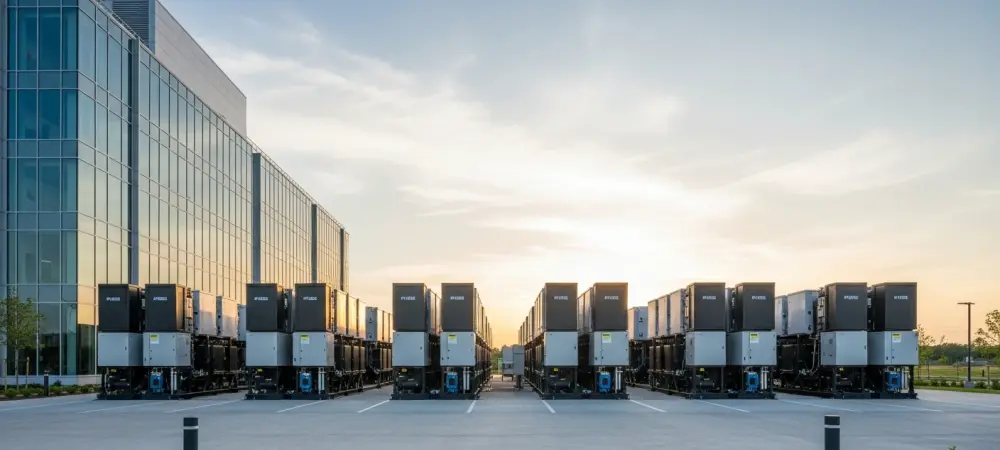
The integration of 2.8 gigawatts of fuel cell capacity is a logistical feat that starts with a modular site design, allowing us to drop in solid oxide units as the data center racks are populated. Unlike traditional combustion engines, these systems use an electrochemical process to generate power, which means we can avoid the massive vibrations and emissions usually associated with on-site generation. By reaching 60% electrical efficiency, we are essentially matching the performance of the world’s most advanced gas-fired power plants but doing so right at the point of consumption. This eliminates the transmission losses that typically plague the delivery of power from distant utility plants to our facilities. From a cost perspective, this high efficiency provides a level of predictability that is incredibly valuable, as it shields our long-term projections from the volatility of grid pricing and the hidden costs of transmission fees.
Local utilities often face multi-year delays for grid upgrades and new transmission lines, making power availability a primary factor in site selection. What specific challenges do you encounter when navigating these infrastructure constraints, and how does power access currently rank against land and connectivity?
The current state of utility infrastructure is perhaps the biggest bottleneck in the entire cloud ecosystem right now. We often find ourselves in a position where we have the land and the fiber connectivity ready to go, but the local utility informs us that a substation upgrade or a new transmission line will take several years to complete. This delay is unacceptable in a market that moves at the speed of AI development, which has pushed power access to the absolute top of our priority list for site selection. We used to choose locations based on proximity to users or cheap land, but now we are hunting for “islands” of power capacity where we can plug in immediately. If a site has the necessary gigawatt-scale access, it often trumps every other geographical or economic advantage a location might offer.
While fuel cells provide steady base load power, hydrogen infrastructure remains limited by high costs. How do you balance the immediate need for on-site gas-powered generation with long-term sustainability goals, and what specific role do solar or wind agreements play in your broader emissions strategy?
It is a delicate balancing act because while hydrogen is the “holy grail” of clean energy, the high costs and limited supply chains make it difficult to deploy at scale today. For now, we rely on gas-powered fuel cells to provide the steady, reliable base load power that AI workloads require, but we don’t do so in a vacuum. We use long-term power supply agreements for solar and wind projects to offset the carbon footprint of our 24/7 on-site generation. These renewable sources are vital for our broader emissions strategy, even though they can be less predictable than the fuel cells themselves. By combining the reliability of on-site gas generation with the environmental benefits of large-scale renewable credits, we can support the immediate boom in AI demand without completely abandoning our long-term sustainability commitments.
Generating power on-site avoids transmission losses and allows operators to add capacity incrementally. Can you share an anecdote where a modular power system streamlined a build-out, and what technical steps are required to reach total efficiency levels above 80% using heat recovery?
I recall a project where the local grid was completely tapped out, and we were looking at a three-year wait just to get the first phase of the data center online. By utilizing a modular fuel cell system, we were able to bring the first few megawatts of capacity live in a fraction of that time, scaling up the power plant in lockstep with the server deployments. The most impressive part of that setup was the push for total efficiency through combined heat and power (CHP) configurations. To get above that 80% efficiency threshold, we had to capture the intense heat generated by the electrochemical process and redirect it into the facility’s cooling loop or nearby industrial processes. It transforms the data center from a simple consumer of energy into a sophisticated energy hub where almost no waste is tolerated, creating a visceral sense of technical mastery over the environment.
What is your forecast for AI data center power demand?
The demand for power in AI data centers is poised to grow at a rate that will likely outpace anything we have seen in the history of computing. As model training becomes more complex and inference becomes ubiquitous, we are going to see a shift where data centers are no longer just buildings filled with servers, but are essentially small-scale utility companies in their own right. I expect that within the next decade, the ability to generate and manage power on-site will be the defining characteristic of a successful cloud provider. We will see a massive move toward “power-first” architectures, where the availability of energy dictates the very design of the hardware and the software that runs on it. The constraints of the grid will force a wave of innovation in fuel cells and modular nuclear power, forever changing how we think about the relationship between data and the physical world.