

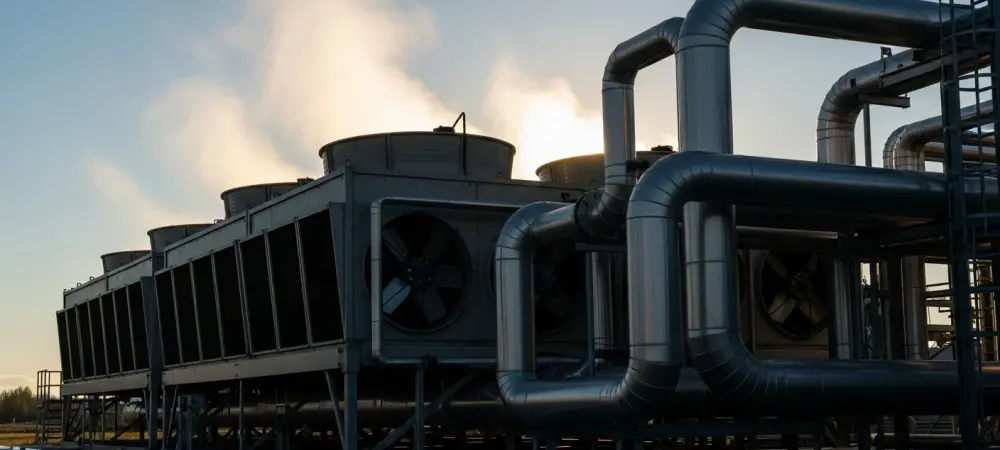
The invisible lifeblood of the global digital economy is no longer just a stream of electrons pulsing through silicon, but a literal flow of billions of gallons of fresh water circulating through massive industrial cooling systems. This shift represents a fundamental transformation in how humanity constructs and maintains its digital environment. As artificial intelligence moves from a speculative novelty to the primary driver of infrastructure demand, the metrics for measuring success have broadened. It is no longer sufficient to track carbon emissions or electricity bills alone. The sheer thermal intensity of modern processors has forced a pivot toward liquid-based thermal management, making water consumption a primary environmental pillar that rivals power usage in its complexity and regional impact. This review explores the technical and ecological trajectory of these facilities, examining how the race for compute power is reshaping the global relationship with local water resources.
Evolution of Data Center Cooling and Water Integration
For several decades, the standard approach to data center cooling relied on a straightforward exchange of air. Servers were housed in large, climate-controlled rooms where high-powered fans moved cold air across the hardware and exhausted the resulting heat back into the environment. This method was effective for traditional cloud computing workloads, which generally maintained predictable power densities. However, the arrival of large language models and generative AI altered the fundamental physics of the server rack. As the industry transitioned from general-purpose CPUs to specialized accelerators like GPUs and TPUs, the amount of heat generated within a single square foot of floor space increased exponentially. This evolution rendered air cooling increasingly obsolete for high-performance applications, as air simply lacks the thermal conductivity required to move heat away from modern high-density chips fast enough to prevent hardware failure.
This technological shift elevated water from a secondary utility used for occasional humidity control to a central component of the cooling architecture. In many modern facilities, water is now used to facilitate evaporative cooling, where the heat from the servers is transferred to a water loop that is then cooled by allowing a portion of it to evaporate into the atmosphere. While this process is incredibly efficient from a power perspective—allowing data centers to achieve impressive Power Usage Effectiveness (PUE) scores—it introduces a significant and often overlooked environmental trade-off. The transition to AI-driven workloads has essentially traded electricity for water, creating a new set of logistical and ethical challenges that are still being mapped by researchers and local governments alike.
Technical Framework of Water Consumption Metrics
Categorization of Water Usage Tiers: Direct and Indirect Impacts
To accurately assess the footprint of a data center, the industry has developed a taxonomy that distinguishes between different types of consumption. Direct water usage represents the liquid actually consumed on-site at the facility. This is primarily the water that enters the cooling towers and is lost to the atmosphere through evaporation or discharged during blowdown cycles to maintain chemical balance. For many operators, this is the only figure reported in transparency disclosures, as it is the most easily measured via on-site meters. However, focusing solely on direct usage provides an incomplete picture of the total environmental cost, as it ignores the vast amounts of water required to sustain the facility’s operation from afar. Indirect water usage represents the “embedded” water cost associated with the electricity the data center consumes. Most traditional power plants, whether they are thermal, nuclear, or even some forms of renewable energy, require significant volumes of water for steam production or cooling during the generation process. In many cases, this indirect consumption can far exceed the direct on-site usage, depending on the composition of the local energy grid. A facility powered by a coal-heavy grid in a region with high ambient temperatures will have a total water footprint that is orders of magnitude larger than a site powered by wind or solar. Understanding this duality is essential for any technical review, as it highlights that a “green” data center in terms of carbon may still be a “thirsty” data center in terms of regional water stress.
The Complexity of Per-Query Performance: Beyond the Averages
A significant amount of public discourse has attempted to quantify the environmental cost of AI through “per-query” metrics, such as the widely cited estimate that a single interaction with a chatbot might consume half a liter of water. While these figures are helpful for contextualizing the impact for a general audience, a deep technical analysis reveals that such universal averages are inherently flawed and often fail to reflect real-world performance. The variance in facility efficiency, climate zones, and grid characteristics means that the same query processed in two different locations can have radically different water costs. For instance, a query handled by a facility in a cool, damp climate using advanced liquid cooling might use a fraction of the water compared to the same task performed in an arid desert environment during a heatwave.
The technical reason for this variance lies in the sensitivity of cooling systems to their surroundings. Researchers have identified that server energy efficiency and the local grid’s water consumption factor are the dominant drivers of the total footprint, far outweighing the specific cooling hardware itself. This suggests that the “water cost” of an AI model is not a static property of the software code, but rather a dynamic result of where and when the computation occurs. This distinction matters for developers and engineers because it shifts the focus from optimizing algorithms for efficiency alone to a more holistic approach that considers geographic and temporal placement of workloads to minimize ecological strain.
Emerging Trends in High-Density Thermal Management
As AI hardware continues to push the boundaries of power density, the industry is moving toward a total abandonment of air-based cooling in favor of liquid-to-chip or immersion systems. Modern AI server racks are now reaching densities of 50 kilowatts to 100 kilowatts, levels that were unthinkable just five years ago. This heat density creates a physical barrier that only liquid can cross effectively. In many new installations, we see the implementation of direct-to-chip cooling, where cold plates are mounted directly onto the processors, allowing water or specialized fluids to carry heat away from the most critical components with surgical precision. This approach significantly reduces the need for massive, energy-hungry fans and allows for more compact facility designs.
Beyond direct-to-chip methods, immersion cooling is emerging as a more radical but increasingly viable solution for the most demanding AI workloads. In this configuration, the entire server is submerged in a non-conductive, dielectric fluid that absorbs heat through direct contact with all components. This technology nearly eliminates the need for water evaporation at the site level, as the heat can be exchanged through closed-loop systems or used for district heating. Furthermore, the adoption of adiabatic cooling systems—which only use water evaporation during the hottest periods of the year—represents an attempt to find a middle ground. These systems allow operators to benefit from the efficiency of water when it is absolutely necessary while relying on dry air cooling during cooler months, thereby reducing the annual consumption footprint.
Real-World Applications and Sector Distribution
The practical deployment of AI-optimized infrastructure is not a uniform phenomenon but is instead concentrated in specific geographic hubs. Hyperscale facilities owned by major technology companies and large-scale colocation centers are the primary drivers of this water-intensive growth. In markets like Northern Virginia, Dublin, or London, the density of data centers has reached a point where their collective water demand is a significant factor in regional utility planning. Interestingly, data from heavily metered regions shows that the vast majority of water consumption is driven by a tiny minority of “mega-sites.” While thousands of smaller, office-scale data centers exist, they typically use negligible amounts of water, as they do not possess the high-density AI hardware that necessitates advanced thermal management.
The difference in how these facilities are deployed also depends on the nature of the service they provide. Facilities dedicated to training large AI models tend to have higher, more consistent water demands due to the 24/7 nature of the intensive computation involved. In contrast, edge data centers or those focused solely on inference may have more fluctuating consumption patterns. This sector distribution reveals that the water challenge is primarily a hyperscale issue. As generative AI becomes more integrated into every aspect of business and consumer life, the concentration of these high-impact sites will likely increase, placing further pressure on the infrastructure of major global tech hubs to adapt to a reality where digital growth is physically constrained by water availability.
Critical Challenges and Regulatory Obstacles
One of the most persistent hurdles in the quest for sustainable data centers is the “energy-water trade-off.” This phenomenon occurs because the most effective way to reduce a facility’s electricity consumption is often to use evaporative cooling, which inherently increases water usage. Conversely, moving to a completely “dry” cooling system that uses no water typically forces the mechanical chillers to work harder, spiking the electricity bill and the carbon footprint. This creates a zero-sum game for operators trying to meet diverse sustainability targets. Furthermore, the problem is compounded by seasonal vulnerabilities. Data centers require the most water during the peak of summer—the exact time when local water tables are lowest and human demand for water is highest, leading to potential conflicts with local communities and agriculture.
The lack of a standardized regulatory framework further complicates the landscape. Currently, there is a significant governance gap, as many jurisdictions do not require data centers to report their facility-level water usage with any degree of granularity. Without mandatory, transparent reporting, it is difficult for regulators to assess the true impact of a new facility on a local watershed. This lack of transparency has led to a fragmented regulatory environment where some regions are beginning to place moratoriums on new data center builds due to water concerns, while others continue to approve massive projects with little oversight. The industry faces a growing need for a unified set of metrics that can account for regional water stress and seasonal variability, ensuring that infrastructure growth does not come at the expense of local ecological stability.
Future Development and Long-Term Outlook
Looking forward, the technology is moving toward a goal of “water neutrality” or even “water-positive” operations. This involves a combination of advanced closed-loop cooling technologies and investments in local water restoration projects. There is significant potential for breakthroughs in cooling fluids that can operate at higher temperatures, allowing data centers to exhaust heat more effectively without the need for evaporation. Additionally, the integration of data centers with circular economy principles—such as using the waste heat from server racks to warm municipal water supplies or greenhouses—could redefine these facilities as productive community assets rather than just industrial consumers. Such innovations could decouple digital growth from water depletion, though they require substantial capital investment and long-term planning.
The long-term outlook for the sector will be shaped by the increasing necessity of zero-carbon grid integration. As the electricity grid decarbonizes and moves toward wind and solar, the indirect water footprint of data centers will naturally decrease, as these energy sources require far less water than thermal power plants. However, the direct on-site consumption will remain a localized challenge that requires specific architectural solutions. We can expect a future where site selection is governed as much by water availability and “free cooling” potential as it is by tax incentives or proximity to fiber lines. The ability of the industry to innovate its way out of the current thermal bottleneck will determine whether the AI revolution can be sustained in a world increasingly defined by climate volatility and resource scarcity.
Summary of Findings and Assessment
The analysis of AI data center infrastructure revealed a technology at a critical crossroads. The transition toward high-density liquid cooling was no longer a matter of choice but had become a physical necessity to support the thermal demands of next-generation AI hardware. While the industry made significant strides in lowering electricity consumption through evaporative techniques, this progress often came at the cost of substantial local water usage. The research highlighted that this consumption was not a broad, industry-wide crisis but was instead heavily concentrated in a small number of massive hyperscale facilities. These sites represented the primary point of friction with local resources, particularly during peak summer months when the environmental trade-offs became most acute.
The governance of these facilities remained underdeveloped, as a lack of mandatory reporting obscured the true extent of the water footprint in many global regions. It was found that generic “per-query” metrics were largely ineffective for policy decisions because the actual water impact was highly dependent on local climate and energy grid characteristics. The assessment concluded that while the technology provided the essential foundation for the modern digital age, its long-term viability depended on a more sophisticated approach to site selection and cooling design. Future infrastructure strategies had to move beyond simple efficiency scores and prioritize localized ecological constraints. Ultimately, the industry’s shift toward closed-loop systems and regional transparency provided a potential path toward a more sustainable integration of artificial intelligence into the global environment.