

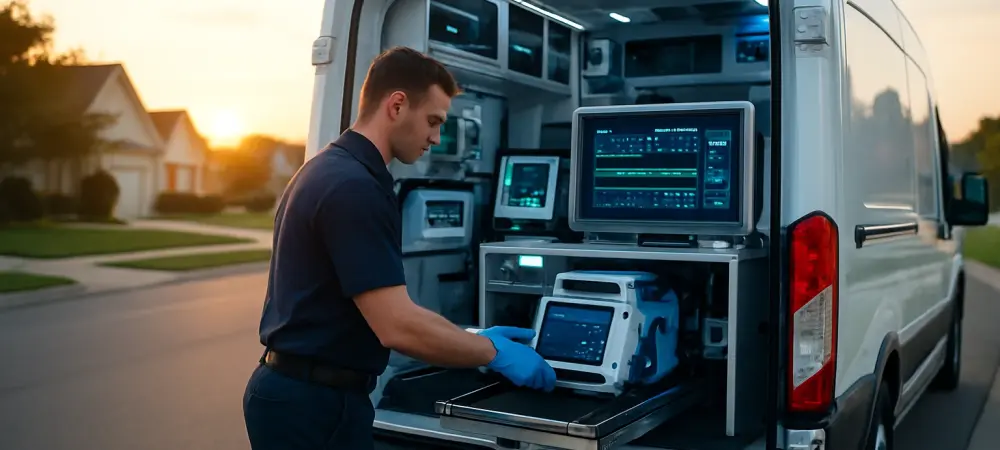
The moment a medical emergency strikes within the confines of a private residence, the clock begins a relentless countdown that often dictates the boundary between recovery and tragedy. The shift toward home-based acute care represents a major evolution in healthcare, moving the high-stakes hospital experience directly into the patient’s living room for maximum comfort and safety. While the clinical benefits of this model are increasingly evident, the logistics of delivering rapid emergency services outside a controlled hospital environment remain immensely complex. This guide explores how sophisticated AI algorithms are currently replacing manual dispatching to solve the intricate routing puzzle, ensuring that patients receive life-saving interventions without the traditional delays associated with emergency room wait times.
Modernizing Emergency Response Through AI Integration
Traditional dispatch methods often struggle to account for the fluid nature of urban traffic and clinician availability in real-time. The complexity of managing a fleet of mobile medical units requires more than a simple map; it demands a system that understands the specific capabilities of each responder at any given second. By integrating artificial intelligence into the core of emergency response, healthcare systems can now bypass the bottlenecks created by human error and fatigue.
This technological integration transforms the home into a viable clinical site, where the speed of arrival matches the urgency of the medical crisis at hand. By automating the most tedious parts of the dispatch process, organizations ensure that the clinical team is already on the road while a human operator is still finalizing the intake details. This proactive stance is essential for maintaining the high standards of care expected in acute situations.
Why AI-Driven Routing Is Essential for Acute Home Care
The transition from manual scheduling to AI-powered optimization is no longer just a technological upgrade but has become a fundamental necessity for patient safety and operational viability. Unlike static medical appointments that can be planned days in advance, emergency home care requires a dynamic response to unpredictable variables that change by the minute. Without automated intervention, the risk of resource misalignment increases significantly.
Enhanced Clinical Precision and Patient Outcomes
AI algorithms perform at a level of detail that human dispatchers cannot replicate, analyzing multi-layered data points such as clinician specialty, vehicle equipment, and live traffic. This high-resolution approach ensures that the most qualified provider reaches the patient with the exact tools needed for a specific diagnosis. By matching the severity of the patient’s condition with the precise skill set of the responding medic, the system reduces the risk of arriving under-equipped for a crisis.
Furthermore, the precision of these algorithms directly correlates with improved patient outcomes and reduced recovery times. When the right resources are deployed correctly the first time, the need for secondary transports or emergency room escalations drops. This level of accuracy provides peace of mind to both the patients and their families, knowing that the dispatched unit is fully prepared for their specific medical needs.
Operational Scalability and Cost Efficiency
Automating the logistics of dispatch allows healthcare organizations to scale their services to meet growing community needs without a linear increase in administrative staff. This efficiency lowers the average cost per visit and permits clinicians to focus entirely on patient care rather than the frustrations of navigating complex schedules. A more streamlined operation ensures that existing resources are used to their maximum potential, preventing the burnout often associated with inefficient routing.
Moreover, the data gathered by these systems provides valuable insights into operational bottlenecks that were previously invisible to management. By analyzing travel patterns and response times over a period from 2026 to 2028, administrators can make more informed decisions about fleet expansion and staffing levels. This long-term perspective ensures that the organization remains financially stable while continuing to provide top-tier emergency interventions.
Implementing AI Best Practices for Rapid Home Intervention
To successfully deploy AI in emergency routing, organizations must move beyond simple digital calendars and adopt sophisticated, constraint-based matching systems. This requires a cultural shift where data becomes the primary driver for operational decisions. Best practices involve the continuous refinement of these algorithms based on real-world performance metrics to ensure that the system remains responsive to the unique challenges of local geography.
Transitioning From Manual Queues to Real-Time Optimization
Effective implementation requires a system that views dispatch as a holistic routing problem rather than a simple chronological list of requests. The AI must continuously recalculate the entire network’s efficiency every time a new call arrives or a clinician finishes a visit. For instance, the organization Care2U successfully shifted away from manual “telephone tag” by utilizing AI to manage peak-hour gridlock effectively.
This shift ensured that busy afternoon rushes were handled with the same precision and speed as quiet morning shifts, resulting in more consistent service levels. By allowing the algorithm to handle the thousands of possible route combinations, the dispatch team can focus on managing special requests and supporting field clinicians. Consequently, the entire organization operates with a level of fluidity that manual systems could never achieve.
Integrating Hybrid Care Models for Faster Stabilization
The most effective use of AI routing supports a hybrid care model that blends physical presence with digital expertise. Algorithms should be programmed to prioritize the arrival of a field clinician who possesses the skills to facilitate an immediate virtual link to an emergency physician. In practice, coordinating field teams and virtual doctors through smart algorithms has demonstrated a 30% reduction in arrival times, which is critical for acute stabilization.
This rapid response allows for the faster treatment of conditions before they escalate into the need for traditional hospitalizations. The field clinician provides the “hands-on” care, such as administering IV fluids or performing physical exams, while the virtual physician provides specialist oversight. This synergy, directed by AI logistics, maximizes the impact of every home visit and keeps the patient safely out of the hospital.
Utilizing Predictive Analytics for Proactive Care
Advanced AI implementation involves moving from a reactive “call-and-respond” model to a proactive stance that anticipates patient needs based on historical trends. By analyzing community health data patterns, organizations can position their medical resources in high-demand areas before emergencies even occur. This strategy effectively prevents emergency room visits by providing intervention at the earliest possible moment.
For example, identifying subtle shifts in patient vitals through remote sensors and historical data allows healthcare teams to deploy clinicians to a neighborhood in anticipation of a potential health crisis. Instead of waiting for a patient to reach a breaking point, the system identifies the risk and triggers a preventive visit. This shift from reactive to proactive care represents the next frontier in mobile health, where technology identifies danger before it becomes a disaster.
Evaluating the Future of At-Home Emergency Care
The implementation of these intelligent systems demonstrated that the primary barrier to at-home acute care was never a lack of clinical skill but rather the friction of outdated logistics. By replacing manual dispatch with automated matching, healthcare providers established a more resilient system that prioritized patient comfort and rapid recovery. These tools allowed organizations to manage large geographic areas and high-acuity populations with unprecedented accuracy and speed. The transition toward AI-driven dispatch was not merely a matter of efficiency but a foundational shift in how care was perceived and delivered.
Clinicians who previously spent hours navigating traffic were able to reach their destinations with significantly less stress, which improved the quality of care provided at the bedside. This transformation ensured that the technical capabilities of a hospital could finally be replicated in a domestic setting without compromising on vital response times.