

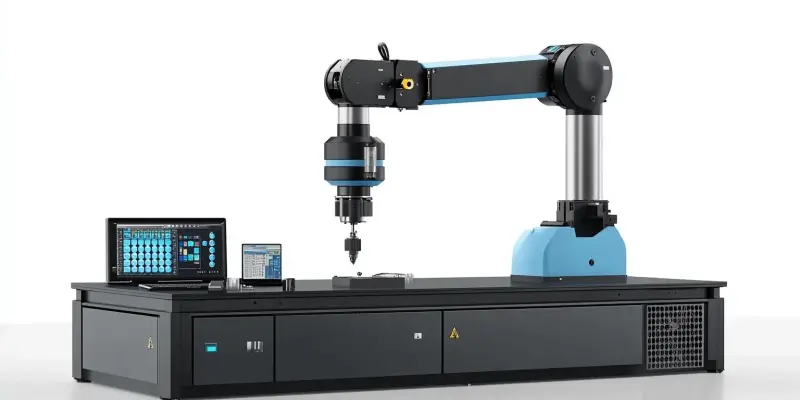
In today’s rapidly evolving technological landscape, advanced automation has emerged as a powerful force transforming multiple industries by revolutionizing efficiency and redefining operational standards. By streamlining processes and optimizing workflows, automation technologies have brought profound changes to sectors such as healthcare, manufacturing, and scientific research. The integration of intelligent systems and cutting-edge tools is not only improving resource utilization but also significantly reducing manual tasks and enhancing overall performance.
Transforming Healthcare with Automation
The integration of advanced automation systems in healthcare has significantly restructured patient care delivery, demonstrating marked improvements in efficiency and service quality. Intelligent workflow automation has dramatically reduced manual tasks, notably cutting patient wait times by an impressive 60%. This has had a direct impact on resource utilization, enabling healthcare facilities to allocate their resources more effectively and efficiently. Additionally, the incorporation of Electronic Health Records (EHRs) has proved to be a pivotal advancement in this transformation. This integration has decreased documentation time by 35%, significantly boosting data accuracy to a remarkable 98%. As a result, healthcare providers have experienced a 42% reduction in treatment delays, ensuring that patients receive prompt and effective care.
Moreover, the seamless integration of automation in healthcare extends beyond patient care delivery. The robust systems put in place address security and compliance concerns, crucial in a field where data protection and regulatory adherence are of the utmost importance. These modern systems feature multi-layer encryption and stringent compliance monitoring, while automated reporting has revolutionized audit preparation. Consequently, healthcare providers have seen a 75% reduction in the time required for audit preparation, ensuring continuous compliance with regulatory standards. By simplifying these processes, healthcare professionals can focus more on patient care, further underscoring the transformative power of automation in the sector.
Revolutionizing Manufacturing Operations
In the manufacturing sector, advanced automation systems have catalyzed a fundamental shift in operations, driving unprecedented levels of efficiency and accuracy. Automated workflow management systems have significantly streamlined production processes, with digital work order automation slashing manual processing times by 60%. These systems have improved scheduling accuracy to an impressive 99.5%, reducing production conflicts by 42% and enhancing overall resource utilization by 35%. The deployment of predictive maintenance frameworks, powered by IoT sensor networks, has further bolstered this transformation. By monitoring real-time machine conditions, manufacturers have decreased unplanned downtime by 55%, consequently prolonging machinery lifespan by 40%.
Additionally, automation has refined quality control processes, ensuring product consistency and minimizing defects. The implementation of automated quality control systems has positioned manufacturing at the forefront of innovation, driving operational excellence and efficiency. This leap into smart automation has not only streamlined production but also enhanced the reliability of manufacturing systems, disrupting traditional models and setting new industry standards. The profound impact of automation on manufacturing is an exemplary demonstration of how intelligent systems can revolutionize processes, leading to widespread improvements in performance and output.
Streamlining Scientific Research
In the realm of scientific research, the introduction of advanced automation technologies has brought about significant improvements in project management and grant application processes. Automated grant management systems have expedited application approvals, reducing processing times by 55% and improving submission accuracy by 85%. This innovation has significantly alleviated the administrative burdens on researchers, allowing them to dedicate more time to their core investigative work. Besides, resource allocation has seen marked improvement, with a 40% increase in scheduling precision and a 65% decrease in booking conflicts. The automation of these processes has not only improved efficiency but also enhanced the overall effectiveness of research initiatives.
Automation has also played a crucial role in ensuring compliance within research institutions. Automated compliance monitoring has achieved a 99.9% compliance rate, significantly cutting down the time required for audit preparation by 75%. This seamless real-time data tracking and secure storage facilitated by automation have fostered enhanced collaboration across institutions, improving research outcomes and promoting the sharing of knowledge. The transformative potential of automation in scientific research underscores the importance of embracing technological advancements to drive innovation and productivity in the pursuit of new discoveries and advancements.
Enhancing Security and Performance with Automation
As industries undergo rapid digital transformation, the importance of security and performance optimization cannot be overstated. Automated security systems are now capable of handling over 50 million encrypted transactions daily, ensuring data integrity and protection. These systems utilize role-based access control mechanisms to further enhance security, guaranteeing compliance with stringent industry regulations. The enhanced security measures provide a fortified framework that is integral to maintaining the integrity of operations across various sectors.
Performance optimization is another critical aspect addressed through advanced automation technologies. Modern cloud infrastructure enables organizations to maintain 99.99% system uptime while efficiently managing millions of transactions per second. AI and machine learning-powered automated decision support systems have revolutionized predictive analytics, enhancing resolution accuracy by 75%. This improvement has streamlined response times in critical operations, reduced downtime, and boosted overall operational efficiency. Through the integration of security measures, automation, and AI-driven analytics, industries have laid the groundwork for stronger, more resilient digital ecosystems, paving the way for future advancements and a more intelligent operational landscape.
Future Prospects of Automation
In today’s fast-paced technological era, advanced automation stands out as a transformative force, reshaping various industries by enhancing efficiency and redefining operational norms. This surge in automation technology has introduced significant advancements in fields such as healthcare, manufacturing, and scientific research. By automating key processes and optimizing workflows, these technologies have driven remarkable improvements. The integration of intelligent systems and state-of-the-art tools ensures better resource management, minimizes manual tasks, and boosts overall performance. For instance, in healthcare, automation streamlines patient data management, allowing quicker and more accurate diagnostics. In manufacturing, automated systems enhance production rates and precision, reducing errors and waste. Scientific research benefits from automation through faster data analysis and experiment precision. These advancements collectively lead to heightened productivity and innovation across sectors, symbolizing a pivotal shift towards a future where automated solutions underpin industry standards.