

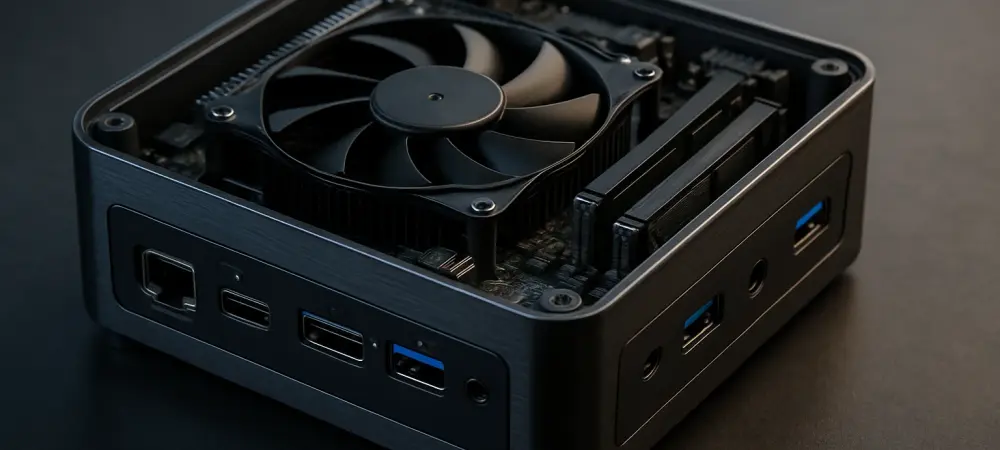
What happens when a company renowned for crafting sleek PC cases decides to build an entire system from scratch, packing the might of a full-sized desktop into a tiny cube? Abee, a Chinese manufacturer, has entered the mini PC arena with a device that’s turning heads in 2025. Priced at $2,524, this compact marvel promises to deliver unmatched power for AI workloads and gaming, all within a footprint smaller than most textbooks. This isn’t just another gadget—it’s a bold challenge to the status quo of computing.
The significance of this launch lies in its timing. As workspaces become more constrained and the demand for portable, high-performance machines skyrockets, mini PCs are no longer niche; they’re essential. Abee’s entry taps into a critical shift in technology, where professionals and enthusiasts alike crave systems that blend raw power with a small form factor. This device represents more than hardware—it’s a glimpse into the evolving landscape of personal computing.
A New Era of Compact Computing
Mini PCs have emerged as a vital solution in an era where desk space is at a premium and mobility is key. The trend is clear: compact systems that rival traditional desktops are gaining traction among data scientists, gamers, and creators. Abee’s debut in this space addresses a growing need for machines capable of handling intensive tasks like machine learning and real-time rendering without occupying half a room. According to recent industry reports, the mini PC market is projected to grow by 15% annually from 2025 to 2027, driven by such innovations.
This particular model stands out by catering to specialized demands. It’s not designed for casual browsing or basic office work; instead, it targets users who push hardware to its limits. The focus on AI-driven performance, in particular, aligns with a surge in applications requiring heavy computational resources, making this release a timely response to current tech challenges.
Inside the Cube: Unpacking the Specs
Dive into the heart of this 199x199x199mm powerhouse, and the specs reveal why it commands such a steep price tag. Powered by AMD’s flagship Ryzen AI Max+ 395 processor, built on the cutting-edge Zen 5 architecture, it boasts a 16-core/32-thread configuration. Paired with an integrated Radeon 8060S GPU based on RDNA 3.5, it’s engineered for both AI operations and high-end gaming. The standout feature, however, is the staggering 128 GB of LPDDR5X-8000 memory—far beyond what most users need, yet ideal for memory-intensive tasks.
Beyond raw power, the design prioritizes efficiency. A built-in water-cooling system ensures thermals remain under control during prolonged, demanding sessions. Additionally, a 400W power supply with a 10-pin ATX12VO design reduces idle power consumption by up to 27% compared to standard setups, as claimed by the manufacturer. Connectivity is equally impressive, with dual LAN ports (2.5G and 10G) and USB4 Type C and Type A options, ensuring seamless integration with modern peripherals.
Abee’s Legacy Meets Innovation
Abee brings a proven track record to the table, having previously designed high-quality PC cases like the C700W chassis for Maxsun’s AI Workstation. That expertise in thoughtful engineering is evident in every detail of this mini PC, from its cooling solutions to its compact layout. Industry analysts have taken note, with one expert commenting, “The shift toward specialized, compact systems for AI and professional workloads is reshaping the market, and Abee’s focus on massive memory and power efficiency positions them as a key player.”
This isn’t just a one-off experiment for the company. Their deep understanding of hardware design suggests a commitment to addressing the nuanced needs of professionals and enthusiasts. By prioritizing features like advanced cooling and robust connectivity, Abee demonstrates a clear intent to compete with established names in the mini PC sector.
Who Needs This Powerhouse?
At $2,524, this device isn’t aimed at the average consumer—it’s crafted for a niche audience. AI developers, data scientists, and hardcore gamers who require desktop-grade performance in a portable package will find it most appealing. For these users, the enormous memory capacity allows for running complex algorithms or multitasking heavy applications without slowdowns, a critical advantage in fast-paced workflows.
Content creators working on 3D rendering or video editing can also benefit from the integrated GPU and expansive storage, starting at 2 TB with room for expansion. The dual LAN ports enable high-speed network setups, ideal for collaborative projects or streaming. Ultimately, this mini PC serves as a tailored tool for those willing to invest in cutting-edge performance to elevate their productivity.
Why This Launch Stands Out
The arrival of this device signals a broader movement in the tech industry toward blending compact design with uncompromised power. Mini PCs are no longer just space-savers; they’re becoming the backbone of specialized computing. Abee’s strategic focus on AI capabilities, evidenced by the powerful APU and extensive memory, mirrors a growing demand for hardware that can keep pace with emerging technologies. One industry study highlights that over 60% of professionals now prioritize portability alongside performance when choosing workstations.
What sets this apart is the meticulous attention to user needs. From energy-efficient power delivery to a cooling system built for endurance, every feature reflects an understanding of the challenges faced by high-performance computing users. This isn’t merely a product launch—it’s a statement that small can indeed be mighty in today’s tech landscape.
Reflecting on a Game-Changing Debut
Looking back, Abee’s bold step into the mini PC market with this $2,524 device marked a pivotal moment for compact computing. It challenged perceptions of what a small system could achieve, delivering a solution that catered to the most demanding users. The fusion of innovative hardware and purposeful design left a lasting impression on the industry.
For those considering an investment, the next step was to evaluate specific workload needs against the machine’s capabilities—whether for AI development or immersive gaming, it offered a unique edge. Beyond individual use, this launch prompted a wider conversation about the future of personal computing, urging manufacturers to push boundaries further. As technology continued to evolve, staying attuned to such advancements became essential for professionals aiming to stay ahead of the curve.