

Dominic Jainy is a seasoned IT visionary who has spent years at the intersection of artificial intelligence, machine learning, and high-stakes systems integration. As the global supply chain faces a transformative era in 2026, his expertise in bridging the gap between legacy infrastructure and cutting-edge robotics has made him a pivotal voice for organizations looking to modernize. Today, we explore the intricate challenges of warehouse automation, moving beyond the hype of hardware to address the underlying software orchestration and operational readiness required to succeed in a market that is rapidly scaling toward a $49 billion valuation.
Integration complexity is often cited as a primary reason why supply chain technology investments fail to meet their potential. From your perspective, what are the specific technical and psychological hurdles that lead to 47% of executives identifying this as their top barrier?
The technical friction usually stems from the “brownfield” reality of most modern warehouses, where we are trying to weave high-tech robotic fleets into the aging fabric of legacy Warehouse Management Systems. When you attempt to connect a multi-vendor environment—perhaps an ASRS from one provider and AMRs from another—to a rigid ERP platform, you aren’t just writing code; you are trying to sync different languages and logic in real-time. This complexity creates a palpable sense of operational anxiety for leadership teams who fear that a single software mismatch could stall live customer orders or lead to the dreaded 12-month timeline overrun. Psychologically, there is a massive fear of the unknown, especially when 92% of peers report that their investments didn’t fully hit the mark. It is not just about the money; it is about the 30% budget overages and the reputational risk that comes when a massive capital deployment fails to deliver the promised throughput while the warehouse floor is in a state of flux.
With the global material handling and system integration market projected to grow from $34 billion today to $49 billion by 2030, what shifts are you seeing in how companies approach the initial discovery phase to avoid these costly pitfalls?
We are finally seeing a departure from the “technology-first” trap where executives would fall in love with a specific robot before even looking at their own data. Leading integrators are now insisting on a deep dive into SKU velocity, order profiles, and peak demand cycles as the very first step of the journey. You have to understand how data actually flows from the host ERP down to the shop floor before you ever pick out a conveyor or a picking arm. It is about identifying whether the bottleneck is truly in storage density or if it’s actually a data-lag issue in the pack-out process. By establishing this clear operational baseline, we can design a solution that fits the business’s reality rather than forcing the business to bend to a rigid, pre-packaged piece of hardware.
How is the shift from custom-coded engineering toward configurable software orchestration changing the way multi-vendor robotic fleets are managed on the warehouse floor?
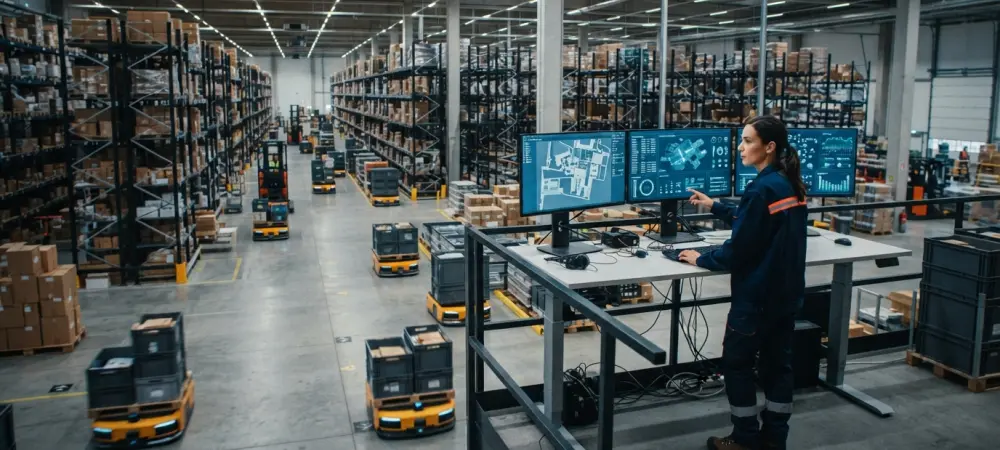
The industry is moving away from the “one-vendor-fits-all” mentality because, frankly, no single manufacturer has perfected every single warehouse function yet. This necessitates a “brain behind the bots,” which is typically a Warehouse Execution System or an intelligent middleware layer that can coordinate commands across diverse systems. Instead of spending months on custom code that is fragile and hard to update, we are using modular, configurable platforms that act as a universal translator for ASRS, AMRs, and sortation systems. This orchestration allows us to balance workloads dynamically; if one robotic zone is overwhelmed, the software can re-route tasks in real-time to ensure the facility maintains a steady rhythm. It turns a chaotic symphony of different machines into a synchronized operation that feeds unified visibility back to the primary enterprise systems without the need for expensive, one-off programming.
Operational readiness is often the “hidden” component of a successful rollout. How can organizations better prepare their human workforce to transition into a high-automation environment without disrupting productivity?
Operational readiness is far more than just handing out a training manual; it is about the sensory and ergonomic harmony between humans and machines. You have to involve the floor staff early in the process so they see automation as an empowering tool that reduces their physical fatigue and travel time rather than a disruptive hurdle. Designing physical workflows where humans and robots complement each other—such as optimized picking stations that reduce stretching and bending—is crucial for maintaining morale. When employees understand the new Standard Operating Procedures and feel confident in exception handling, the facility reaches its target throughput rates significantly faster. There is a specific kind of “buy-in” that happens when a picker realizes the robot is doing the heavy lifting and long-distance walking, allowing them to focus on accuracy and speed.
Post-commissioning support is frequently overlooked once the “go-live” celebrations are over. What role does continuous optimization play in maintaining a low Total Cost of Ownership over the life of the system?
A “set it and forget it” mentality is the fastest way to see your ROI evaporate as SKU profiles evolve and customer demands shift. A true partnership involves periodic system performance audits where we look at equipment utilization and software bottlenecks to see if the original logic still holds up. We might need to fine-tune wave-releasing logic or update slotting patterns as inventory patterns change from year to year. This iterative adjustment ensures the hardware remains an asset rather than a legacy burden, extending the physical life of the machinery through planned preventive service. By treating the automation as a living organism that needs regular “check-ups” and software updates, companies can keep their cost-per-order fulfillment low even as their business model grows and changes.
Given the risks involved in these massive capital deployments, how valuable is it for leadership teams to engage with real-world simulations like those found in an Innovation Lab?
Seeing is believing, but more importantly, seeing is de-risking. When an executive team can walk into an environment where multi-vendor integration is happening in real-time, they can observe how unified software orchestration actually coordinates distinct robotic and storage systems. It allows them to test operational concepts and data flows before a single bolt is turned in their own facility, which is an incredible safeguard for their capital. You can discuss facility layouts and growth objectives with strategic advisors while watching the equipment handle real-world scenarios, which clears up the ambiguity that reports alone cannot replicate. It transforms a high-stakes gamble into a calculated, strategic move by proving the concept works in a controlled, observable setting.
What is your forecast for warehouse automation?
From 2026 to 2030, we are going to see the “Great Integration” where the focus shifts entirely from the physical capabilities of robots to the intelligence of the software layers connecting them. I expect the 10% CAGR we are currently seeing to be driven by mid-sized companies who previously thought automation was out of reach but are now finding that configurable, modular systems make it accessible. As labor shortages remain a persistent pressure, the standard for a “modern” warehouse will no longer be determined by how many square feet it occupies, but by how seamlessly its data flows from the cloud to the robotic arm. We will reach a point where the distinction between “software” and “hardware” in the supply chain disappears entirely, resulting in a fully autonomous, self-optimizing ecosystem that can pivot in hours rather than months.