

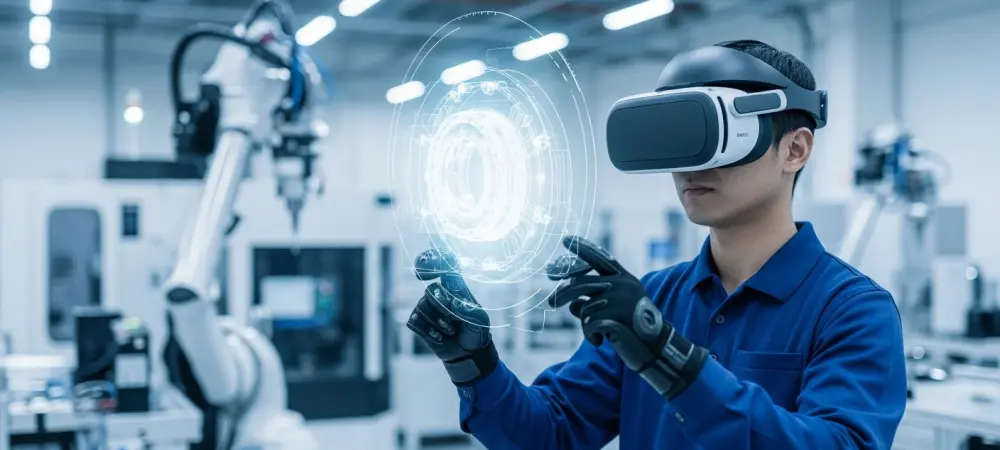
The journey from filing cabinets and paper resumes to cloud-based HR information systems has culminated in a new frontier where the digital and physical worlds merge to redefine the employee experience. Human Resources is no longer just about managing personnel but about creating engaging, efficient, and deeply connected workplaces, a challenge magnified by the permanence of remote and hybrid models. In this context, immersive technologies like virtual reality (VR) and augmented reality (AR) are emerging as transformative tools, offering powerful solutions to modern challenges like distributed team engagement, scalable skills development, and the persistent talent gap. This analysis will explore the current landscape of immersive HR technology, examining its key applications, expert insights, future potential, and the significant challenges that lie ahead.
The State of Immersive HR: Adoption and Application
Defining the Technologies and Market Momentum
Before exploring its applications, it is essential to distinguish between the core immersive technologies. Virtual reality offers a complete digital immersion, transporting users into a simulated three-dimensional environment through a headset that blocks out the physical world. In contrast, augmented reality overlays digital information, graphics, and data onto the user’s real-world view, enhancing rather than replacing their surroundings. Together, these technologies form the building blocks of what is often called the metaverse, a new generation of interactive digital spaces.
The momentum behind these technologies in the corporate world is driven by a convergence of powerful trends. The once-prohibitive cost of hardware has fallen dramatically, making large-scale deployment feasible for organizations. This is exemplified by Accenture’s landmark purchase of 60,000 VR headsets to onboard its global workforce through a sprawling virtual campus. Furthermore, the increasing consumer adoption of VR for gaming and entertainment means that a growing segment of the workforce is already comfortable and familiar with the technology, lowering the barrier to entry for professional use.
This corporate interest is being met with massive investment from the technology sector’s biggest players. Companies like Meta, Microsoft, and Nvidia are pouring billions into developing the foundational hardware, software, and platforms needed to support widespread adoption of simulated environments. Their long-term commitment signals a clear trajectory toward a future where immersive interaction becomes a standard component of the digital toolkit, pushing HR leaders to consider how these platforms will integrate into their strategies.
Practical Implementations Across the Employee Lifecycle
Immersive technology is already making a tangible impact across the entire employee journey, from the first point of contact to long-term career development. In hiring and recruiting, it moves beyond the limitations of promotional videos to offer genuinely immersive experiences. Companies like Toyota have partnered with platforms such as InstaVR to create virtual office tours, giving candidates a palpable sense of the work environment and company culture before they even apply. This technology also enhances the vetting process, allowing for realistic job simulations that test practical skills, not just credentials on a resume.
Once an employee is hired, VR proves invaluable for onboarding, particularly for remote workers who can often feel disconnected. It fosters a genuine sense of presence and connection, allowing new team members to meet, collaborate, and build rapport in a shared virtual space, as demonstrated by Accenture’s success with its virtual campus. Beyond social integration, VR accelerates practical training with remarkable efficiency. Walmart’s partnership with the training platform Strivr, for instance, reduced the time required to teach new hires key skills from a full eight-hour day to just 15 minutes.
The benefits extend deeply into employee training, especially for abstract or “soft” skills. A comprehensive study by PwC using the Talespin platform found that learners in VR completed training four times faster than in a traditional classroom, were 275% more confident in applying their skills, and felt a nearly fourfold increase in emotional connection to the content. This capability democratizes high-level training in areas like leadership and communication, making it scalable for employees at all levels. Moreover, it offers powerful applications for technical and high-stakes learning in industries like manufacturing and aviation, where companies such as PTC use digital twin software to provide safe, controlled environments for complex operational training.
Insights from Industry Leaders on Engagement and Effectiveness
Industry experts consistently point to the unique quality of total immersion as the primary advantage of VR over other digital learning methods. As Dan Eckert, formerly of PwC, highlights, a learner in a VR headset is completely absorbed in the training module, free from the constant distractions of emails, text messages, or other browser tabs that plague traditional e-learning. This undivided attention fosters a deeper emotional connection to the material, which directly translates into significantly higher rates of knowledge retention and application.
Beyond individual focus, the technology excels at creating safe-to-fail environments for practicing complex interpersonal skills. Aaron Sorensen of Lotis Blue Consulting emphasizes that the true differentiator is “the ability to interact with others in a dynamic way where teaming can be applied.” VR allows organizations to simulate high-stakes business scenarios—a difficult client negotiation, a critical presentation to leadership, or a sensitive feedback session—without any real-world consequences. This provides an invaluable training ground for emerging leaders to build confidence and hone their abilities in a controlled setting.
The strategic value of this trend is reinforced by a chorus of industry analysts. Holger Mueller of Constellation Research notes that VR provides an unparalleled opportunity to “present your company in much better ways” during recruitment, creating a lasting impression that a standard video cannot match. Meanwhile, Lisa Rowan of IDC points to the technology’s growing importance in fostering a sense of community for an increasingly distributed workforce, asserting that immersive platforms can “provide a feeling of togetherness when you’re working alone in your house,” a critical function for maintaining culture in a hybrid world.
Navigating the Future: Potential and Pitfalls
Emerging Opportunities and Advanced Capabilities
Looking ahead, the evolution of immersive technology promises even more sophisticated applications that could fundamentally reshape talent development. One of the most compelling prospects is “cognitive load measurement,” a technique that would leverage advanced biometric sensors in future headsets to measure a user’s capacity to process information in real time. This data could be fed into AI-driven learning systems to dynamically adjust the complexity and pace of training, creating truly personalized learning paths that accommodate different learning styles and support neurodiversity in the workplace.
This level of personalization and effectiveness will further democratize access to high-quality training. Historically, intensive, simulation-based coaching for skills like public speaking or leadership was reserved for senior executives due to its high cost and logistical complexity. Immersive technology makes it possible to scale these transformative learning experiences, offering them to employees at every level of the organization and fostering a more equitable approach to career development.
Ultimately, these advancements will play a crucial role in strengthening the connective tissue of organizations navigating a permanent hybrid work landscape. As shared virtual spaces become more common and sophisticated, they will serve as digital hubs for collaboration, innovation, and culture-building. For HR, this represents a powerful new toolkit for fostering a cohesive and engaged workforce, regardless of where individual employees are physically located.
Acknowledging the Hurdles to Widespread Adoption
Despite its immense potential, the path to mainstream adoption of immersive HR technology is not without significant obstacles. One of the most immediate concerns is ergonomics and user experience. Some individuals experience motion sickness, dizziness, or eye strain from prolonged headset use, while the physical safety of navigating a virtual space without colliding with real-world objects remains a practical consideration for at-home use.
Furthermore, the complexity of content development presents a major hurdle. Creating a truly realistic and effective simulation for soft skills training requires far more than just a 3D environment; it demands sophisticated programming to simulate nuanced human behavior and robust analytics to measure progress meaningfully. The investment in time and resources to build this high-quality content is substantial and may be prohibitive for smaller organizations.
Finally, two broader challenges must be addressed. Widespread adoption in the workplace is heavily dependent on the technology first becoming more mainstream in the consumer market, as familiarity lowers the psychological barrier to professional use. More critically, the potential for advanced headsets to collect highly personal biometric data raises profound ethical and privacy concerns. Organizations will need to establish rigorous safeguards and transparent policies to prevent the misuse of this sensitive information, ensuring that these powerful tools are deployed responsibly.
Conclusion: The Imperative for HR Innovation
The analysis of immersive technologies has revealed their profound potential to transform core HR functions, from attracting and vetting talent to onboarding new hires and developing seasoned leaders. The evidence has shown that VR and AR are far more than novelties; they are strategic tools capable of delivering measurable improvements in learning efficiency, skill application, and employee engagement. Their ability to create distraction-free, safe-to-fail environments has positioned them as a superior modality for both technical and interpersonal skills development.
It has become clear that immersive technology offers a powerful solution to some of the most pressing challenges of the modern workplace. In an era defined by distributed teams and a constant need for upskilling, these tools have provided a tangible way to foster connection, build culture, and accelerate learning at an unprecedented scale. The successful implementations by pioneering companies have served as a compelling proof of concept for the rest of the industry. Ultimately, the exploration of this trend confirmed that the question for HR leaders was no longer if they should engage with immersive technology, but when and how. The hurdles of cost, content creation, and user comfort remained, but the strategic imperative to build a more resilient, skilled, and connected workforce demanded innovation. Forward-thinking HR departments recognized this and had already begun experimenting with these platforms, understanding that mastering these tools was essential to designing the future of work.