

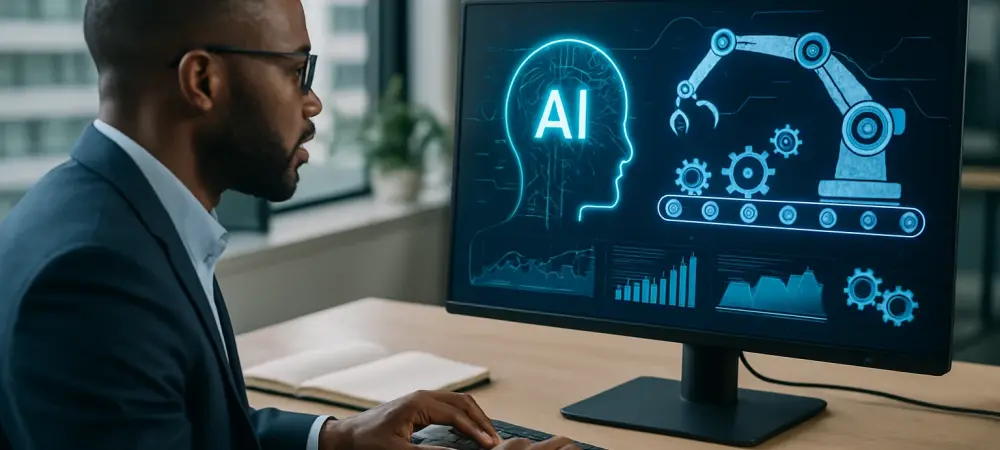
Imagine a corporate world where the drudgery of scheduling meetings, drafting reports, and managing resources vanishes almost overnight, replaced by seamless AI systems that handle these tasks with precision. According to a recent McKinsey report, over 30% of current corporate tasks could be automated by AI within the next few years, signaling a profound shift in how work is structured. This rapid integration of artificial intelligence into workplaces marks a pivotal moment in the digital era, presenting both unprecedented opportunities for efficiency and significant challenges in job displacement. The transformation raises critical questions about the future of corporate roles while offering a chance to refocus on human strengths. This analysis delves into AI’s role in automating mundane tasks, reshaping job structures, and reigniting passion in work by freeing employees to pursue creativity and connection.
The Rise of AI in Corporate Environments
Automation of Routine Tasks: Data and Trends
The adoption of AI tools to handle repetitive corporate tasks has surged in recent years, fundamentally altering the daily grind for many employees. Industry insights from Gartner indicate that as of this year, nearly 40% of organizations have implemented AI for functions such as scheduling, data entry, and basic reporting, with projections estimating a rise to 60% by 2027. These tools are not mere conveniences; they target the bureaucratic backbone of corporate life, tasks that often consume disproportionate time and energy with little strategic value.
This trend is reshaping the corporate landscape at an accelerated pace. McKinsey studies reveal that approximately 25% of current corporate roles are directly impacted by automation, with roles in administrative support and data processing most affected. Looking ahead, forecasts suggest that AI integration will influence up to 50% of roles in some capacity over the next few years, pushing companies to rethink how they allocate human resources.
The implications of these statistics are far-reaching for both workers and organizations. As AI takes over routine operations, the focus shifts to identifying areas where human input remains irreplaceable. This transition, while promising in terms of efficiency, underscores the urgency of adapting to a rapidly changing work environment where traditional task-based roles may soon become obsolete.
Real-World Applications of AI in Business
Across industries, companies are already harnessing AI to streamline operations and reduce administrative burdens, showcasing tangible benefits. For instance, Microsoft’s AI-driven tools, such as those integrated into Outlook, automate calendar management and meeting coordination, saving employees hours each week. Similarly, Salesforce employs AI to generate automated reports and customer insights, allowing sales teams to focus on relationship-building rather than data crunching.
Specific case studies highlight the measurable impact of these technologies. A multinational consulting firm recently reported a 20% increase in productivity after implementing AI platforms to handle project scheduling and resource allocation. By delegating these time-intensive tasks to algorithms, consultants could dedicate more effort to strategic problem-solving, directly boosting client satisfaction.
Another example comes from a leading retail corporation that adopted AI for inventory tracking and supply chain coordination. The result was a 15% reduction in operational delays and significant cost savings, as documented in their annual performance review. These real-world applications demonstrate that AI is not just a futuristic concept but a practical tool already transforming how businesses operate, paving the way for a reimagined corporate workflow.
Expert Insights on AI’s Impact on Work
Industry leaders and tech analysts offer a balanced perspective on AI’s dual role in reshaping corporate environments, acknowledging both disruption and potential. A prominent HR executive from a Fortune 500 company recently noted that while AI is eroding traditional roles tied to repetitive tasks, it simultaneously creates space for work that prioritizes emotional intelligence and innovation. This shift, though unsettling for some, is seen as a chance to redefine what constitutes meaningful contribution.
On the flip side, tech analysts caution against unchecked optimism, pointing to widespread anxiety among workers about job relevance. A recent survey paraphrased by a leading technology consultant revealed that many employees fear their skills may become outdated as AI advances. Yet, the same consultant emphasized that with proper reskilling initiatives, these fears can be mitigated, turning displacement into an opportunity for growth in more dynamic roles.
HR professionals also weigh in on the cultural impact, suggesting that AI’s influence extends beyond tasks to the very ethos of work. One expert highlighted that freeing employees from mundane duties could foster a renewed sense of purpose, provided organizations actively guide this transition. These varied insights underscore a critical tension: AI’s capacity to hollow out rote jobs must be balanced with strategies to elevate human-centric skills, ensuring that technology serves as an enabler rather than a threat.
The Future of Corporate Work with AI
Looking ahead, AI is poised to drive a fundamental shift from static job roles to more fluid, project-based arrangements, unbundling tasks in ways that redefine employment. This evolution allows workers to engage in diverse initiatives without being confined to rigid descriptions, contributing expertise in targeted bursts. For organizations, the benefit lies in heightened agility, enabling faster innovation cycles and adaptability to market demands.
However, this promising outlook comes with notable challenges that cannot be ignored. Job insecurity remains a pressing concern as roles tied to automatable tasks diminish, necessitating robust reskilling programs to prepare workers for emerging demands. Additionally, the transition to fluid work structures risks alienating employees if not managed with care, potentially undermining the very engagement AI aims to foster.
Broader implications point to a seismic shift in organizational design, moving away from bureaucratic hierarchies toward dynamic networks of collaboration. Supported by AI, these networks prioritize meaningful initiatives over outdated processes, offering the potential for renewed worker engagement. Yet, the balance hangs on leadership’s ability to navigate this change thoughtfully, ensuring that the positive outcomes of flexibility and purpose outweigh the risks of disconnection and uncertainty.
Conclusion: Embracing AI for a Human-Centric Work Future
Reflecting on the journey of AI’s integration into corporate life, it becomes evident that automation tackles mundane tasks, fundamentally alters job structures, and opens pathways to prioritize human strengths like creativity and connection. This transformation challenges traditional notions of work, pushing both leaders and employees to adapt to a landscape where technology handles the routine while humanity takes center stage. The shift exposes vulnerabilities, particularly around job security, but also illuminates a profound opportunity to rebuild engagement. Navigating this transition demands deliberate action to prevent disengagement and cultivate environments where work holds deeper meaning. Leaders need to champion reskilling efforts and redesign roles to emphasize interpersonal and innovative contributions, ensuring AI becomes a partner in progress. By embracing these strategies, the corporate world can turn the void left by automation into a canvas for growth.
Looking back, the path forward requires a commitment to thoughtful adaptation, leveraging AI as a tool to reignite passion in corporate settings. The next step is clear: stakeholders must collaborate on frameworks that balance technological efficiency with human fulfillment, crafting a future where work reflects the best of both worlds. This vision, though complex, holds the promise of redefining corporate life for generations to come.