

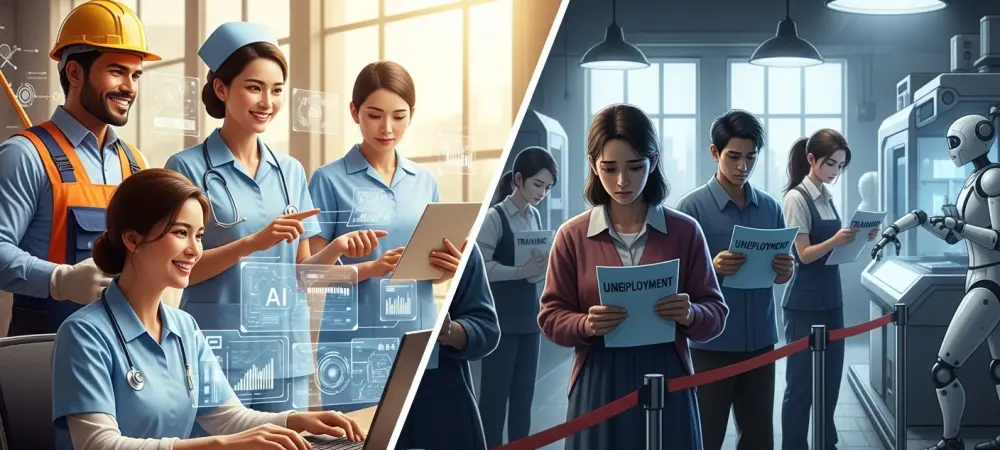
The corporate boardroom has undergone a remarkable transformation in how it discusses the future of work and the integration of machine intelligence into the daily lives of global professionals. Only a short while ago, the conversation was dominated by high-stakes warnings of mass displacement, but that tone has rapidly softened into a message that emphasizes collaboration and support. This strategic shift in communication is not a mere accident of timing; it is a fundamental pivot intended to reshape how labor forces perceive their potential obsolescence. While the public language emphasizes empowerment and co-piloting, the internal metrics of major corporations often reveal a more complicated reality of restructuring and efficiency-driven downsizing.
Understanding this narrative shift is essential for any professional navigating the current job market, as the stakes remain incredibly high. The divergence between what is stated on stage at major technology conferences and what occurs behind the closed doors of human resources departments creates a precarious environment for those in the middle of their careers. If the new narrative is merely a tool for corporate reputation management, workers may find themselves unprepared for the subtle ways their roles are being hollowed out or combined. Consequently, the challenge lies in distinguishing between genuine organizational growth and the calculated management of worker anxiety during a period of unprecedented technological transition.
The Rhetorical Pivot: From Mass Displacement Threats to the Rise of the AI Co-Pilot
Just over a year ago, industry leaders like Ford CEO Jim Farley were sounding the alarm, suggesting that artificial intelligence could replace half of the white-collar workforce in the United States. Such statements captured global headlines and stoked a fire of widespread fear across various professional sectors, from law to finance. However, as the technology has become more pervasive, the narrative has undergone a calculated makeover. OpenAI’s Sam Altman now suggests that the industry may have underestimated the central role humans will play in the workplace, reframing the technology as a supportive partner rather than a total substitute for human thought.
This transition from a replacement-first mentality to one focused on augmentation is a linguistic choice designed to replace worker anxiety with a sense of collaborative opportunity. By rebranding AI as a co-pilot or an assistant, the industry has successfully moved away from the imagery of a cold machine taking over a desk. Instead, the messaging suggests that the technology is there to handle the drudgery, leaving the creative and strategic elements to the human operator. This change in messaging is less about a fundamental shift in the capabilities of the technology and more about ensuring that the public remains receptive to its integration into every aspect of professional life.
Why the C-Suite Is Changing Its Tune on Workforce Automation
The transition to a human-centric AI narrative is born out of practical necessity rather than pure altruism. For corporations to see a return on their massive investments in generative technology, the employees actually doing the work must be willing to integrate these tools into their daily routines. Executives have realized that they cannot capture the full value of their digital transformations if the workforce is too paralyzed by fear to use the very tools meant to increase output.
Furthermore, there is a clear distinction between using automation for cost-cutting and using it as a primary engine for organizational growth. While internal surveys reveal that a majority of growth leaders currently use these tools for efficiency—a term often used as a euphemism for reducing labor costs—nearly 78% believe the technology will eventually accelerate broader expansion. To transition from a narrative of doing more with less to one of achieving more together, CEOs must convince their staff that the technology is an instrument for expansion. SEC filings and quarterly reports now reflect this shift, emphasizing how digital integration allows the existing workforce to tackle more complex projects rather than simply reducing the headcount.
The Hidden Mechanics of Modern Job Displacement: From Layoffs to Role Consolidation
While the public narrative focuses on collaboration, the reality of the labor market suggests a more subtle form of displacement often described as job redesign. Instead of a single, dramatic wave of layoffs that targets thousands of individuals at once, many companies are opting for reduced backfilling. When an employee leaves a company voluntarily or reaches retirement, management simply chooses not to hire a replacement, redistributing the necessary tasks to remaining staff members who are expected to use AI to bridge the gap. This invisible attrition allows companies to shrink their workforce over time without the negative publicity or the morale-crushing impact of formal layoff announcements.
Role consolidation has also become a standard practice in the modern corporate environment, where one employee uses automation to handle the responsibilities previously assigned to multiple people. This trend is particularly evident in AI-native startups, which have begun to redefine the relationship between company valuation and team size. Recent studies indicate that these younger firms often maintain similar valuations to traditional companies despite having workforces that are roughly 25% smaller. This indicates that while job titles may remain, the total number of available roles—particularly at the entry and middle-management levels—is quietly contracting as software takes over the heavy lifting of data processing and routine administration.
Data vs. Dialogue: Comparing Executive Optimism with Empirical Market Trends
Despite the inclusive language coming from the C-suite, a significant reality gap persists between corporate messaging and worker sentiment. Pew Research Center reports that only 6% of workers believe AI will create more opportunities for them in the long term, while nearly a third anticipate a steady decline in available roles. This skepticism is not just a matter of pessimism but is backed by hard data from the labor market. In the first half of 2026, AI-related restructuring accounted for nearly a quarter of all announced layoffs, according to reports from Challenger, Gray & Christmas. These figures highlight a disconnect where public reassurance often masks private corporate actions focused on efficiency measures and headcount reduction.
This gap between dialogue and data creates a trust deficit that can be difficult for organizations to bridge. Even when layoffs are officially categorized under broad headings like restructuring or strategic realignment, employees often perceive the underlying driver to be technological replacement. The 14,000 job cuts cited in mid-2026 as being directly influenced by AI integration served as a stark reminder that the co-pilot narrative does not always result in a larger crew. As companies continue to report record profits alongside smaller staff sizes, the tension between the corporate growth story and the individual worker’s reality continues to escalate, forcing a re-evaluation of what job security means in a digitized economy.
Future-Proofing Your Career: Strategies for Navigating the Shift Toward AI Integration
To maintain career security, professionals looked past executive rhetoric and focused on their specific task mix to identify where they provided the most unique value. Roles that relied on rules-based, repetitive, or easily standardized processes faced the highest exposure to automation during the initial waves of integration. Conversely, human value remained strongest in areas requiring high-level ethical judgment, relationship management, and the ability to navigate complex business contexts. The most successful workers were those who moved away from transactional duties and toward roles that demanded cross-functional influence and accountability for final outcomes.
Developing deep AI fluency became a vital differentiator for those seeking to remain relevant in a tightening labor market. Research indicated that candidates who demonstrated specific competencies in leveraging these tools to solve complex problems saw a significant increase in interview invitations across various fields. They treated the technology as a lever to amplify their expertise rather than a replacement for their fundamental skills. By leaning into high-judgment tasks and mastering the ability to direct automated systems, these individuals ensured that their human contribution was not only visible but indispensable to the organizational goals of the future.