

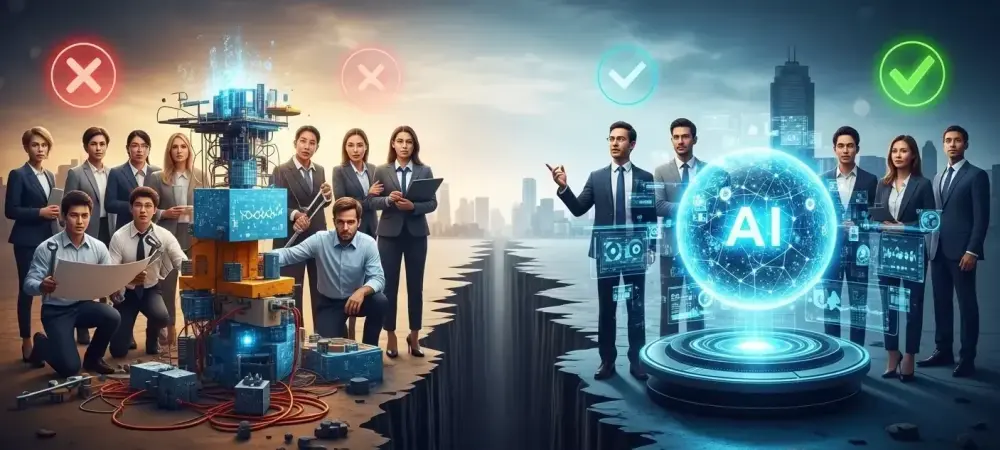
The Great AI Divide: Why Executive Optimism and HR Reality Are Clashing
The staggering difference between high-level boardroom enthusiasm and the boots-on-the-ground reality of human resources reveals a corporate landscape that is deeply fractured over the actual utility of artificial intelligence. While the theoretical potential of generative tools offers a seductive vision of automated efficiency, the messy reality of enterprise-wide implementation tells a more cautious story. The current transition from experimental pilot programs to full-scale integration has exposed a significant gap in how different tiers of leadership perceive the timeline and difficulty of this digital transformation.
This disconnect between strategic ambition and operational capacity threatens to derail progress before it can yield a significant return on investment. Financial and technical leaders often overlook the structural, cultural, and operational hurdles that define the current corporate environment, viewing AI as a plug-and-play solution. However, those responsible for managing the workforce recognize that the success of these tools depends entirely on a foundation that many organizations have yet to build, leading to a state of stalled momentum across various sectors.
The Statistics of Skepticism: Dissecting the Confidence Gap Across the Boardroom
Internal data highlights a massive disparity in how departments view their own preparedness, with IT departments reporting a 96% confidence level in organizational learning readiness. In contrast, only 14% of human resources leaders share this optimistic outlook, suggesting that the people building the tools and the people managing the talent are operating in two different worlds. This statistical chasm suggests that technical capability is being confused with organizational readiness, leaving a vacuum where cohesive strategy should exist.
Recent surveys, such as the Protiviti AI Pulse Survey, confirm that the perception of “learning readiness” is highly subjective depending on one’s proximity to technical development. While engineers see the potential of the software, HR professionals see the lack of training and the massive skill gaps that remain unaddressed within the broader employee base. This tension creates a significant bottleneck, as the builders of the future find themselves at odds with the custodians of the current workforce.
Beyond the Bottom Line: Why HR Leaders Prioritize Operational Pragmatism Over Financial Projections
Chief Human Resources Officers are increasingly focused on the intricate details of people enablement, such as the complex task of redesigning jobs and shifting legacy compensation models. While the broader C-suite remains fixated on top-line revenue growth and immediate performance spikes, HR leaders are grappling with the organizational complexity that arises when AI compresses roles. They recognize that without a clear path for career progression in an automated environment, employee engagement and retention will likely suffer.
The risks of ignoring internal structures in favor of aggressive adoption schedules are becoming more apparent as companies struggle with role definition. Only 13% of HR leaders believe current job designs are actually ready for AI integration, compared to nearly double that percentage among other executive roles. This grounded perspective suggests that a focus on financial projections alone misses the fundamental shift required to make the workforce functional and productive in a machine-augmented world.
The Talent Paradox: Why Leadership Inexperience Threatens to Stall AI Implementation
A critical expertise vacuum exists at the highest levels of management, with only 3% of top-tier executives feeling highly prepared to lead their organizations through an AI-centric shift. This lack of specific expertise suggests that many leaders are making high-stakes decisions about technology they do not fully understand, creating a ripple effect of uncertainty. Furthermore, roughly 43% of managers feel unequipped to lead teams where AI is a primary collaborator, highlighting a systemic failure in leadership development.
Technical access does not naturally lead to effective change management or organizational leadership, a fact that many firms are learning the hard way. The assumption that providing tools to a workforce is enough to drive transformation ignores the human need for guidance and strategic direction. Without a concerted effort to upskill leadership first, the implementation of sophisticated software will likely result in confusion rather than the promised gains in productivity and innovation.
Rethinking the Operating Model: From Marginal Gains to Fundamental Workforce Overhauls
The timeline for AI enablement remains a point of contention, as only 5% of HR leaders believe their functions will be fully integrated within the next three years. This “slow and steady” approach stands in direct opposition to the accelerated vision held by financial and technical directors who expect rapid results. The disparity indicates that the transition is proving much harder than expected, requiring a total overhaul of process designs rather than just another software layer. Real value from artificial intelligence depends on a fundamental shift in the operating model that prioritizes agility and cross-functional collaboration. Financial leaders may push for marginal gains in the short term, but HR perspectives suggest that long-term sustainability requires a more patient strategy focused on deep structural change. Bridging this gap is essential for ensuring that technological investments do not result in a collection of disparate tools that fail to work in harmony with the human element.
Strategic Pillars for Bridging the Organizational Readiness Chasm
Success in the current landscape required a deliberate alignment between C-suite expectations and the pragmatic insights held by workforce experts. Leaders discovered that the most effective path forward involved redesigning job roles to emphasize human-centric skills while updating legacy compensation models to reflect new forms of value creation. By establishing clear frameworks for collaboration between the CHRO, CTO, and CEO, organizations were able to move past the initial friction of adoption. Pragmatic workforce insights became the cornerstone of every successful deployment, ensuring that the human infrastructure could support the weight of technical change. Managers who focused on job redesign rather than simple automation found that their teams were more resilient and adaptable to the shifting demands of the market. These actionable steps transformed AI from a source of anxiety into a catalyst for organizational growth and enhanced productivity across the board.
Forging a Unified Path Toward a Sustainable AI-Driven Future
The transition toward an AI-augmented workforce eventually proved that the challenge was a human-centric one rather than a purely technical endeavor. Companies that prioritized workforce readiness as a prerequisite for technological investment saw much higher rates of success than those that rushed to implement new tools. It became clear that the most resilient organizations were those that treated their people as the primary drivers of innovation, using technology to amplify rather than replace human capability.
Leadership roles evolved significantly during this period, shifting toward a model that valued change management and psychological safety as much as technical literacy. The most successful firms realized that the speed of business was defined not by the software itself, but by the ability of the organization to absorb and utilize that software. By closing the gap between executive ambition and human reality, these leaders ensured a sustainable future where AI and human talent operated in a unified and highly effective ecosystem.