

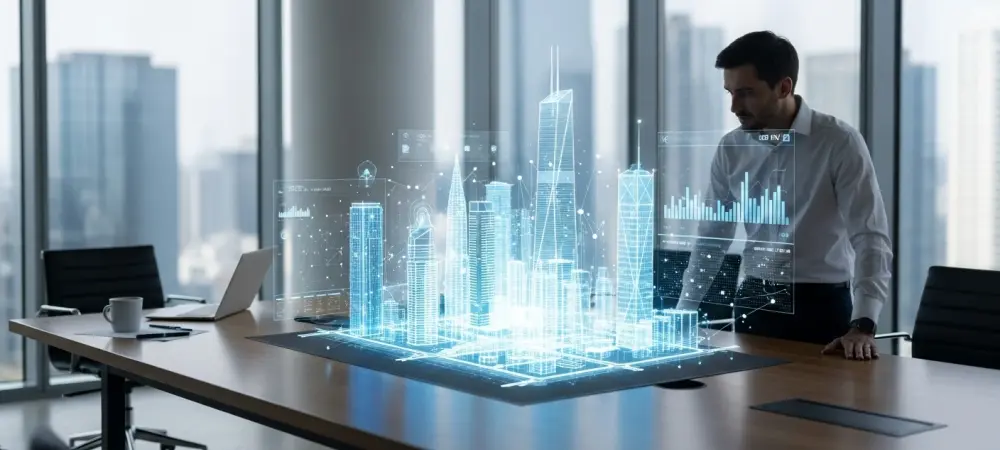
The days of staring at glowing rectangles to manage complex logistics or architectural designs have rapidly faded as the environment itself has become the ultimate user interface. This transition represents a fundamental departure from the era of mobile-first thinking, moving instead toward a reality where digital information is inextricably woven into the physical objects and spaces around us. While the tech industry once fixated on the “metaverse” as a cartoonish digital escape, a far more powerful and pragmatic evolution has quietly taken hold: spatial computing. This isn’t about fleeing reality into a virtual playground; it is about the sophisticated fusion of digital intelligence with the physical environment we inhabit every day. By merging AI, augmented reality, and digital twins, spatial computing is dismantling the traditional barrier between “the computer” and “the task,” turning our entire surroundings into an interactive, data-rich interface.
Modern enterprises have recognized that the old paradigm of “windowed” computing creates a significant cognitive bottleneck. When a worker must constantly look away from a physical task to consult a screen, the brain experiences a micro-reset known as context switching, which reduces efficiency and increases the likelihood of error. Spatial computing solves this by anchoring data to the physical world, allowing information to exist in the exact location where it is most useful. This shift represents the most significant change in human-computer interaction since the introduction of the graphical user interface. It signifies an era where technology finally adapts to the three-dimensional nature of human biology, rather than forcing humans to adapt to the limitations of two-dimensional screens.
Beyond the Screen: Why the World Is No Longer Flat
The conceptual shift toward a non-flat computing world is driven by the realization that physical space is the most intuitive canvas for data visualization. In the current professional landscape, the reliance on flat monitors often obscures the true complexity of data, particularly in fields like urban planning, molecular biology, or global supply chain management. Spatial computing introduces a layer of “depth” that allows professionals to walk through data, manipulate virtual prototypes with their hands, and perceive scale in a way that was previously impossible. This immersion does not serve as a distraction but as a clarity-enhancing tool that leverages human spatial memory and depth perception to improve decision-making.
Furthermore, this evolution is supported by a robust infrastructure of sensors, high-speed connectivity, and advanced spatial mapping. As these technologies have converged, the physical office has been transformed into a living data environment. Walls, desks, and equipment are no longer just inanimate objects; they are potential anchors for digital twins and collaborative work-surfaces. This allows for a level of environmental intelligence where the workplace understands the presence, orientation, and needs of the worker. When a designer enters a studio, the relevant 3D models and project timelines don’t just appear on a screen; they materialize in the center of the room, ready for manipulation and review.
The implications for global collaboration are equally profound, as spatial computing eliminates the “flatness” of video conferencing. Instead of seeing a grid of faces on a screen, team members can now engage in co-presence, where remote colleagues appear as lifelike volumetric entities within the same physical room. This sense of shared space fosters a higher degree of psychological safety and creative synergy, as the non-verbal cues and spatial awareness essential for human communication are preserved. The world is no longer flat because our interactions are no longer confined by the borders of a glass panel, allowing the digital and physical realms to coexist in a single, unified workspace.
From Speculative Hype to Industrial Utility
Understanding the shift toward spatial computing is essential for any leader navigating the post-digital era. Unlike its predecessors, which often prioritized social networking or entertainment, spatial computing addresses the high-stakes demands of the modern enterprise. As industries face increasing complexity and a shrinking margin for error, the need to bridge the gap between digital information and physical execution has become a critical business imperative. It is the move from “context switching”—looking away from work to consult a screen—to “contextual clarity,” where information exists exactly where the work happens. This pragmatism has rescued the technology from the “trough of disillusionment” that swallowed earlier iterations of the metaverse.
This transition from hype to utility is visible in how organizations now allocate their innovation budgets. There is a growing intolerance for “innovation theater”—the practice of deploying flashy technology without a clear return on investment. In contrast, spatial computing initiatives are increasingly judged by their ability to solve tangible problems, such as reducing the time it takes to onboard a new technician or decreasing the scrap rate in high-precision manufacturing. The focus has moved from “What can this technology do?” to “What specific friction point can this technology eliminate?” This results in a more disciplined and effective integration of spatial tools into the daily workflows of the enterprise.
Moreover, the maturity of the hardware has played a pivotal role in this industrial adoption. The bulky, uncomfortable headsets of the past have been replaced by lightweight, ergonomic wearables that can be worn for entire shifts without fatigue. These devices are now treated as essential personal protective equipment (PPE) in many sectors, providing workers with heads-up displays that warn of hazards or provide real-time environmental data. By focusing on the utilitarian needs of the “deskless worker”—those who work on factory floors, in hospitals, or in the field—spatial computing has found a permanent and indispensable home in the modern industrial complex.
The Pillars of Spatial Integration: Professional Environments
Spatial computing eliminates the mental load of translating 2D manuals into 3D actions, a transformation most evident in manufacturing and field services. By using AR overlays, technicians see internal schematics projected directly onto physical machinery, allowing for real-time diagnostics and guided repairs without ever breaking focus. This direct visual guidance reduces the training curve for complex systems from months to weeks, as the technology provides a “digital hand-hold” through every step of a procedure. If a sensor fails on a turbine, the system doesn’t just send an alert; it highlights the specific bolt that needs to be loosened and displays the torque specifications in the technician’s field of view.
In medicine, spatial computing allows for the spatial transmission of expertise, a concept that has revolutionized healthcare and remote surgery. Surgeons now use 3D digital overlays to navigate complex anatomical structures or guide remote practitioners through life-saving procedures from thousands of miles away, ensuring that geography no longer limits the quality of care. This capability is particularly vital in specialized fields like neurosurgery or cardiology, where millimeters matter. By projecting a patient’s MRI data directly onto their body during an operation, surgeons gain a form of “X-ray vision” that allows them to plan incisions with unprecedented accuracy and avoid critical structures that would be invisible to the naked eye.
Enterprises are also increasingly utilizing digital twins—high-fidelity virtual replicas of physical systems—to simulate outcomes before committing capital. Whether it is testing a new robotics line in a virtual factory or simulating viral interventions in a digital laboratory, this technology allows teams to solve engineering and logistical bottlenecks in a risk-free environment. These digital twins are not static models; they are dynamic entities that ingest real-time data from IoT sensors to reflect the current state of their physical counterparts. This allows for predictive maintenance and “what-if” scenario planning that can save companies millions of dollars by identifying potential failures before they occur in the physical world.
The Human-Machine Synergy: Augmentation Over Replacement
The transformation of the workplace is not a zero-sum game between human labor and automation. Expert consensus suggests that spatial computing acts as a “teammate” rather than a replacement, providing a layer of cognitive support that enhances human capability. Just as an oncologist is more effective when supported by AI diagnostic tools that can scan thousands of pathology slides in seconds, a worker equipped with spatial insights becomes more capable and precise. This shift requires a cultural evolution where technology is viewed as a partner that handles the data-heavy “heavy lifting,” leaving humans to focus on high-level decision-making, empathy-driven leadership, and creative problem-solving.
This synergy is grounded in the idea of “human-in-the-loop” systems, where the technology provides the raw data and spatial context, but the human provides the intuition and ethical judgment. In a high-pressure environment like an air traffic control tower or an emergency response center, spatial computing can synthesize massive amounts of incoming data into a coherent 3D visualization. This prevents information overload and allows the human operator to maintain situational awareness. The technology does not make the decision; it prepares the environment so that the human can make the best decision possible with the least amount of cognitive strain.
Furthermore, the integration of spatial tools into the workplace helps to preserve institutional knowledge. As an aging workforce nears retirement, spatial computing allows veteran experts to record their workflows in 3D, creating “spatial tutorials” that capture the nuances of their craft. A junior engineer can then “step into” the expert’s shoes, seeing exactly where they looked and how they moved their hands during a specific task. This ensures that the intangible skills of experienced workers are not lost but are instead codified into a spatial library that benefits future generations. The focus remains on elevating the person, using the machine to bridge the gap between novice and master.
Strategies for Leading the Spatial Transition
HR and operational leaders must distinguish between “soft trends” and the “hard trends” of computing power and wearable miniaturization to navigate this transition effectively. Adopting an anticipatory leadership mindset involves moving beyond reactive management to proactively upskilling the workforce for a spatial environment. This means identifying which roles will be most impacted by spatial tools and providing the necessary training before the technology is fully deployed. Leaders who waited until the transition was complete often found their organizations struggling to adapt, whereas those who anticipated the shift were able to cultivate a culture of technological fluency and resilience.
To successfully integrate these tools, organizations also prioritized utility over optics, moving beyond the phase of innovation theater. The focus remained on solving tangible business problems—such as reducing error rates or shortening training cycles—rather than simply deploying flashy gadgets to appear tech-savvy. This required a rigorous assessment of where spatial computing could provide a genuine competitive advantage. For some, it was in the design phase, reducing the need for physical prototypes; for others, it was in customer service, allowing remote experts to “see” what the customer sees. By anchoring technology in real-world outcomes, these leaders ensured that spatial computing became a driver of growth rather than a drain on resources.
As spatial computing matured, the physical office evolved from a place where tasks were “housed” to a hub for high-intensity human interaction. Leaders designed workspaces that facilitated the creative and interpersonal synergy that digital overlays supported but could not entirely replicate. The office became a “spatial laboratory” where physical and digital assets were co-located to foster rapid iteration and deep collaboration. This reimagining of physical space recognized that while we can work from anywhere, there is a unique value in coming together to solve the most complex, ambiguous challenges. The workplace of the future was not abandoned; it was transformed into a more purposeful and technologically integrated environment.
The transition toward spatial computing was characterized by a deliberate move away from the distractions of the virtual world toward the enhancement of the physical one. Organizations that embraced this shift focused on creating a seamless interface between digital intelligence and human action, ensuring that information was always available in context. They invested in the necessary infrastructure and upskilled their teams to handle the new demands of 3D data management. This proactive approach allowed them to realize significant gains in productivity and employee satisfaction. Ultimately, the successful integration of these tools demonstrated that the most effective technology is the kind that makes us more present in our work, not less. The journey toward a spatially aware workplace proved that when digital tools are designed to work in harmony with human biology, the potential for innovation is limitless. Moving forward, the focus remained on refining these interactions to ensure that the human element stayed at the center of the technological loop. Leaders consistently evaluated the impact of spatial tools on workforce well-being, ensuring that the technology served to reduce stress rather than increase it. By maintaining this balance, the modern workplace became a more efficient, collaborative, and human-centric environment.