

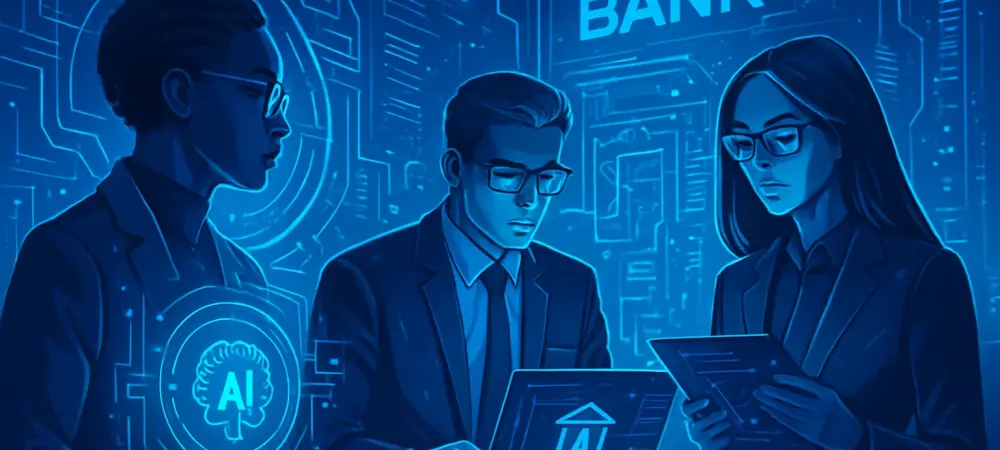
What happens when a traditional industry like banking collides with the unstoppable force of artificial intelligence? In boardrooms across the globe, executives are grappling with a stark reality: AI, especially generative AI (GenAI), is no longer a distant prospect but a present-day game-changer that demands immediate attention. The challenge isn’t just adopting cutting-edge tools; it’s ensuring the workforce can keep pace with a technology that’s evolving faster than most can comprehend. This exploration dives into how banks are rethinking talent development, moving beyond the hunt for scarce tech experts to transform their existing teams into AI-ready powerhouses, setting a new standard for innovation in finance.
Why Banks Are Racing to Prepare for an AI Future
The urgency for banks to adapt to AI stems from its transformative potential across every facet of operations, from fraud detection to customer service. A staggering 72% of bank executives, as revealed by Accenture’s Pulse of Change survey, acknowledge that AI advancements are outstripping their ability to train staff. This gap isn’t merely a technical hurdle; it’s a strategic imperative that could determine which institutions lead and which lag in a hyper-competitive market.
Beyond the numbers, the stakes are evident in how AI promises to redefine efficiency. Tasks that once consumed hours—think data analysis or risk assessment—can now be handled in minutes, freeing employees for higher-value work. Yet, without a workforce equipped to leverage these tools, such benefits remain out of reach, pushing banks to prioritize internal readiness over external recruitment.
This race isn’t just about staying relevant; it’s about seizing a first-mover advantage. Institutions that successfully integrate AI with human talent stand to gain not only operational edge but also customer trust, as personalized, swift services become the norm. The question remains: how can banks build this capability without starting from scratch?
The AI Talent Gap: A Barrier Hiring Can’t Solve
Relying on hiring to close the AI skills gap is proving to be a costly and unsustainable strategy for banks. The pool of highly specialized AI experts is limited, with fierce competition driving up salaries and making talent acquisition a financial burden. Moreover, onboarding external hires often fails to address the unique cultural and operational nuances of a specific institution.
Instead, the focus is shifting toward upskilling current employees, a move driven by necessity and pragmatism. Democratizing access to AI tools allows staff at all levels to experiment and innovate, uncovering use cases that external hires might overlook. This approach not only saves resources but also fosters a sense of ownership among teams already embedded in the bank’s ecosystem.
The broader trend of digital disruption amplifies this need for internal development. As AI reshapes everything from loan processing to compliance checks, banks recognize that a workforce unprepared for this shift risks obsolescence. Building skills from within emerges as the only viable path to bridge the gap without breaking the budget.
Redefining Talent: Innovative Approaches to AI Readiness
Preparing for an AI-driven future requires banks to rethink how talent is identified and nurtured, moving beyond conventional training. One key strategy involves democratizing AI access, ensuring tools are available to diverse roles, not just tech departments. This opens doors to unexpected innovation, as employees from varied backgrounds discover unique applications for GenAI.
Another approach draws inspiration from history, such as IBM’s 1970s Information Processing Aptitude Test, which unearthed programming talent in unlikely places like music departments. Banks are now encouraged to design similar assessments to spot high-agency individuals—those with curiosity and problem-solving prowess—who can champion AI initiatives regardless of their formal credentials.
Real-world examples highlight the power of human-AI collaboration, with institutions like Bank of America and JPMorgan Chase leading the way. Their focus on co-learning, where employees manage multiple AI agents, has spiked productivity, demonstrating that AI amplifies rather than replaces human effort. Meanwhile, studies from MIT and Stanford point to the need for nuanced automation, prioritizing “green light” tasks—those easily automatable—over resisted “red light” ones, ensuring smoother transitions.
Overcoming Resistance: Turning Skeptics into Advocates
Despite AI’s potential, resistance among employees remains a significant hurdle, with 31% of workers—and 41% of Gen Z—pushing back, according to research from the AI platform Writer. Fears of job displacement often fuel this reluctance, echoing anxieties from the 1980s when Excel’s introduction sparked similar concerns. Yet, history shows that such tools ultimately created more opportunities by eliminating drudgery.
Leading banks are tackling this head-on with transparent communication, showcasing AI as an additive force. For instance, JPMorgan Chase emphasizes removing “no-joy work”—tedious, low-value tasks—allowing staff to focus on strategic roles. Anecdotes from these institutions reveal that when employees see tangible benefits, skepticism often turns to enthusiasm.
Expert insights reinforce that cultural transformation is as vital as technological adoption. Addressing fears through dialogue and demonstrating real-world value can shift mindsets, creating a workforce that views AI as a partner. This balance of empathy and evidence proves essential in navigating the human side of digital change.
Practical Steps to Forge an AI-Ready Banking Future
Turning vision into reality demands actionable steps for banks aiming to cultivate AI readiness. Start by developing tailored assessments to identify high-agency employees, focusing on traits like curiosity over traditional tech skills. These tools can uncover hidden champions who drive adoption across departments. Investing in upskilling programs is equally critical, with training tailored to practical AI applications for all levels of staff. Alongside this, fostering a culture of curiosity—where experimentation is encouraged without fear of failure—requires leadership that balances innovation with compliance. Starting small by automating low-value tasks builds trust, paving the way for scaling to complex areas.
Empathetic leadership rounds out this framework, ensuring leaders address job displacement concerns through open dialogue. Reframing AI as a productivity enhancer, not a threat, helps align teams with the broader vision. These steps collectively offer a roadmap for banks to lead in an era where human-machine collaboration redefines financial services.
Reflecting on a Transformative Journey
Looking back, the journey of banks integrating AI into their workforce revealed a profound shift in perspective. What began as a daunting challenge evolved into an opportunity to reimagine talent and technology working in harmony. The stories of institutions overcoming resistance and the data underscoring AI’s potential painted a picture of resilience and adaptation.
The path forward demanded a commitment to continuous learning and strategic action. Banks that invested in upskilling, prioritized cultural shifts, and embraced empathetic leadership found themselves not just surviving but thriving amid digital disruption. For others still on the fence, the lesson was clear: start now by identifying internal champions and automating the mundane, setting the stage for broader innovation.
As the industry reflected on these strides, the focus turned to sustaining momentum. Scaling AI initiatives with a keen eye on employee engagement and evolving tools promised to keep banks at the forefront. This era of collaboration between human ingenuity and machine efficiency held the potential to redefine finance for generations to come.