

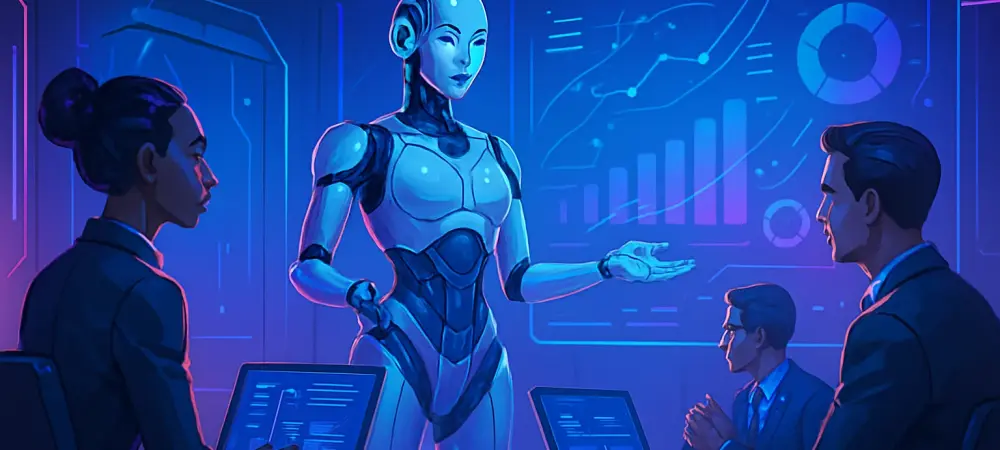
In an era where artificial intelligence is no longer a futuristic concept but a daily reality, the modern workplace is undergoing a seismic transformation that raises critical questions about the role of human managers. With AI tools becoming integral to operations across industries, a staggering 72% of white-collar workers globally are regular users, and this figure climbs to 78% among managers. This pervasive integration, especially in the U.S. where 64% of employees engage with generative AI multiple times a week, signals a shift that could redefine traditional hierarchies. As technology automates routine tasks and analytical processes, there’s growing speculation about whether managers, once seen as indispensable, might be losing their foothold to algorithms and machine intelligence. This evolving dynamic presents both unprecedented challenges and opportunities, prompting a deeper exploration into how AI is reshaping the very fabric of leadership and organizational structure.
The Rise of AI in Organizational Dynamics
AI Adoption and Its Impact on Roles
The rapid adoption of AI across workplaces is not merely a trend but a fundamental restructuring of how tasks are performed and roles are defined. Recent studies surveying over 10,000 white-collar workers across 11 countries reveal that managers are at the forefront of this shift, with a significant majority utilizing AI tools in their daily responsibilities. However, this technological embrace comes with a shadow of uncertainty, as 43% of managers worldwide express genuine concern over job security, a higher percentage than the 36% of non-managerial employees who share similar fears. The automation of task assignment, performance tracking, and even personalized communication within teams challenges the traditional value managers bring to organizations. What was once a domain of human expertise is increasingly being handled by sophisticated algorithms, leaving many to question where the line between augmentation and replacement truly lies in this tech-driven landscape.
Shifting Hierarchies and Flatter Structures
Beyond individual roles, AI is catalyzing a broader transformation toward flatter organizational structures that prioritize efficiency over traditional hierarchical models. This “AI-first” approach often results in fewer managerial layers, as automation takes over operational and analytical functions that once required human oversight. A notable cultural shift accompanies this change, with less than half of younger workers expressing a desire to climb into managerial positions, reflecting a generational pivot away from conventional career aspirations. Meanwhile, employees are increasingly tasked with managing AI assistants, with 71% of daily users finding these tools beneficial to their productivity. While this suggests a new kind of workflow where technology and human effort coexist, it also underscores the diminishing need for middle management in certain contexts, pushing organizations to rethink how leadership is structured and valued in an era dominated by intelligent systems.
Redefining Leadership in an AI-Driven Era
The Persistent Value of Human Connection
Despite the undeniable capabilities of AI in handling operational efficiencies, the essence of human interaction remains a cornerstone of workplace engagement that technology cannot fully replicate. Data indicates that 70% of employee satisfaction and engagement still depend on meaningful interactions with managers, highlighting a critical area where human leadership excels over machines. Skills such as inspiring teams, articulating a clear vision, and fostering group dynamics are uniquely human traits that AI struggles to emulate, especially in nuanced situations like conflict resolution. As automation absorbs routine and data-driven tasks, the role of managers appears to be pivoting toward these human-centric responsibilities. This shift suggests that while technology may handle the “what” and “how” of work, the “why” and emotional resonance of leadership remain firmly in the domain of human managers, necessitating a recalibration of their focus and skill set.
Adapting to a Future of Hybrid Leadership
Looking ahead, the future of management seems to lie in a hybrid model where human leaders and AI systems collaborate to create a balanced and effective workplace environment. Managers are encouraged to evolve from being technical overseers to becoming facilitators of inspiration and interpersonal connection, areas where their impact is irreplaceable. This adaptation involves embracing AI as a partner rather than a threat, leveraging its strengths to enhance decision-making and streamline processes while preserving the irreplaceable elements of human judgment and empathy. As predictions suggest that a significant portion of entry-level white-collar roles could be automated within the next five years, the emphasis for managers shifts to cultivating skills that technology cannot duplicate. This redefined paradigm of leadership, blending human insight with machine efficiency, emerges as a critical response to the challenges faced, ensuring that the workplace of tomorrow values both innovation and the human touch.