

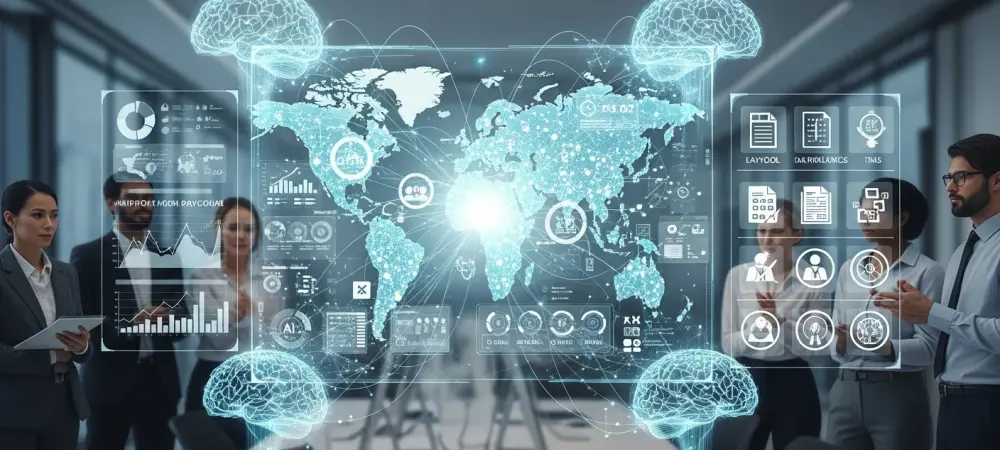
Managing the intricacies of a global workforce has reached a level of complexity where the traditional reliance on fragmented spreadsheets and manual entry is no longer just inefficient but a source of significant operational risk. This evolution has paved the way for the emergence of sophisticated AI-driven platforms, such as Papaya Global’s 360 AI, which seek to unify the disparate threads of payroll, payments, and compliance into a single intelligence layer. The transition from manual oversight to an integrated artificial intelligence environment represents a fundamental shift in how organizations perceive their human capital. This review explores how such technology bridges the gap between massive data sets and the localized expertise required to operate across more than 180 countries.
Modernization in the human resources sector is characterized by the movement away from static records toward dynamic, conversational ecosystems. Unlike previous generations of software that served as mere digital filing cabinets, current AI implementations act as a proactive nervous system for the enterprise. This technological advancement is particularly relevant in the current economic landscape, where businesses must navigate a maze of contradictory labor laws and financial regulations in real time. By layering AI over existing workforce data, companies can finally achieve a holistic view of their global operations without getting bogged down in the administrative friction that traditionally slowed international growth.
The Convergence of Artificial Intelligence and Global Human Resources
The emergence of AI in global human resources marks a departure from the “black box” era of international payroll. Historically, companies expanding into new territories had to rely on a patchwork of local providers, each with their own reporting standards and technical limitations. This fragmentation often resulted in data delays and a lack of transparency for central leadership. The introduction of 360 AI addresses this challenge by providing a unified data layer that integrates directly with the platform’s core infrastructure. This implementation is unique because it combines high-speed data processing with the nuanced judgment of human experts, ensuring that the automation remains grounded in localized reality.
Moreover, the technology serves as a bridge between high-level financial strategy and day-to-day HR tasks. While traditional systems focus on the “what” of workforce management, such as the total headcount or the gross monthly spend, this new AI layer explores the “why” and “how.” It interprets the complex relationships between currency fluctuations, tax law updates, and employee performance metrics. This contextual understanding allows finance and HR teams to transition from reactive problem-solving to strategic planning, effectively turning administrative overhead into a source of competitive advantage in the global market.
Technical Architecture and Core Functionalities
Conversational Data Interfaces: Real-Time Insights
At the heart of this technological shift is the conversational interface, which allows users to interact with live workforce data using natural language. Instead of navigating through multiple menus or building complex SQL queries, managers can simply ask questions in plain English. The underlying system uses domain-specific AI agents that have been trained specifically on payroll, finance, and compliance datasets. This ensures that the responses are not just grammatically correct but technically accurate within the specific context of labor management.
The performance of these agents is rooted in their ability to pull from live, secure records. When a query is made, the AI analyzes the structured data within the platform to generate a response that often includes visual aids like charts and trend lines. This capability democratizes data access within an organization, allowing even those without a background in data science to extract meaningful insights. Because the system operates within a closed-loop ecosystem, the security of sensitive employee information is maintained, as the data never leaves the protected environment to interact with external generative models.
Proactive Monitoring and Automated Compliance Triggers
The most significant technical leap forward is the shift from reactive reporting to proactive monitoring. The system utilizes “trigger event” technology to scan for regulatory shifts and filing deadlines across 180 jurisdictions. This constant vigilance is crucial in a world where labor laws change frequently, often with little notice. By identifying a status change or a compliance gap the moment it occurs, the AI allows teams to intervene before a minor administrative error becomes a major legal liability during a year-end audit.
This automated oversight functions as a digital watchdog, flagging anomalies that would be impossible for a human team to spot manually at scale. For instance, if a specific region in Germany updates its local tax withholding rules, the system immediately surfaces this information and highlights which employees are affected. This reduces the cognitive load on payroll managers and ensures that the company remains in good standing without requiring constant manual research. The uniqueness of this implementation lies in its ability to translate abstract legal changes into actionable operational tasks within the user interface.
Integrated Financial Infrastructure: Payment Routing
A workforce management platform is only as effective as its ability to move money, and this is where the integration of financial infrastructure becomes vital. The AI environment manages the entire lifecycle of a payment, from initial salary calculation to final delivery in a local bank account. By handling cross-border routing and currency conversion within a secure, AI-driven environment, the system eliminates the delays and hidden fees often associated with traditional intermediary banks. This level of integration ensures that 95% of payments can be delivered in real time, providing a level of predictability that is essential for maintaining employee trust.
Furthermore, the system’s ability to manage “wallet funding” and real-time reconciliation provides finance leaders with unprecedented visibility into their cash flow. The AI doesn’t just process the payment; it monitors the health of the entire payment ecosystem, identifying potential bottlenecks or routing errors before they impact the payroll run. This synergy between financial technology and human resources management creates a more resilient infrastructure that can adapt to the volatile nature of global banking. The result is a unified system where payroll and payments are no longer siloed functions but two sides of the same coin.
Industry Shifts Toward Generative Analytics
The transition toward generative analytics represents a major trend identified by industry analysts who predict that the majority of analytics content will soon be driven by AI. This movement signals the end of the era of static dashboards that require manual interpretation. Instead, the future of management lies in contextual intelligence, where the system provides not just the data, but the narrative behind the data. This shift allows executives to understand the broader implications of their workforce decisions, such as how turnover in one region might be linked to compensation trends in another.
Treating payroll, payments, and compliance as a single connected ecosystem is a radical departure from the traditional approach of managing these as separate administrative tasks. By breaking down these silos, organizations can achieve a level of operational agility that was previously impossible. This trend toward convergence is driven by the realization that workforce data is most valuable when it is viewed through a multi-dimensional lens. As companies continue to adopt these generative models, the focus will move from basic data collection to the engineering of strategic workforce deployments that are optimized for both cost and compliance.
Practical Deployment: Global Enterprise Environments
In practical enterprise settings, the application of this technology has led to immediate efficiency gains. HR directors are now using AI to resolve payroll discrepancies instantly, identifying why a specific salary changed month-over-month or why a payment remains pending. This speed of resolution is critical for maintaining high levels of employee satisfaction and reducing the administrative burden on support teams. Real-world scenarios, such as mitigating legal risks in countries like Belgium or Germany through localized data validation, demonstrate the tangible value of having an AI that understands the nuances of regional labor laws.
The impact of this technology extends beyond mere troubleshooting; it informs high-level strategic decision-making. Companies use AI to analyze headcount distribution and turnover trends, receiving live updates that help them refine their retention strategies. In a competitive global market, the ability to act on this data in real time can be the difference between a successful expansion and a costly failure. By providing a clear, evidence-based view of the entire global workforce, the technology empowers leadership to make informed choices about where to invest resources and how to scale their operations efficiently.
The Challenge: Overcoming Barriers to Automated Global Management
Despite the advancements, several barriers remain that require a careful balance between automation and human oversight. Maintaining high data security standards within generative AI models is a primary concern, as the sensitive nature of payroll data leaves no room for error. The technical hurdle of navigating the diverse and often opaque labor laws of nearly 200 countries remains a significant challenge for any automated system. While AI can process vast amounts of information, it occasionally lacks the cultural and legal nuance that only a human expert can provide, making the “human-in-the-loop” model essential for long-term accuracy.
Ongoing development efforts are focused on refining the accuracy of AI models to prevent the “hallucinations” that can sometimes plague generative systems. Trust is the currency of the payroll industry, and any automated error can have devastating consequences for a company’s reputation and legal standing. Therefore, the goal of modern workforce infrastructure is not to replace human experts but to augment their capabilities. The successful deployment of these systems depends on creating a feedback loop where AI handles the heavy lifting of data processing while human professionals provide the final validation and strategic judgment.
The Future: Autonomous Workforce Infrastructure
The trajectory of workforce technology points toward an even deeper integration between AI agents and global banking tiers. Future developments will likely involve the creation of autonomous workforce infrastructure that can manage entire lifecycle events—from hiring to retirement—with minimal manual intervention. This concept of “workforce deployment engineering” suggests a future where administrative friction is virtually eliminated, allowing for greater economic mobility on a global scale. As these systems become more sophisticated, they will act as strategic advisors, suggesting the best jurisdictions for expansion based on real-time labor market data.
Long-term development will also focus on the interoperability of these AI systems with other corporate functions, such as procurement and supply chain management. The ultimate goal is to create a seamless operational environment where the human element is supported by a robust digital foundation. This will allow businesses to focus on their core mission rather than the logistical complexities of global expansion. The continued evolution of AI workforce management will likely redefine the standard for what it means to be a truly global enterprise, making international operations accessible to companies of all sizes.
Final Assessment: The AI Workforce Transformation
The implementation of 360 AI and similar technologies marked a definitive turning point in the management of global human capital. Organizations that adopted these unified platforms realized a significant reduction in administrative friction, achieving measurable gains of 30% in operational efficiency. This shift demonstrated that the complexity of international payroll could be managed effectively when machine intelligence was paired with localized human expertise. The transition from reactive reporting to proactive, conversational analytics provided decision-makers with the clarity needed to navigate a volatile global market with confidence.
The successful integration of AI into the workforce ecosystem proved that technology was most effective when it functioned as an assistant rather than a replacement for human intuition. As companies moved away from fragmented spreadsheets, they established a new standard for transparency and compliance in the HR and finance sectors. This transformation paved the way for a more fluid global economy, where the barriers to international employment were lowered and administrative burdens ceased to dictate the pace of corporate growth. The legacy of this shift remained the fundamental improvement in how global teams collaborated and were supported across borders.