

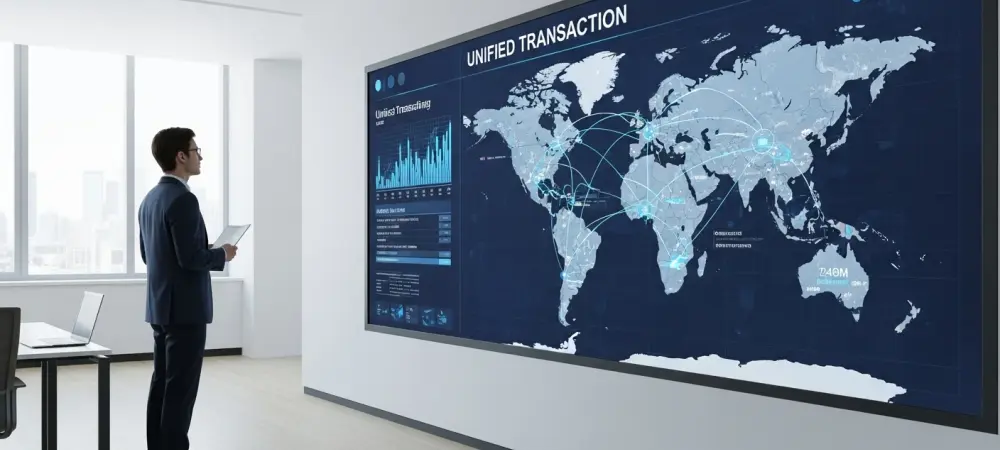
The digital economy has reached a critical juncture where the speed of a transaction is no longer a competitive differentiator but a fundamental requirement for any institution that wishes to remain relevant in a hyper-connected marketplace. For decades, the back-end infrastructure of banking was built on a series of disconnected silos, each handling a specific type of money movement. However, as consumers and businesses increasingly demand instantaneous results, these legacy systems are beginning to buckle under the weight of modern expectations. The shift toward unified orchestration represents the definitive end of fragmented finance, replacing the “patchwork” approach with a streamlined, centralized hub that treats every payment as a priority.
The Shift Toward Integrated Payment Architecture
Market Dynamics and the Surge in Orchestration Adoption
The rapid acceleration of instant settlement networks has forced a reevaluation of traditional banking priorities. With the widespread adoption of rails like FedNow and the RTP network, regional banks and credit unions are no longer just competing with one another; they are fighting for market share against agile fintech giants. Data from the current year indicates that institutions prioritizing centralized orchestration are seeing a dramatic uptick in operational efficiency. By consolidating reporting into a single interface, these entities have effectively neutralized the complexity of managing multiple payment types.
Furthermore, the cost-benefit analysis of core modernization has undergone a radical transformation. Moving away from legacy architecture is no longer viewed as a burdensome capital expense but as a vital revenue-enabling strategy. Modern orchestration platforms allow financial institutions to monetize faster payment services more effectively while simultaneously reducing the manual labor associated with exception handling. This shift allows staff to pivot from repetitive administrative tasks toward high-value activities that directly enhance the member experience.
Real-World Application: Desert Financial and Alacriti
The partnership between Desert Financial Credit Union and Alacriti serves as a primary benchmark for how large-scale institutions can navigate this infrastructure overhaul. Managing over $9 billion in assets, Desert Financial recognized that its existing systems could not scale to meet the demands of a real-time world. By implementing the Orbipay Payments Hub, the credit union successfully unified diverse rails, including the FedNow Service, RTP, and Visa Direct, into a single, cloud-native ecosystem. This integration proves that legacy institutions can achieve rapid speed to market without the catastrophic downtime often associated with a total core replacement.
The success of this implementation lies in its ability to coexist with existing fraud and online banking systems. By creating a bridge between the old and the new, the partnership demonstrated a blueprint for architectural agility. Instead of managing five different channels for five different payment types, the institution now operates through a singular lens. This consolidation has not only simplified the back-office workload but has also provided members with immediate visibility into their transactions, fulfilling the promise of a truly seamless digital banking journey.
Strategic Insights from Industry Leaders
Maintaining separate channels for different payment types is no longer an operationally viable or scalable model for modern financial entities. Experts argue that the primary advantage of a unified hub is the ability to create a “competitive moat” through intelligent routing. By directing payments through the most economically efficient rails in real-time, institutions can optimize their margins while ensuring the fastest possible delivery for the end-user. This level of sophistication was once reserved for global Tier-1 banks, but orchestration platforms have effectively democratized these capabilities.
Moreover, the value of orchestration extends deep into the back office through automated balancing. When a system can automatically reconcile disparate data streams, it removes the friction that traditionally slows down financial reporting. Industry professionals emphasize that this technological leap is less about the “pipes” themselves and more about the data that flows through them. A unified hub provides a holistic view of liquidity and risk, allowing leadership to make data-driven decisions with a level of precision that was previously impossible under a siloed framework.
The Future of Universal Instant Settlement
The industry is moving toward a future defined by ubiquitous interoperability, where the specific underlying rail—whether Wire, ACH, or RTP—becomes entirely invisible to the end-user. The next stage of this evolution involves the integration of predictive payment routing powered by advanced algorithms. These systems will automatically select the optimal path for a transaction based on fluctuating costs, settlement speeds, and real-time risk profiles. While the technical debt of migrating away from decades-old systems remains a challenge, the risk of inaction now far outweighs the complexities of modernization.
As regional players continue to adopt these sophisticated hubs, the gap between local credit unions and global financial giants will likely continue to shrink. This democratization of technology ensures that the size of an institution’s balance sheet no longer dictates the quality of its digital services. However, this transition also requires a heightened focus on real-time fraud detection. As money moves faster, the windows for intervention close, making it imperative for orchestration platforms to weave security directly into the fabric of the payment flow rather than treating it as an afterthought.
Conclusion: Navigating the New Standard of Money Movement
The transition to unified payment orchestration platforms marked a fundamental departure from the era of fragmented processing, establishing a new benchmark for how money moves in a digital-first society. The partnership between Desert Financial and Alacriti illustrated that even large, established institutions could successfully aggregate complex payment rails into a streamlined, hub-based model. This shift effectively prioritized scalability and speed, proving that architectural agility was the only viable path forward for entities looking to survive the decline of legacy systems.
Looking ahead, financial institutions must prioritize the development of unique, value-added products that leverage this newfound efficiency to create distinct revenue streams. The next phase of modernization will likely involve expanding these hubs to include cross-border capabilities and integrated identity verification to further reduce transaction friction. Those who invested early in orchestration have already secured a significant advantage, while those who delayed their migration now face a steep climb to catch up with an increasingly instant and interconnected global marketplace. Success in the coming years will depend on the ability to turn these invisible payment “pipes” into a platform for continuous innovation.