

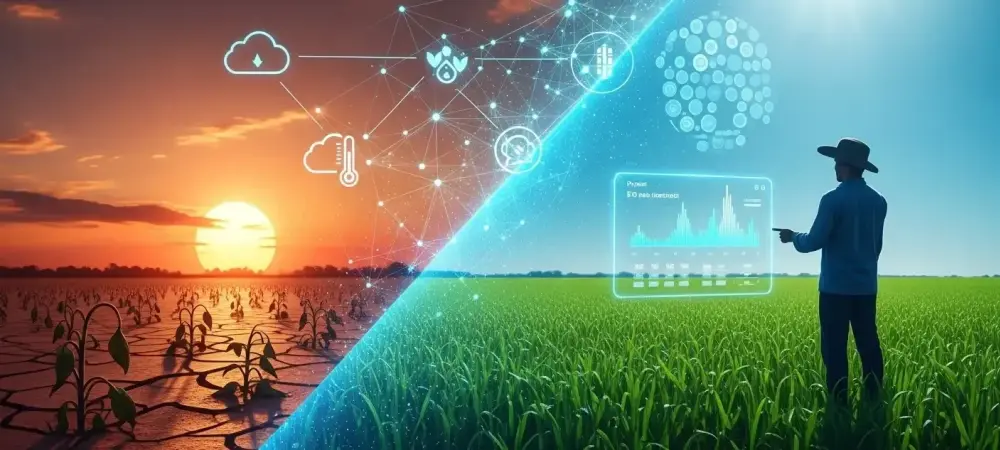
Smallholder farmers across the globe are no longer waiting for traditional insurance adjusters to arrive on their doorstep after a disaster because high-speed satellite data now triggers immediate financial relief the moment a climate threshold is breached. This evolution represents a fundamental shift in how agrarian economies shield themselves from the intensifying volatility of weather patterns. By moving away from slow, subjective loss assessments, the agricultural sector is adopting a model where technology dictates the flow of capital, ensuring that a single bad harvest does not lead to permanent insolvency for those who feed the world.
The significance of this trend lies in its ability to bridge the gap between global financial markets and the individual field. Historically, insurance was a luxury reserved for industrial-scale operations that could navigate complex claims processes. Today, parametric frameworks have democratized access to risk mitigation, allowing even the smallest maize or rice producer to benefit from sophisticated underwriting. This change is not merely a technical upgrade; it is a structural reorganization of rural economic resilience that prioritizes speed and transparency over bureaucracy.
The Rise of Data-Driven Risk Mitigation
Global Adoption Statistics and Growth Trajectory
The transition from traditional indemnity-based models to parametric frameworks has accelerated rapidly in emerging markets. In the past, a farmer would have to wait months for a physical inspection of their fields before receiving a payout, a delay that often led to missed planting seasons and mounting debt. Today, the scaling of climate-indexed insurance is visible in the millions of new policyholders among smallholder farmers, particularly in regions where traditional infrastructure is lacking. This growth is driven by the realization that data, when harnessed correctly, provides a more reliable safety net than reactive government aid.
International funding bodies, such as the InsuResilience Solutions Fund (ISF), have played a pivotal role in this expansion by subsidizing early-market entry and technical development. These organizations recognize that the initial cost of building weather stations and calibrating satellite feeds can be high, but the long-term savings are immense. By providing the “seed” capital for these programs, they have helped transition agricultural risk management from a reactive system of disaster aid toward a proactive, threshold-based financing model. This shift allows national budgets to be allocated more efficiently, as the financial burden of weather shocks is transferred to global insurance and reinsurance markets.
Real-World Implementation: Ecuador’s Landmark Initiative
Ecuador has emerged as a primary case study for this trend through the Tripartite Agreement Programme, a collaborative effort involving the UNDP, the German BMZ, and the Ecuadorian Ministry of Agriculture. This initiative focuses on protecting the rice and maize cycles in provinces that are particularly vulnerable to climate fluctuations. By utilizing satellite-based and meteorological data, the program removes the guesswork from insurance claims. When sensors detect that rainfall has fallen below a certain millimeter count for a specific period, payouts are initiated automatically, often reaching the farmer’s bank account before the drought has even concluded.
The success of the Ecuadorian model is largely due to the involvement of private sector leaders like AXA Climate, Blue Marble, and Hispana de Seguros, who have worked to build local capacity and refine risk models. This public-private synergy ensures that the insurance products are not just theoretical exercises but functional tools integrated into the local economy. Furthermore, the demographic impact of these rollouts is profound; recent data shows that women make up 44 percent of policyholders, while youth participation stands at 15 percent. By targeting these specific groups, the program is helping to stabilize the most vulnerable segments of the rural workforce.
Industry Expert Perspectives on Financial Resilience
Global leaders at the Insurance Development Forum (IDF) have emphasized that the future of agricultural stability depends on “risk layering.” This concept involves using different financial instruments to handle varying levels of disaster severity. For instance, parametric insurance handles high-frequency events like seasonal droughts, while state-level catastrophe bonds manage rare, massive floods. Experts agree that this approach is critical for maintaining national food security, as it prevents the total collapse of domestic production during moderate weather cycles that would otherwise devastate unprotected smallholders.
The consensus among development professionals is that parametric models create a “win-win” scenario for all parties involved. For governments, these models reduce the fiscal burden of emergency disaster relief, which is often unpredictable and politically charged. For insurers, it opens a vast and previously uninsurable market of millions of clients. However, the technical challenge remains in reconciling these “trigger-based” payouts with existing national legal and regulatory frameworks. Many countries still have laws written for traditional insurance, and updating these definitions to include data-driven triggers is a primary hurdle for widespread adoption.
Future Outlook and the Evolution of Climate Finance
The long-term sustainability of parametric insurance will depend on its ability to transition from donor-subsidized premiums to market-driven scales. As the pool of insured farmers grows, the cost of premiums is expected to decrease, making the products affordable without international aid. There is also significant potential for integrating insurance with other AgTech innovations. Imagine a scenario where a predictive weather app not only warns a farmer of an impending heatwave but also automatically adjusts their insurance coverage or suggests the use of more resilient seed technologies in real time.
The “real test” for these programs will be maintaining farmer participation and premium affordability once the initial subsidies phase out. To solve the issue of “basis risk”—where the data trigger might not perfectly align with the actual loss on a specific farm—technology is evolving toward higher-resolution satellite imagery and localized IoT sensors. If these technical refinements succeed, the Ecuadorian blueprint could serve as a global standard for climate justice, providing a tangible financial mechanism to protect agrarian economies in Latin America and beyond from the inescapable reality of weather volatility.
Summary and Strategic Implications
The emergence of parametric insurance has fundamentally rewritten the rules of engagement for agricultural risk management by replacing human estimation with hard data. This shift has begun to break the cycles of debt that have historically trapped smallholder farmers after every major storm or dry spell. By establishing a financial system that prioritizes speed and objectivity, stakeholders have created a more stable environment for food production. The importance of public-private synergy cannot be overstated, as the combination of sovereign backing and private sector expertise has proven to be the only way to build a functional safety net against extreme weather volatility.
Looking back at the progress made, it was clear that scaling these data-driven solutions was a necessity for ensuring global agricultural stability. The transition from reactive aid to proactive finance provided farmers with the dignity of being policyholders rather than mere recipients of charity. As regional economies continue to face environmental challenges, the lessons learned from these early initiatives have offered a viable path forward. The integration of insurance into the broader development toolkit has demonstrated that while climate change is an inevitable force, the financial destruction it causes does not have to be. Moving forward, the focus shifted toward making these systems entirely self-sustaining within the global market.