

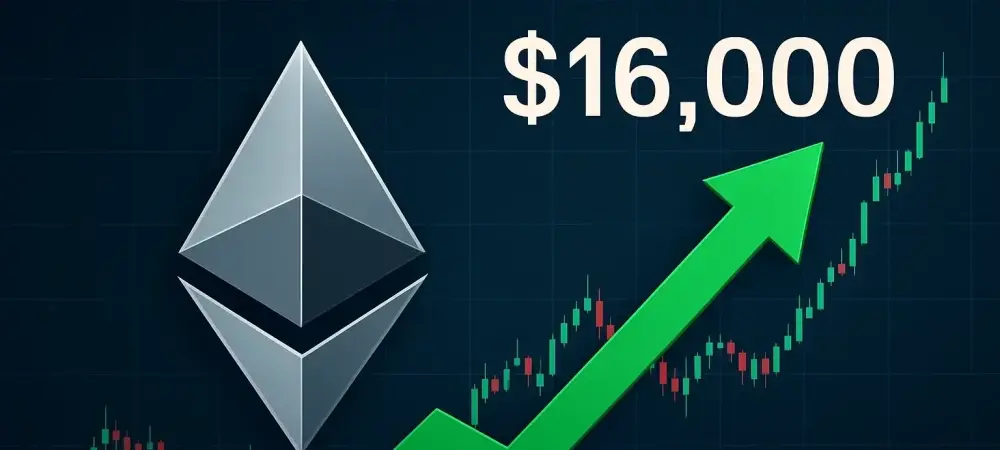
The Ethereum blockchain ecosystem has undergone a radical transformation over the past several cycles, evolving from a speculative platform into a foundational layer of global finance. This transition is not merely a technical achievement but a fundamental shift in how digital assets are perceived by institutional investors and retail participants alike. As the network matures, the convergence of deflationary economic policies and increased utility through decentralized applications provides a compelling argument for a significant price appreciation. Market analysts are increasingly focusing on the psychological and technical threshold of $16,000, a figure that once seemed astronomical but now sits within the realm of mathematical probability based on current adoption curves. By examining the current state of on-chain activity and the influx of institutional capital, one can observe a pattern that mirrors previous bull cycles but with much deeper liquidity and a more robust infrastructure. The integration of advanced scaling solutions has further bolstered this sentiment, creating a sustainable environment for long-term growth.
Structural Dynamics: Network Supply and Demand
The economic model governing the Ethereum protocol has transitioned into a highly efficient mechanism that systematically reduces the circulating supply during periods of high activity. Through the implementation of the burn mechanism associated with transaction fees, the network often experiences net-negative issuance, creating a scarcity effect that was previously unseen in large-scale blockchain networks. This deflationary pressure is further amplified by the massive amount of capital currently locked in staking contracts, which effectively removes millions of tokens from the liquid market. As validators continue to secure the network, the reward structure ensures a steady but limited flow of new assets, which is frequently offset by the volume of burned fees from decentralized finance protocols. Consequently, the available supply on exchanges has reached historic lows, creating a supply crunch scenario. This environment suggests that any increase in buying pressure could result in a rapid upward price movement as buyers compete for a dwindling pool of available assets.
While supply-side constraints provide a solid floor for valuation, the demand side is being driven by the explosive growth of Layer 2 scaling solutions that have redefined network utility. These platforms, including Arbitrum, Optimism, and Base, have successfully offloaded transaction volume from the mainnet while still requiring the underlying security of the base layer. This symbiotic relationship ensures that as the total value locked in Layer 2 ecosystems increases, the demand for the native asset remains robust. Institutional players are particularly drawn to this layered architecture because it offers the speed and low cost necessary for complex financial operations without compromising on the decentralization and security that the primary chain provides. The integration of zero-knowledge proofs and optimistic rollups has effectively solved the trilemma of blockchain scaling, paving the way for mass adoption in sectors such as supply chain management and tokenized real-world assets. Utility is now the primary driver of value.
Institutional Influx: The Evolution of Financial Products
The arrival of sophisticated financial instruments, most notably the spot exchange-traded funds, has fundamentally altered the demographic of the typical Ethereum holder in recent years. Professional fund managers and pension funds, who were previously sidelined by regulatory uncertainty, now have a direct and compliant path to gain exposure to the asset. This influx of capital is characterized by a long-term holding mentality, which differs significantly from the speculative trading patterns seen in earlier years. Furthermore, the inclusion of staking rewards within some of these institutional products provides a yield-bearing component that makes the asset highly attractive compared to traditional fixed-income securities. Major banking institutions are also increasingly utilizing the network for private stablecoin issuance and international settlements, further legitimizing the technology within the global financial system. This transition from a niche project to a recognized institutional asset class provides the stability to support higher price targets.
Navigating the path toward a valuation of $16,000 required a disciplined approach to risk management and a deep understanding of the underlying technological shifts. Investors who prioritized long-term fundamental growth over short-term volatility found themselves well-positioned to capitalize on the network’s expansion. The focus shifted toward identifying high-utility decentralized applications and maintaining a diversified portfolio that accounted for the rapid development of the Layer 2 landscape. Future considerations for participants involved monitoring the progress of upcoming protocol upgrades designed to further reduce gas costs and enhance interoperability across fragmented ecosystems. Successful strategies frequently incorporated automated dollar-cost averaging to mitigate the impact of market fluctuations while maintaining a core position in the asset. By viewing the network not just as a currency but as a global settlement layer, market participants developed a framework for assessing value that transcended traditional financial metrics.