

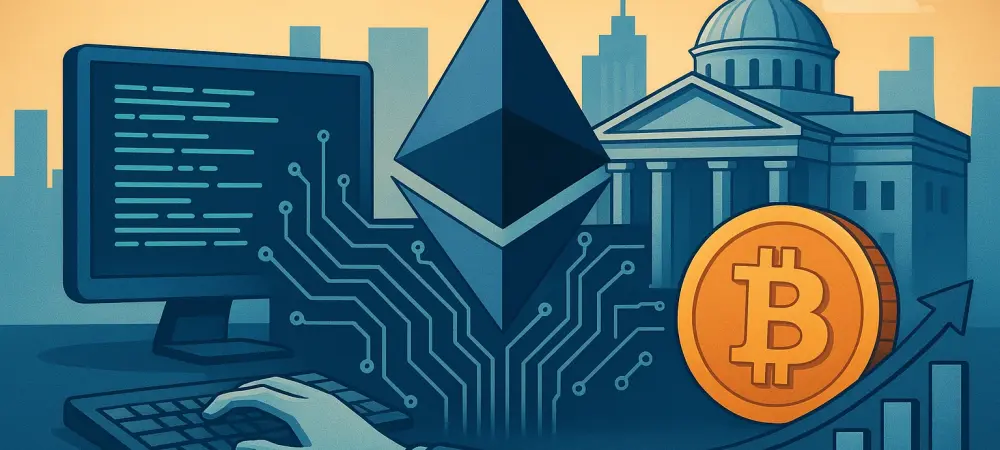
Smart contracts are expected to more than double in market value by 2031, reaching approximately 7.73 billion dollars as they become a burgeoning standard for complex financial logic. This transformation marks a significant departure from traditional legal frameworks toward a paradigm where software functions as the primary enforcement mechanism for high-stakes agreements. In the United States, major financial institutions are increasingly migrating their operational logic to decentralized networks, moving away from private servers that are prone to localized failures or administrative interference. By utilizing the Ethereum protocol, these entities are able to create transparent, immutable pathways for capital movement that do not rely on the physical presence or subjective interpretation of human intermediaries. This shift toward code-based infrastructure offers a level of resilience that was previously unattainable, effectively forcing a complete reimagining of risk management and trust in the digital age.
Decentralized Infrastructure: The Rise of Economic Expansion
The financial magnitude of this transition reflects a profound change in how American firms perceive blockchain technology, with the total market value of the sector projected to climb toward 455 billion dollars by 2031. This is not merely a speculative surge but a calculated pivot by institutional players who see decentralized protocols as the most viable path for modernizing aging financial systems. As these organizations transition from experimental pilot programs to fully integrated core operations, the demand for Ethereum-based solutions has reached an unprecedented peak. The move toward this standard is driven by the necessity for interoperability and the elimination of silos that have historically slowed down international and domestic settlements. US banks and investment firms are now competing to establish their dominance within this new ecosystem, recognizing that early adoption provides a critical advantage in an economy that is rapidly moving toward the total digitization of assets. At the heart of this technological shift lies the Ethereum Virtual Machine, a shared digital engine that functions as the global consensus mechanism for every transaction executed on the network. This environment ensures that every participant, regardless of their geographic location or organizational status, arrives at the exact same computational result simultaneously. For the American banking sector, the ability to operate in a trustless environment means that the mathematical certainty of the code effectively replaces the systemic risks traditionally associated with human error or centralized manipulation. By removing the need for a central clearinghouse to verify every movement of capital, the system drastically reduces the latency that has long plagued the traditional financial markets. This architecture provides a level of security that remains intact even if individual nodes or servers fail, ensuring that the financial infrastructure remains operational and consistent under any circumstances.
Operational Management: Efficiency and Gas Costs
Operating within a decentralized network requires a strategic approach to resource management, particularly regarding the gas fees that represent the cost of computational power. In the current landscape, American financial institutions treat these fees as a standard operational expense, much like the budgeting required for established cloud computing services such as Amazon Web Services or Microsoft Azure. Developers working on these platforms are tasked with creating highly optimized smart contracts to ensure that transaction costs do not erode the profitability of complex financial instruments. This focus on code efficiency has led to the emergence of a new class of financial engineering where the primary goal is to achieve the maximum possible utility with the minimum amount of computational overhead. As network demand fluctuates, the ability to dynamically manage these costs becomes a key differentiator for firms looking to scale their automated products across the broader US market. The development lifecycle for these financial tools is governed by a philosophy that prioritizes security and stability over the traditional move fast and break things approach found in Silicon Valley. Utilizing languages like Solidity, developers must adhere to strict coding standards to prevent vulnerabilities that could lead to catastrophic capital loss. Before any smart contract is deployed to the main network, it must undergo extensive testing and rigorous third-party auditing to identify potential flaws in the logic. This high level of digital craftsmanship is non-negotiable because, unlike traditional software that can be easily patched or rolled back, blockchain-based code is permanent once it is live on the network. Consequently, the role of the auditor has become as critical as that of the programmer, creating a robust ecosystem where safety is baked into the very foundation of the financial products being offered to American consumers and institutional investors.
System Integration: Real-World Data and Future Strategies
Since blockchain environments are inherently isolated from the outside world to maintain security, the integration of real-world data remains one of the most critical challenges for developers. This gap is bridged by specialized services known as oracles, which serve as secure pipelines that feed external information like stock prices, interest rates, and commodity values onto the chain. For US financial markets, the reliability of these data bridges is paramount, as the execution of multi-billion dollar contracts depends entirely on the accuracy of the information they receive. These systems require sophisticated consensus mechanisms of their own to ensure that no single data point can be manipulated to trigger an incorrect financial outcome. By effectively linking the digital ledger with the physical economy, oracles allow smart contracts to function as dynamic entities that respond to market shifts in real time, enabling the creation of automated hedges and complex derivatives.
The successful integration of Ethereum into the US financial architecture demonstrated that decentralized logic could effectively handle the complexities of institutional capital. As the transition progressed, firms that prioritized modular code design were able to adapt more quickly to the shifting demands of the global market. The industry moved toward a standard where the transparency of the blockchain was utilized for real-time auditing and regulatory compliance. This shift allowed oversight bodies to monitor systemic risks with a level of precision that was previously impossible, transforming the relationship between regulators and the institutions they supervise. Strategic planning involved the creation of hybrid systems that leveraged the security of decentralized protocols while maintaining the flexibility of traditional assets. This approach allowed for a gradual transition that minimized disruption while maximizing the benefits of automation. By embracing these innovative practices, the US financial sector ensured its relevance in a digital world.