

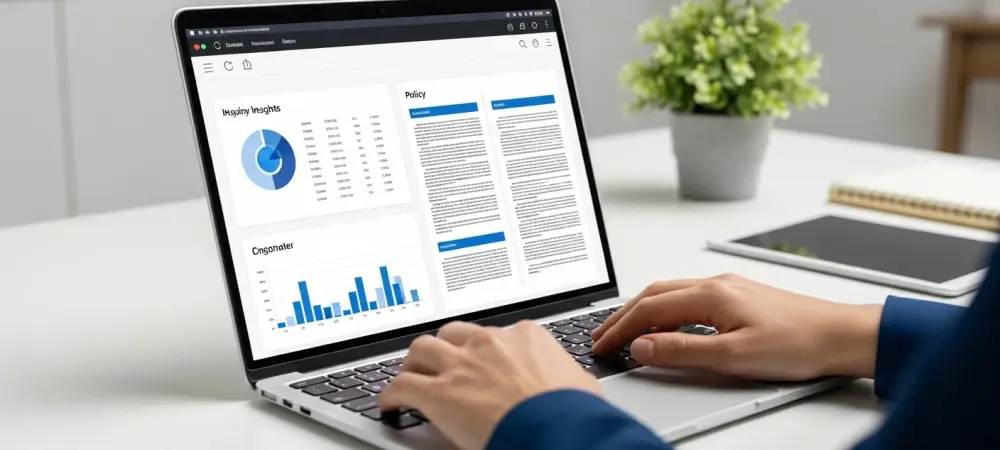
As the property and casualty insurance landscape undergoes a massive digital transformation, we sit down with a leading expert to discuss the latest innovations in core system technology. This conversation focuses on the strategic deployment of the Palisades release, exploring how specialized AI tools are moving from experimental side projects to the very heart of underwriting, claims, and finance operations. We delve into the mechanics of role-specific insights, the necessity of rigorous governance, and the ways in which real-time data integration is reducing the friction traditionally found in high-volume commercial lines and global markets.
AI tools are often standalone applications, but embedding them directly into core insurance platforms changes the workflow. How does this integration assist underwriting and billing teams specifically, and what metrics should they track to measure its success in their daily operations?
When an AI assistant like ProNavigator is embedded directly within InsuranceSuite and InsuranceNow, it eliminates the “swivel-chair” effect where staff must constantly jump between different applications. Underwriting and billing teams can now access role-specific insights grounded in their own policy documentation and guidelines, which allows them to make much more confident decisions on the fly. To measure success, firms should track the reduction in “time-to-answer” for complex policy queries and the overall accuracy of decisions made by frontline staff. You can almost feel the shift in energy when an underwriter no longer has to dig through a hundred-page PDF to find a specific clause because the AI has surfaced it instantly.
Balancing data access with security is critical when AI uses internal policy documentation and guidelines. How do role-based access controls and audit trails prevent unauthorized data leaks, and what steps are necessary to maintain human-in-the-loop oversight for complex decision-making?
Security is the bedrock of this new release, utilizing role-based access controls to ensure that only authorized users can touch sensitive datasets or specific internal documents. This means a customer service representative won’t accidentally stumble into high-level financial guidelines meant only for executives, maintaining a strict wall of governance. To keep the process transparent, every AI-generated response is backed by an audit trail, allowing managers to see the exact source material used for any given piece of advice. Human-in-the-loop oversight is maintained by ensuring that the AI functions as a co-pilot, providing the data while the human professional makes the final, nuanced call on high-stakes claims or policy exceptions.
Developers are now integrating custom AI tools into digital experiences using specialized design systems like Jutro. What are the practical challenges of merging third-party AI with existing insurance workflows, and how can teams ensure these digital experiences remain user-friendly for frontline staff?
The biggest hurdle for developers is ensuring that third-party AI tools don’t feel like a clunky “bolt-on” that disrupts the user experience. By leveraging the Jutro design system, developers can create a unified visual and functional language that makes these sophisticated tools feel like a native part of the daily workspace. It requires a meticulous approach to UI design to ensure that as new capabilities are added, the screens remain clean and intuitive for frontline staff who are already juggling high workloads. When done correctly, the technology fades into the background, leaving the adjuster or agent with a powerful, invisible assistant that handles the data-heavy heavy lifting.
Specialized updates now allow for electronic claims exchanges in the London Market and predictive litigation insights for workers’ compensation. How do these automated exchanges reduce administrative friction, and what step-by-step process do adjusters follow when using predictive data to forecast claim outcomes?
In the complex environment of the London Market, the move to electronic claims exchanges between brokers, bureaus, and insurers removes the manual paperwork that has slowed down global commerce for decades. For workers’ compensation, adjusters now follow a proactive workflow: they start by opening a new file, the system flags potential litigation risks using predictive insights, and the adjuster then uses that forecast to set more accurate reserves. This process turns a traditionally reactive role into a strategic one, allowing adjusters to address high-risk claims before they spiral out of control. It’s a sensory shift for the office—moving away from the frantic piles of paper toward a calm, data-driven dashboard that highlights exactly where attention is needed most.
Financial reconciliation requires detailed funds tracking and audit trails to ensure payment and refund accuracy. How does real-time pricing integration within policy management systems improve high-volume commercial lines, and what specific anecdotes illustrate the impact of this transparency on finance teams?
Real-time pricing integration means that when a quote is generated in PolicyCenter, the data is instantly synced with PricingCenter, ensuring that there are no discrepancies between what is sold and what is billed. This level of transparency is a game-changer for finance teams who previously spent hours—or even days—reconciling disparate accounts for high-volume commercial lines. I’ve seen finance managers who used to dread the end-of-month reconciliation find a new sense of peace because the detailed funds tracking shows exactly where every dollar is at any given moment. This accuracy not only protects the company’s bottom line but also drastically improves the customer experience by ensuring that refunds and payments are processed without error.
What is your forecast for the adoption of embedded AI in the property and casualty insurance industry?
I forecast that within the next three years, embedded AI will move from being a competitive advantage to a fundamental requirement for any insurer wanting to stay relevant in the P&C space. We will see a shift where 100% of core insurance processes—from initial quote to final claim settlement—are assisted by role-specific AI that acts as a primary interface for employees. As more companies realize that AI “just works” when it is grounded in their own internal data, the fear of “hallucinations” will fade, replaced by a new standard of operational efficiency. Ultimately, the industry will evolve into a more “human-centric” model, where the technology handles the administrative burden, freeing up professionals to focus on the complex, empathetic side of insurance.