

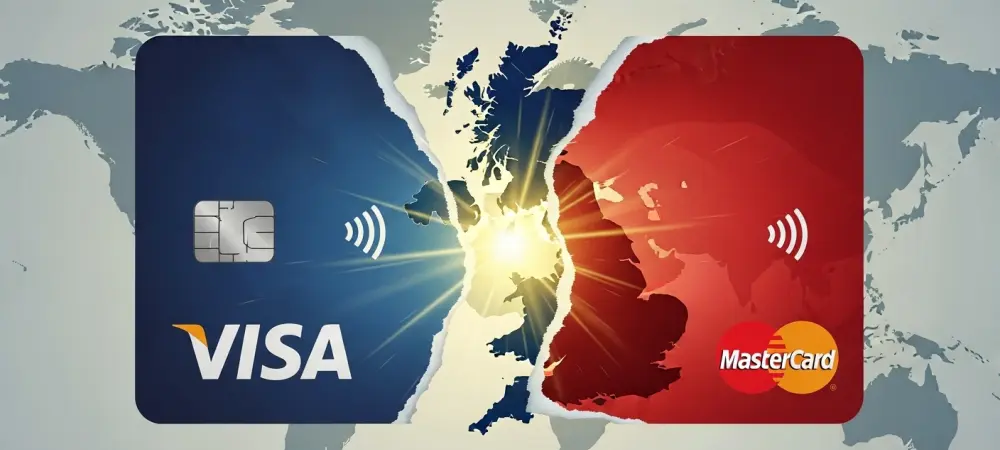
With geopolitical tremors reshaping global alliances, the UK’s financial sector is making a seismic shift of its own. A consortium of top British banks is laying the groundwork for DeliveryCo, a domestic payment rail designed to rival the long-standing dominance of Visa and Mastercard. This move signals a profound change, driven less by commercial competition and more by a pressing need for national economic resilience. We’ll explore the strategic motivations behind this ambitious project, the surprising collaboration with the very giants it seeks to challenge, the monumental financial and logistical hurdles it faces, and what it could all mean for the future of payments in the UK.
For years, UK banks were content with non-domestic payment rails. What specific geopolitical shifts have suddenly made creating a domestic alternative like DeliveryCo a priority, and how exactly does this new system address potential national security vulnerabilities? Please elaborate on the risks being considered.
For the longest time, the calculus was simple: building and managing a domestic switch was an expense UK banks were happy to avoid. The existing system, dominated by non-domestic schemes, worked well enough. However, the geopolitical landscape has grown far more uncertain. With questions swirling around foundational alliances like NATO, there’s a palpable anxiety that the UK’s heavy reliance on U.S.-based rails like Visa and Mastercard has become a critical vulnerability. The core risk isn’t just about system outages; it’s about sovereignty. The concern is that the U.S. government could, in a future political dispute, interfere with the ability of these companies to process transactions overseas, effectively holding the UK’s economy hostage. DeliveryCo is the answer to that nightmare scenario—an “onshore” system that ensures the UK’s payment network can function independently, safeguarding it from the fallout of international political friction.
With Visa and Mastercard handling approximately 95% of UK card transactions, why would they invest in a potential competitor like DeliveryCo? Explain their strategic motivation and the specific, practical role you expect them to play in the development of this new system.
It definitely looks counterintuitive on the surface, but it’s a very shrewd strategic play. Visa and Mastercard understand that this initiative is being driven by a force more powerful than market competition: national security. The train is leaving the station whether they are on it or not. By taking a stake in the project, they secure a seat at the table. This allows them to influence the development of the new rail, ensuring it can integrate with their existing networks and standards rather than becoming a completely isolated, disruptive force. Their role will likely be advisory and technical, leveraging their decades of experience to help navigate the immense complexities of building such a scheme. It’s a classic case of “if you can’t beat them, join them” to mitigate risk, maintain influence, and position themselves for whatever the future payment ecosystem looks like.
Given the immense cost of launching a national payment rail, what are the primary financial and logistical hurdles for DeliveryCo to become operational by 2030? Can you walk me through the key milestones and metrics the consortium must achieve to make this a reality?
The hurdles are simply immense, both financially and logistically. We’re talking about an incredible cost to build a secure, scalable, and resilient national infrastructure from the ground up. This isn’t just software; it’s a complex web of hardware, network protocols, and security measures that must be flawless from day one. Logistically, the biggest challenge is achieving universal adoption. For this to work, it needs buy-in from every major bank, merchant acquirer, and payment processor in the country. Key milestones will start with establishing the core governance and funding model, led by figures like Barclays’ Vim Maru. Then comes the technical build-out, followed by rigorous testing phases. The ultimate metric for success won’t just be launching by 2030, but achieving a critical mass of transaction volume shortly after, proving it’s a viable alternative and not just a very expensive backup plan.
Historically, low interchange fees meant UK merchants had little incentive to seek alternatives. How might a new, domestic payment rail impact card acceptance costs for businesses and the overall transaction experience for consumers? Please provide some potential scenarios.
This is where things could get very interesting for businesses and consumers. For years, EU regulations kept interchange fees in the UK low, so merchants didn’t feel the same cost pressures as their U.S. counterparts. A new domestic rail introduces competition on a national scale. In one scenario, DeliveryCo could be positioned as a lower-cost alternative, putting downward pressure on the fees charged by Visa and Mastercard and delivering significant savings to merchants, especially small businesses. For consumers, the transaction experience itself might not feel different at the point of sale—it should be just as seamless. However, they might see benefits emerge indirectly, such as more merchants being able to afford card acceptance or loyalty programs and offers tied specifically to the new domestic scheme.
What is your forecast for the UK’s payment landscape by 2030?
By 2030, I forecast a more fragmented but also a more resilient payment landscape in the UK. I don’t see DeliveryCo completely displacing Visa and Mastercard; their grip on the market, handling 95% of transactions, is too deep, and their global networks are essential for international commerce and travel. Instead, I expect DeliveryCo to exist alongside them as a robust domestic backbone, primarily for UK-to-UK debit transactions. Its presence will be a strategic one, acting as a crucial national security asset and a competitive force that keeps downward pressure on transaction costs. The conversation will have fully shifted from “why do we need this?” to “how can we best leverage our sovereign payment infrastructure?” The biggest variable remains the geopolitical climate; if international tensions rise, DeliveryCo’s importance will skyrocket from a strategic alternative to an essential service for daily economic life.