

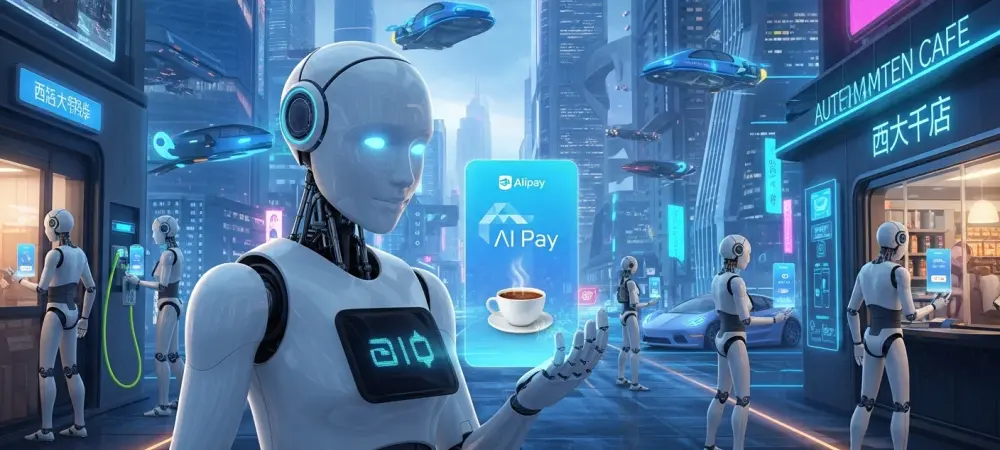
As we stand at the threshold of the “agentic commerce” era, the landscape of digital payments is shifting from manual transactions to autonomous interactions facilitated by AI agents. Our guest today has been at the forefront of this revolution, observing how these intelligent tools—affectionately known as “lobsters” in certain markets—are reshaping the way consumers and developers interact with financial systems. This conversation explores the transition from traditional app-based payments to voice-activated, AI-native solutions that have already captured the attention of over 100 million users. We delve into the mechanics of secure autonomous purchasing, the rise of “vibe coding” for developers, and the integration of financial tools into wearable hardware, providing a comprehensive look at the future of frictionless commerce.
AI agents, often called “lobsters,” can now execute purchases autonomously after a simple identity verification. How does the three-step flow of stating a need, confirming, and authorizing change the consumer experience, and what specific steps ensure users maintain control over modifications or cancellations?
The shift toward agentic commerce replaces the tedious process of navigating multiple screens with a streamlined, three-step conversational flow that feels remarkably human. It begins when a user simply states a need, such as “help me renew my membership,” which triggers the AI to handle the heavy lifting behind the scenes. Once the agent identifies the correct service and price, the user moves to the second step of confirming the order details, followed by a final authorization via the payment platform. This flow is designed to feel empowering rather than intrusive, as the user remains the ultimate decision-maker at every juncture. To ensure full control, we have implemented a system where a single voice command can modify or cancel an order at any point before completion, providing a safety net that feels as natural as the purchase itself.
AI-native payment products have reached milestones of over 100 million users and massive weekly transaction volumes. What infrastructure challenges arise when scaling these voice-activated services, and how do you measure the impact on transaction efficiency compared to traditional methods that require switching between different app pages?
Scaling a service that reached 100 million users by February 2026 requires an incredibly robust infrastructure capable of handling intense bursts of activity, such as the 120 million transactions processed in just one week between February 5 and February 11. The primary challenge is ensuring that voice recognition and intent processing happen in real-time without the latency that would frustrate a user. We measure efficiency by looking at the “friction-to-finish” ratio; traditional methods often require users to jump through five or six different app pages, whereas AI-native payments eliminate page-switching entirely. The result is a tactile sense of ease, where the cognitive load on the consumer is virtually zero, allowing the technology to fade into the background while the transaction is completed securely.
Security for agentic commerce relies on 24/7 intelligent risk control and full account protection programs. What are the technical trade-offs between seamless automation and multi-layer verification, and how do these safeguards handle complex scenarios where an agent might misinterpret a user’s specific purchase intent?
The tension between seamlessness and security is the central challenge of autonomous commerce, but we address this by embedding safeguards into every layer of the transaction. Activation always requires a deliberate user initiation and identity verification, ensuring that the “lobster” agent never acts without a clear mandate. Our 24/7 intelligent risk control system acts as a silent guardian, monitoring for anomalies while the user enjoys a frictionless experience. In cases where an agent might misinterpret a request, the mandatory authorization step acts as a final filter, and our “Full Compensation” account protection program provides a definitive safety net that builds deep emotional trust with the user. This multi-layered approach ensures that even if the AI misjudges a “vibe,” the user’s financial integrity remains untouched and fully insured.
New tools like Payment MCP Servers and AI Tipping allow developers to integrate payment functions using natural language. How does “vibe coding” simplify the commercialization of AI agents, and what are the practical implications for developers trying to monetize services based on usage duration or frequency?
“Vibe coding” represents a paradigm shift where developers no longer need to write complex back-end scripts to enable commerce; they can simply use natural language to integrate sophisticated payment functions. By utilizing tools like the Payment MCP Server or AI subscription modules, a developer can set up a monetization structure based on service usage times or duration without touching a single line of traditional code. This democratization of financial technology means that a creative individual can launch a fully commercialized AI agent on platforms like Claude Code or Hermes Agent in a matter of minutes. The practical implication is a massive surge in specialized AI services, as the barrier to entry for receiving payments—whether through tips or subscriptions—has been virtually eliminated.
Payment capabilities are moving beyond standard apps into smart glasses and specialized coding agents. How do the design requirements shift when embedding financial functions into wearable hardware, and what unique challenges do developers face when bridging the gap between digital AI assistants and physical retail environments?
Moving financial functions into wearable hardware like Rokid’s smart glasses requires a complete rethinking of the user interface, shifting from visual confirmation to auditory and heads-up displays. In a physical retail environment, such as a Luckin Coffee shop, the AI must bridge the gap between the digital instruction and the physical point of sale with perfect synchronization. Developers face the unique challenge of ensuring that the AI agent can “see” or “understand” the physical context of the user to provide relevant suggestions and execute payments without the user having to reach for a phone. This requires high-precision geolocation and ultra-secure local communication protocols to ensure that the “lobster” agent identifies the correct merchant and applies the correct user credentials in a crowded physical space.
What is your forecast for AI-native payments?
I predict that by the end of this decade, the concept of “opening a wallet app” will feel as antiquated as writing a physical check, as AI-native payments become the invisible backbone of the global economy. We will see a shift where transactions are no longer events we perform, but rather outcomes of our daily conversations and needs, managed by agents that understand our preferences and budgets better than we do. As these systems move from 120 million transactions a week to billions per day, the focus will move toward “hyper-personalization,” where your AI agent doesn’t just pay for things, but actively negotiates better prices and manages your subscriptions in real-time. The ultimate goal is a world of “zero-effort commerce,” where the technology serves the human experience, ensuring that every transaction is as secure as it is effortless.