

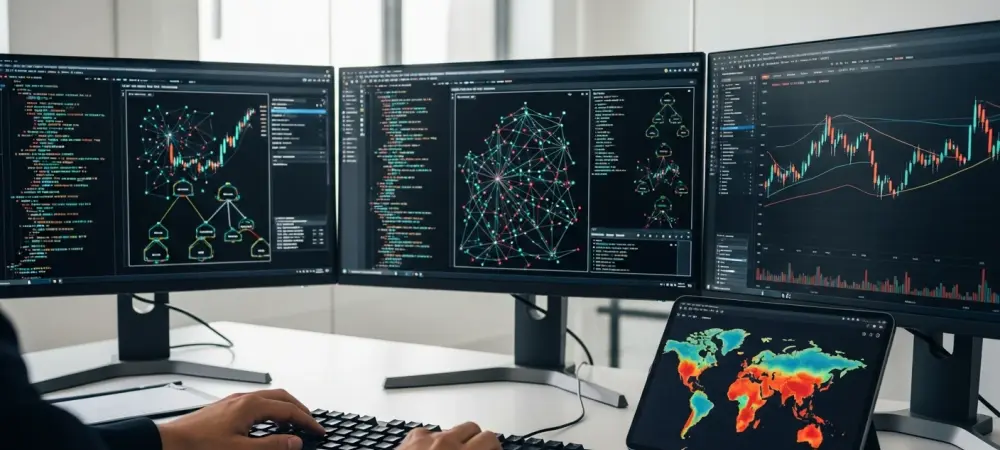
The Algorithmic Transformation of Wall Street
The traditional image of a lone mathematician scribbling stochastic differential equations on a dusty glass whiteboard is rapidly fading into the shadows of financial history as automated systems take center stage. Today, the transition from static whiteboard equations to self-learning neural networks defines the modern trading landscape. Financial institutions are racing to integrate generative models and reinforcement learning, yet this technological acceleration is meeting a stark statistical reality. A significant 75% of industry experts anticipate a total reshaping of quantitative roles by 2029, leaving little room for those who cling to legacy methods.
The tension between high-speed technological adoption and a stagnating talent pool has reached a boiling point within global markets. While firms deploy increasingly sophisticated algorithms to gain a millisecond’s edge, the human capacity to manage these tools remains a significant bottleneck. This misalignment creates a unique paradox where the very tools designed to enhance efficiency are creating a new layer of organizational friction due to a lack of specialized personnel capable of steering the ship.
The Structural Shift from Classical Quants to AI Practitioners
Quantitative finance is no longer just about pricing derivatives; it now demands a “trifecta” of expertise encompassing finance, data science, and machine learning. This structural shift has moved the goalposts for career success, forcing practitioners to bridge the gap between abstract mathematical theory and applied computational intelligence. Consequently, 58% of professionals have seen their daily responsibilities balloon in just 24 months, reflecting an industry that no longer values narrow specialization or static expertise.
The death of the silo is perhaps the most significant cultural change within modern financial hubs. Isolated financial knowledge is no longer a viable career anchor when modern alpha generation depends on high-dimensional data processing and cloud architecture. Practitioners must now act as hybrid architects, capable of translating complex market signals into robust code while maintaining a deep understanding of the underlying economic drivers that move global markets in an increasingly interconnected world.
The Great Educational Disconnect
A profound gap exists between academic theory and the harsh realities of the trading floor, where 75% of practitioners rely on skills never mentioned in their degree programs. This “University Lag” suggests that higher education curricula remain rooted in traditional calculus and linear algebra, failing to integrate the Python-heavy, data-centric workflows required today. The result is a “Graduate Readiness” crisis that leaves firms scrambling to find entry-level talent capable of immediate and meaningful contribution. Recent evaluations indicate that less than 9% of new hires meet current AI proficiency standards, highlighting a systemic failure in the global talent pipeline. Recruitment friction has reached record highs as firms struggle to find candidates who can both build and validate complex AI-driven models. This scarcity of talent has turned the hiring process into a high-stakes competition, with institutions often forced to pay massive premiums for a handful of truly “AI-literate” quants who can navigate the nuances of deep learning.
Systematic Vulnerabilities and the Risk of “Black Box” Reliance
As the technical bar rises, a dangerous layer of complexity threatens to obscure the internal logic of financial models. This complexity creates significant barriers to entry and prevents internal advancement for those without a background in advanced computation. The human oversight dilemma is equally pressing, with 39% of experts expressing fear over a growing reliance on automated systems that few truly understand. This lack of transparency can lead to unintended consequences during periods of extreme market stress.
The risk of “Black Box” reliance extends beyond individual firm losses to the broader financial ecosystem. When a lack of expertise leads to poorly understood model outputs, the potential for market volatility increases exponentially. Systemic vulnerabilities are born when quants can no longer explain why a model is executing a specific trade, making it nearly impossible to intervene during a flash crash or an unexpected market pivot. Without skilled human oversight, the speed of AI can become a liability rather than an asset.
Navigating the Era of Perpetual Education
Navigating this landscape required a fundamental shift from “one-and-done” degrees to a model of continuous, lifelong reskilling that prioritized adaptability over static knowledge. Institutions that succeeded moved toward strategic frameworks that integrated cloud computation and algorithmic validation into every level of their professional development. They recognized that bridging the internal knowledge gap was a requirement for long-term survival in an era where model transparency became as valuable as the predictive power of the models themselves.
Forward-thinking firms established internal academies to foster fluency in advanced statistical modeling, ensuring their workforce remained relevant amid rapid change. This proactive approach helped mitigate the risks of automation while empowering quants to master the tools of the future. By embracing a culture of perpetual education, these organizations turned the skills gap into a competitive advantage, proving that human oversight remained the ultimate safeguard against the unpredictability of AI-driven markets. Professional development finally transitioned from an optional benefit to a core operational necessity.