

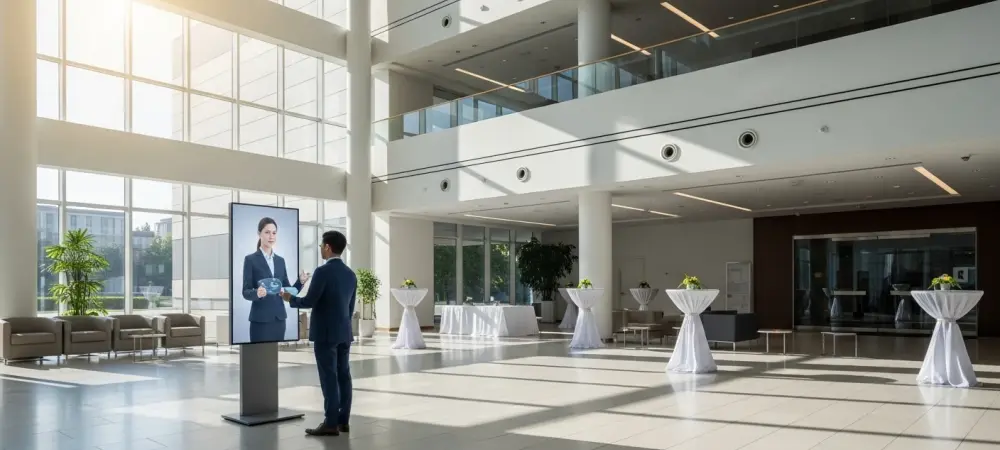
The typical trade show experience often involves a sensory overload of dazzling displays and competing sounds, where genuine brand-to-consumer dialogue is a rare and fleeting commodity. Amid this environment, a new form of digital ambassador has emerged, one that does not wait for a question but instead initiates a meaningful, context-aware conversation. This development signals a potential paradigm shift, moving beyond passive information delivery toward proactive, AI-driven engagement that could redefine how businesses connect with their audiences in crowded physical spaces.
The Challenge of Cutting Through the Noise
In today’s saturated markets, conventional engagement tools are proving increasingly inadequate. Static displays, looping video presentations, and even reactive chatbots rely on the customer to make the first move, a significant hurdle in environments like exhibitions or busy retail floors where attention spans are short. These passive methods often fail to create memorable interactions, blending into the background noise and leaving potential connections unexplored. The result is a missed opportunity to convey a brand’s message with the depth and personalization that modern consumers expect. This reality has created a clear and growing demand for systems that can proactively capture attention and foster genuine connections. To stand out, brands need more than just visually appealing booths; they require interaction models that are personalized, seamless, and intelligent. The goal is to transform a momentary glance into a sustained dialogue, building brand affinity from the very first touchpoint. Achieving this requires a technological leap from responsive systems to ones that can anticipate, initiate, and guide a conversation with human-like intuition.
A Breakthrough in Proactive AI Engagement
At this year’s Consumer Electronics Show, a collaboration between AI services company ESTsoft and Samsung Electronics offered a compelling glimpse into this future. During Samsung’s prestigious “The First Look” event, the “AI Promoter” was unveiled, showcasing a new type of brand ambassador designed to autonomously engage attendees. This AI human solution moved beyond the limitations of its predecessors, actively greeting visitors and initiating discussions about the products on display. At the heart of this innovation lies “Perso Interactive,” a real-time conversational AI human platform. Its architecture is built upon advanced on-device AI and sophisticated object recognition, which allows the system to operate with minimal reliance on network connectivity. This technical design ensures stable, fluid conversations even in the high-density environment of a trade show floor, eliminating the lag or instability that can plague cloud-based solutions. The AI Promoter could automatically recognize nearby individuals and proactively start a relevant conversation, a key distinction that drew considerable attention. Further demonstrating its practical capabilities, the AI conversed fluently in 32 different languages, including English, Spanish, and Japanese, providing detailed information on complex products like the Micro RGB and the Galaxy Z Fold. Its deep knowledge base covered everything from technical specifications to unique features. This experience was enhanced by its integration with Samsung’s Spatial Signage, which created a sense of depth and realism that made the interaction feel remarkably natural and immersive, bridging the gap between digital assistance and human-like engagement.
The Verdict from Industry Leaders
The demonstration at CES did not go unnoticed. Global technology leaders, industry influencers, and attendees expressed significant praise for the AI Promoter’s capabilities, frequently noting their amazement at its natural and fluid conversational skills. Instead of providing scripted, robotic responses, the AI managed nuanced dialogue, answered complex follow-up questions, and maintained the context of the conversation with impressive accuracy. This high-profile debut served as a powerful proof of concept for the technology. By succeeding in the demanding, real-world conditions of one of the world’s largest tech events, the AI Promoter validated its effectiveness and commercial viability. The positive feedback from seasoned industry professionals confirmed that the system was more than just a novel prototype; it was a functional and scalable solution poised to address a critical need in customer engagement. The event effectively showcased the technology’s potential to perform reliably and impressively under pressure.
From Exhibition Standout to a New Global Standard
Building on this successful launch, ESTsoft has outlined an ambitious vision for the technology’s evolution. CEO Sangwon Chung indicated that the company plans to advance the AI human solution beyond the exhibition hall, adapting it for a diverse range of commercial and public environments. The goal is to establish this proactive engagement model as a new standard for customer interaction across multiple sectors.
The strategic roadmap includes expansion into retail spaces, public venues, corporate events, and other areas where direct and intelligent customer interaction is paramount. The technology could function as a tireless, multilingual concierge in a hotel lobby, a knowledgeable product expert in a flagship store, or an efficient guide in a busy transit hub. The successful partnership with Samsung is viewed as the official launchpad for a full-scale global market expansion planned for this year. This move is positioned not as a minor upgrade to existing tools but as a fundamental shift in how organizations will approach customer interaction strategies moving forward. The era of waiting for the customer to engage appears to be drawing to a close, replaced by an AI that actively seeks to connect.